
June 21, 2003
After 60 years, 8 soldiers lost during WWII are laid to rest
Cousins Wayne Bosler III and Sandra Gilley of Kansas City, Missouri, strolled along the National Mall in the drizzle, but it wasn't the usual tourist attractions that brought them to Washington last week.
They were here to honor their uncle, Sergeant Charles Bosler — a World War II soldier missing for nearly 60 years — and finally lay him to rest.
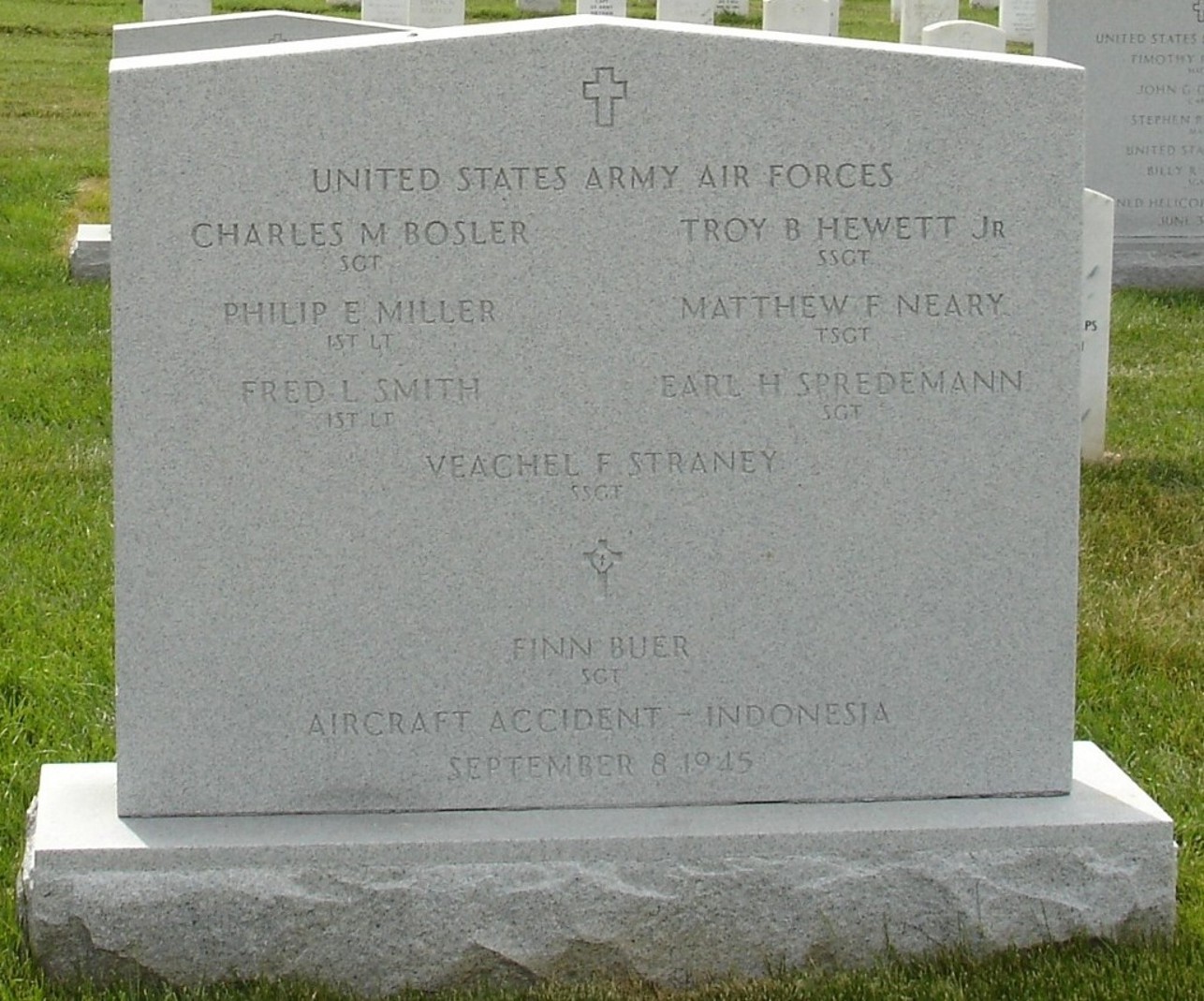
On September 8, 1945, Bosler and seven other Army Air Forces servicemen left Australia on board a B-25 bomber, bound for Biak Island, Indonesia. Their plane never arrived, and there was no clue to their whereabouts. The debris was not discovered until 1995, and civil unrest in Indonesia hampered salvage efforts until 1999, when U.S. military helicopters began retrieving remains and personal items. With the help of DNA from members of their families, the victims were identified, their families contacted and the bodies finally brought home.
On Wednesday, Bosler and Gilley joined the families of the other victims at Arlington National Cemetery, where the Army gave their loved ones a formal, final salute. And as the muted strains of Taps echoed through the damp air, David Miller of Santa Monica, California, could finally say goodbye to the father he does not remember.
Miller was just 2 years old when First Lieutenant Philip Miller, the B-25's pilot, took off on what became his final flight. His mother assumed the worst when the Army was unable to salvage any evidence from the disappearance, which was officially declared to be weather-related. The eight men were listed by a military review board as “presumed dead; body not recovered.”
So they remained, lost for 50 years until a mining company helicopter pilot spotted aircraft wreckage on an Indonesian mountain.
Then, on September 25, 2001, Miller's mother, Sarah Burch of Walla Walla, Washington, received a call: Her husband had been found.
“I was shocked,” she said. “Really, I thought he had fallen into the ocean.”
Burch paged through a scrapbook of newspaper clippings and photos chronicling her husband's life and disappearance. Miller displayed his father's wings, recovered from the crash site.
The surprising discovery has brought bittersweet closure to the family, and renewed sadness.
“It started the grieving process all over again,” said Mary Lue Hart, of Salem, Oregon, one of Burch's daughters from her second marriage.
But in the nearly 60 years since her first husband disappeared, the pain of Burch's loss has not dulled.
“It's hard,” she said, looking downward.
Miller was forced to revisit a tragedy that occurred when he was a toddler. “You've got to realize I'm the son of someone I never knew,” he said. “I thought he'd never be found.”
As remarkable as the victims' recovery is to their families, the Army locates and identifies with some frequency the remains of the thousands of American soldiers lost in combat. Soldiers from the Army's Central Identification Laboratory in Hawaii undertake helicopter searches around the world 250 to 260 days a year, according to Shari Lawrence, deputy public affairs officer for the Army's personnel command.
She said Wednesday's group burial was the third such Army service this year; she anticipates three more this summer, all of which will take place in a special group section of Arlington National Cemetery.
The B-25 crew's odyssey — in miles and years — ended as seven black limousines threaded their way past the legions of white tombstones. A horse-drawn caisson carrying the flag-draped casket containing the commingled remains of seven servicemen headed the procession. Sergeant Finn Buer was interred separately.
During the service in the chapel at nearby Fort Myer, the bell tolled as the Rev. Robert Williams, an Army chaplain, read the eight names, which also included First Lieutenant Fred Smith, Technical Sergeant Matthew Neary, Staff Sergeant Troy Hewett Jr., Staff Sergeant Veachel Straney and Sergeant Earl Spredemann. None of their hometowns was listed.
World War II Aircrew
Missing In Action, 8 September 1945
Returned Home In May 2003

Charles M. Bosler
Sergeant, U.S. Army Air Forces
37373769
68th Airways and Communications Service Group
Entered the Service from: Missouri
Died: September 8, 1945
Missing in Action or Buried at Sea
Tablets of the Missing at Manila American Cemetery
Manila, Philippines

Troy B. Hewett, Jr.
Staff Sergeant, U.S. Army Air Forces
14085851
68th Airways and Communications Service Group
Entered the Service from: Florida
Died: September 8, 1945
Missing in Action or Buried at Sea
Tablets of the Missing at Manila American Cemetery
Manila, Philippines

Philip E. Miller
First Lieutenant, U.S. Army
0-855507
718th Air Force Base Unit
Entered the Service from: Oregon
Died: September 8, 1945
Missing in Action or Buried at Sea
Tablets of the Missing at Manila American Cemetery
Manila, Philippines

Matthew F. Neary
Technical Sergeant, U.S. Army Air Forces
39540319
68th Airways and Communications Service Group
Entered the Service from: California
Died: September 8, 1945
Missing in Action or Buried at Sea
Tablets of the Missing at Manila American Cemetery
Manila, Philippines

Fred L. Smith
First Lieutenant, U.S. Army
0-869748
718th Air Force Base Unit
Entered the Service from: North Carolina
Died: September 8, 1945
Missing in Action or Buried at Sea
Tablets of the Missing at Manila American Cemetery
Manila, Philippines

Earl H. Spredemann
Sergeant, U.S. Army
36258838
718th Air Force Base Unit
Entered the Service from: Wisconsin
Died: September 8, 1945
Missing in Action or Buried at Sea
Tablets of the Missing at Manila American Cemetery
Manila, Philippines

Veachel F. Straney
Staff Sergeant, U.S. Army
15068630
718th Air Force Base Unit
Entered the Service from: Kentucky
Died: September 8, 1945
Missing in Action or Buried at Sea
Tablets of the Missing at Manila American Cemetery
Manila, Philippines


Michael Robert Patterson was born in Arlington and is the son of a former officer of the US Army. So it was no wonder that sooner or later his interests drew him to American history and especially to American military history. Many of his articles can be found on renowned portals like the New York Times, Washingtonpost or Wikipedia.
Reviewed by: Michael Howard