
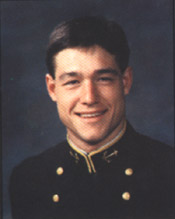
From contemporary press reports
Tears belied the stoic military front and prim Naval dress uniforms this gray morning as the remains of a star athlete from the United States Naval Academy were carried into the Roman Catholic church where she had once hoped to be married. Her old boss from Cook's pharmacy, teachers from her high school and coaches and half the woman's track team from the Academy cried until they ran out of tears over a Naval officer killed not by a foreign enemy but by one of her own – an Ensign she once pledged to marry – in a murder-suicide that took the lives of three officers last week. Mourners lines up four-deep in the bitter cold at the wake here to pay their respects to 21-year-old Ensign Kerryn O'Neill, some leaving the closed, flag-draped coffin with their hands cupped over their faces, others sinking to chairs and staring into space. People in the military know how to prepare for the sudden loss of a fallen officer. But not this way or this soon.
Early last Wed morning, George Smith, a 24-year-old Ensign distinguished in his own right, showed up at the door of Ensign O'Neill's apartment at the Naval Amphibious Base in Coronado, California, with a 9-millimeter Ruger, distraught over their recent breakup. When Lieutenant (jg) Alton L. Grizzard, 24, a former Navy quarterback and mutual friend, answered the door for Ensign O'Neill, Ensign Smith fired four shots, killing Lieuenant Grizzard. Ensign Smith then shot Ensign O'Neill in the head as she cowered behind a chair. He then turned the gun on himself. He died on the way to the hospital. All three Naval officers had graduated from the United States Naval Academy, and were assigned to Coronado. The shootings occurred a day before Smith was scheduled to go off to sea in a submarine, and friends said they figured he must have wanted to resolve his relationship with O'Neill one way or the other. The two were buried on the same day on opposite coasts, she just outside Wilkes-Barre and he in his hometown of Huntington Beach, California. Lieutenant Grizzard's remains are to be buried on Friday at Arlington National Cemetery.
“It makes you want to put glass domes over your children,” said Marion Rosenfield O'Neill, a cousin of Ensign O'Neill's from New Canaan, Connecticut. “I don't know what we do to fix it. How do we fix the world?” The three Naval officers were the cream of an elite and insular corps. The gunman was an electrical engineer and specialist in nuclear submarines, who crewed on the Navy sailing team, threw he javelin, and was voted “best all-around senior” in high school. Ensign O'Neill, the fiancee he feared he had lost, was an ocean engineer and Captain of the woman's cross country track team who set three track records at the Naval Academy, scaled the school's Big Bertha Hill with ease and left half the men trailing behind her in the freshman obstacle race.
The friend who got caught in the middle was one of the best quarterbacks Navy ever had. Lieutenant Grizzard was the team's career leader in total offense with 5,666 yards. The son of a retired Chief Petty Officer who served 28 years, he was a Navy SEAL commando and had served in Somalia before being assigned to Coronado. The two men were handsome, the woman beautiful and any one of them could have made admiral one day, friends said.
“It's a shame and a waste,” said Ed Shedlock, a friend of the O'Neill family, standing on line to pay his respects.
“All three of them,” said Elizabeth DePasquale, a co-worker of Ensign O'Neill's father, Edmund.
Naval officers have sent their condolences from ships in the Pacific and from bases across the country. An admiral called from Guam. To her colleagues at Coronado, Ensign O'Neill was the woman who ran every day along the Pacific Ocean at sunset, did not believe in elevators and always had a smile on her face and the candy jar filled on her desk. To her former classmates, she was the one who helped Navy beat Army every year she was on the team. To the father, a guidance counselor, who was so devoted he took notedsat her high school track meets and dictated the stories to the local newspaper on deadline, she was “an angel.”
Lighting a cigarette and fighting a periodic burst of tears, he expressed no anger toward his daughter's former fiancee. “George was a driven kid, a nice kid,” Dr. O'Neill said.
“He was the kind of guy I thought could and would make a good father and husband.” Karen Boyle, the woman's cross country coach, said of O'Neill: “She was the most perfect person any of us had ever met.” Of Grizzard, Keith Goganious, linebacker for the Buffalo Bills and a former Navy teammate said: “He had the world at his fingertips. He was in the wrong place at the wrong time.”
His high school football coach, Thomas Rhodes said: “I thought he was the kind of kid the whole country would read about one day, but not like this.” There were equally high expectations of ENS Smith, who friends say had been a rock for his family since his father's death four years ago. Friends and colleagues said his actions were out of character.
Lieutenant Commander Frank Thorp, the Public Affairs Commander for the Surface Forces in the Pacific, said about Smith: “There is an incredible amount of sympathy for him. All indications are that he was a wonderful individual. What he did was a total surprise to those who knew him.” It is against military regulations to carry guns onto military bases unless conducting operations. The military does not routinely issue guns except for that purpose. Ensign Smith brought two guns to the base, the Ruger and a 9-millimeter Walther pistol that was fully loaded but never fired. The only clues to his torment were a 13-page letter to Ensign O'Neill in which Ensign Smith implored her to reconsider her decision to end their engagement, another letter found in his apartment, torn into tiny pieces, and a heated argument between the two in the hall outside her room at about 7:30 Tuesday night. Witnesses said she was crying and he was shouting. He went home and returned to her quarters at about 1:45 AM Wednesday morning. Friends say that Lieutenant Grizzard was the type of man who would step in to help if Ensign O'Neill had expressed concern for her safety, and the friends say that the two were not romantically involved. Nonetheless, when Smith saw him at the door, he fired.
“Someone was in the room with her, and he must have snapped,” Said Todd DeStatte, who friends said would have been best man at the wedding. “It has to have been pure emotion and pure love. It's just a disaster. It doesn't make any sense. It's not George at all. He was so secure and so level.” This weekend there was an outpouring of sympathy and disbelief in Wilkes-Barre. Ed Kalley, a mourner who knew neither Ensign O'Neill or her family drove in from Scranton to show his support, as he had driven to Washington, D.C. after President John F. Kennedy was shot thirty years ago. The funeral home here had flowers crammed against the walls -lilies from her Aunt Gail, carnations from Representative Paul E. Kanjorsku, who nominated her to the Academy, mums from her Navy Company, the 21st. There were even flowers from former opponents, the track team at Cornell.
Saturday in East Rutherford, New Jersey, a cloud hung over the Army-Navy game, the 94th meeting of the arch rival academies. The Midshipmen wore stickers on their helmets that said “GRIZ” in memory of their beloved quarterback. Navy missed a field goal in the final seconds. The team lost the game 16 to 14. Most everyone could understand. As outsiders continued to try to make sense of the inexplicable, some blaming guns and some blaming a troubled soul, Ensign Smith's mother, Lorraine, had little to say. “I'm too devastated to talk about this,” said Mrs Smith, reached by telephone. “Say a prayer for him. Yes, say a prayer.”
Lieutenant (jg) Alton L. Grizzard. July 1, 1969-December 1, 1993. He was buried Friday, December 10, 1993, in Section 59, Grave 1192.
GRIZZARD, ALTON L
- LTJG US NAVY
- SOMALIA
- DATE OF BIRTH: 07/01/1969
- DATE OF DEATH: 12/01/1993
- BURIED AT: SECTION 59 SITE 1192
ARLINGTON NATIONAL CEMETERY
On December 1, 1993, a double murder and suicide rocked the U.S. Navy and destroyed forever the worlds of three families . . .
One of those killed was Ensign Kerryn L. O'Neill, an honors graduate and track star at the U.S. Naval Academy in Annapolis, Maryland.
I Have Finished the Race is her father's inspiring story of his journey from shock and anger to profound and extended grief and of his emergence into a world of acceptance and renewed faith.
“Alton Grizzard, the acclaimed Navy quarterback who set team career records for total offense from 1987 to 1990, and Kerry O'Neill, a 1993 Naval Academy graduate who set records in women's track, were shot to death by a fellow Academy graduate at a California naval base early yesterday…”
December 2, 1993 — The New York Times
“The heart can be an enemy of promise, undoing even the most disciplined of lives — as the élite community of sailors based in Cor onado, California, found out last week.”
December 13, 1993 — Time
“Rear Admiral Thomas C. Lynch, the superintendent of the Academy, described the brilliant and beautiful O’Neill as ‘the darling of the brigade.’”
August 29, 1994 — Sports Illustrated
I HAVE FINISHED THE RACE
THE STORY OF AN OFFICER AND A LADY
AND HER FATHER'S ATTEMPT TO DEAL WITH HER TRAGIC DEATH
by Edmund J. O'Neill, D.Ed.
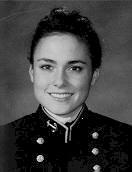
The Supreme Court Monday refused to revive a lawsuit against the government stemming from a double murder and suicide at a U.S. Navy base in San Diego five years ago.
The justices, without comment, rejected a Kingston, Pennsylvania, woman's appeal that had urged them to overturn a 1950 Supreme Court decision barring lawsuits against the government or any military branch for injuries suffered ”incident to service.”
That ruling in a case called Feres vs. U.S. and subsequent decisions by the nation's highest court grant the government virtually total immunity for the deaths of service members.
”Lower courts have been mired in confusion and conflict as to … (the 1950 ruling's) meaning and proper application,” lawyers for Bonnie O'Neill argued.
Mrs. O'Neill's daughter, Kerryn, was a 21-year-old naval officer based in San Diego when she was shot to death by her former fiance.
She and George Smith had become engaged while both attended the U.S. Naval Academy, where O'Neill was a track star and academic standout. She broke the engagement, and months later Smith stormed into her barracks and fatally shot her and a friend, fellow Navy officer Alton Grizzard, 24. Smith then turned the gun on himself.
Grizzard, of Bowie, Maryland, was a football star at the Naval Academy, from which he graduated in 1991. He and O'Neill were not romantically linked, but she had asked him to accompany her home that night because she had been harassed by Smith.
Bonnie O'Neill and her husband, Edmund, sued the government in 1996, seeking $14 million in damages and alleging that their daughter's death stemmed from a Navy psychologist's negligence in ignoring Smith's instability.
The murders-suicide occurred the day before Smith was to have begun his first tour of duty on a nuclear submarine. Mrs. O'Neill's lawsuit said the results of his psychological fitness test showed a higher-than-normal inclination toward aggressive and destructive behavior, and that no follow-up evaluation, required by Navy regulations, was made.
A federal judge, citing the 1950 Supreme Court decision, threw out the lawsuit. The dismissal was upheld by the 3rd U.S. Circuit Court of Appeals in January.
In the appeal acted on today, lawyers for Mrs. O'Neill said the court should strike down the so-called Feres doctrine because it deprives military service members ”of the protection and compensation that Congress intended.”
Clinton administration lawyers urged the court to reject the appeal, noting that it had repeatedly turned down invitations to reconsider the 1950 ruling. They also said Congress could undo that ruling whenever it chose, but has not done so in 48 years. The case is O'Neill vs. U.S., 98-194.
No. 98-194
In the Supreme Court of the United States
OCTOBER TERM, 1997
BONNIE A. O'NEILL, ET AL., PETITIONERS
v.
UNITED STATES OF AMERICA
ON PETITION FOR A WRIT OF CERTIORARI
TO THE UNITED STATES COURT OF APPEALS
FOR THE THIRD CIRCUIT
BRIEF FOR THE UNITED STATES IN OPPOSITION
SETH P. WAXMAN
Solicitor General
Counsel of Record
FRANK W. HUNGER
Assistant Attorney General
ROBERT S. GREENSPAN
LOWELL V. STURGILL, JR.
Attorneys
Department of Justice
Washington, D.C. 20530-0001
(202) 514-2217
QUESTIONS PRESENTED
1. Whether petitioners' suit under the Federal Tort Claims Act alleging that the death of a Navy officer was caused by military negligence is barred by Feres v. United States, 340 U.S. 135 (1950), and subsequent cases interpreting the Act.
2. Whether Feres should be overruled.
In the Supreme Court of the United States
OCTOBER TERM, 1997
No. 98-194
BONNIE A. O'NEILL, ET AL., PETITIONERS
v.
UNITED STATES OF AMERICA
ON PETITION FOR A WRIT OF CERTIORARI
TO THE UNITED STATES COURT OF APPEALS
FOR THE THIRD CIRCUIT
BRIEF FOR THE UNITED STATES IN OPPOSITION
OPINIONS BELOW
The order of the court of appeals affirming dismissal of petitioners' complaint (Pet. App. 1a-2a) is unpublished, but the judgment is noted at 142 F.3d 428 (Table). The court's order denying rehearing and the accompanying dissent (Pet. App. 7a-12a) are reported at 140 F.3d 564. The opinion of the district court is unreported. JURISDICTION The judgment of the court of appeals was entered on February 10, 1998. A petition for rehearing was denied on May 1, 1998. Pet. App. 7a-8a. The petition for a writ of certiorari was filed on July 29, 1998. The jurisdiction of this Court is invoked under 28 U.S.C. 1254(1). STATEMENT
1. Petitioners are the parents and estate of Kerryn O'Neill, formerly an Ensign in the United States Navy. After graduating from the United States Naval Academy in 1993, O'Neill was assigned to the Southwest Division Naval Facilities Engineering Command in San Diego, California. Pet. App. 17a-18a.
Petitioners' complaint alleges that O'Neill met and became engaged to marry George Smith while both were attending the Naval Academy. Pet. App. 14a-15a.1 Smith graduated from the Academy in 1992, a year before O'Neill, and began to train for duty aboard Navy submarines. As part of that training, he was required to undergo a “psychological screening test” known as the “Subscreen” test. Id. at 15a. Because Smith's test showed unusually high scores in a number of areas, including “aggressive/destructive behavior” and “low situational control,” standard procedure required that the test results be referred to the Department of Psychiatry at the Naval Hospital in Groton, Connecticut, for further evaluation. Id. at 15a-16a. According to the complaint, however, the civilian Navy psychologist who received the results “did not review them and did not interview Smith or require any additional testing.” Id. at 16a. In November 1993, after finishing his shoreside training, Smith was stationed in San Diego and ordered to report aboard the submarine U.S.S. Salt Lake City for a cruise scheduled to begin on December
2. Id. at 18a. Shortly after Smith arrived in San Diego, O'Neill broke off their engagement. Pet. App. 18a. Smith proceeded to harass or “stalk” O'Neill, appearing uninvited at her duty station and personal quarters, sending her letters accusing her of having relationships with other men, and even calling her mother in the middle of the night to request help in achieving a reconciliation. Id. at 18a-19a. On the evening of November 30, 1993, O'Neill requested that another Academy friend and Navy colleague, Lieutenant (j.g.) Alton Grizzard, visit her in her quarters, apparently because she was concerned about Smith's behavior. Id. at 19a-20a. Smith came to O'Neill's room in the on-base Bachelor Officers' Quarters three times that night. Ibid. On the third visit, at approximately 1:30 on the morning of December 1, he shot and killed O'Neill, Grizzard, and himself. Id. at 20a.
2. Petitioners filed suit against the United States, asserting jurisdiction under the Federal Tort Claims Act (FTCA), 28 U.S.C. 1346(b), and seeking damages for negligence, wrongful death, and “stalking.” Pet. App. 13a-23a (complaint). Their complaint alleges that Ensign O'Neill's death was caused by the Navy's failure to conduct an adequate follow-up evaluation of Ensign Smith after receiving his initial Subscreen scores, and that the stalking and harassment O'Neill experienced after she terminated her engagement to Smith was caused by “the intentional and/or negligent acts or omissions of one or more employees of the Navy.” Id. at 21a-23a. According to the complaint, a “full psychological evaluation” undertaken as a follow-up to the Sub-screen test “would have revealed what later events showed-that Smith had a serious personality disorder, either a borderline personality or other type of disorder characterized by extreme aggressiveness and dependency, high risk of danger to himself and others, and extreme lack of fitness for submarine duty.” Pet. App. 17a. Moreover, the complaint contends, “[h]ad Smith been evaluated according to Navy regulations,” O'Neill's death would have been averted, because “[c]ommon psychiatric treatments such as consultation with a psychiatrist, drugs or, if necessary, hospitalization would have significantly reduced or eliminated Smith's aggressive/destructive tendencies,” and in addition “the Navy could have taken other corrective measures to place Smith in a situation of no risk to others or to himself.” Ibid.; see also id. at 21a. Instead, “in violation of its own required procedures, the Navy failed to evaluate Smith's Subscreen scores”; and, as a proximate result of that failure, “the pressure of Smith's imminent separation and isolation due to submarine sea duty led to a rapid rise in paranoia, anxiety, and fear of loss of his obsessional focus (Kerryn O'Neill),” ultimately leading him to “act[] on an elemental and primitive level” by killing O'Neill, Grizzard, and himself. Ibid. The district court dismissed petitioners' complaint on the basis of the Feres doctrine, which generally bars FTCA suits by members of the armed services for injuries that “arise out of or in the course of military duty.” Feres v. United States, 340 U.S. 135, 146 (1950); see Pet. App. 3a-6a. The court rejected petitioners' argument that “the murder was not in the course of Ensign O'Neill's service activity because she was off-duty at the time and engaged in a personal activity.” Id. at 4a. The court noted, instead, that O'Neill “was not on leave status [at the time of the attack], and that she was off-duty in her private quarters at the military base.” Id. at 5a. Under those circumstances, the court concluded, “Feres precludes recovery.”
Ibid.
The court of appeals affirmed. Pet. App. 1a-2a. In a brief order, the court noted that it “agree[d] with the district court that the Feres doctrine applie[d],” although it “d[id] not place the same emphasis on the situs of injury.” Id. at 2a n.1. In the court's view, the case was “controlled by the Supreme Court's decision in United States v. Shearer, 473 U.S. 52 (1985).”
Ibid. Chief Judge Becker, joined by Judges Sloviter and McKee, dissented from the court's subsequent rejec- tion of petitioner's suggestion that it rehear the case en banc. Pet. App. 9a-12a. Judge Becker would have distinguished Feres and Shearer on the ground that O'Neill's injuries were “wholly unrelated to her military service.” Id. at 11a. In addition, noting scholarly and judicial criticism of the Feres doctrine, he “urge[d] the Supreme Court to grant certiorari and reconsider Feres.” Id. at 12a. ARGUMENT The court of appeals' decision applies settled law to particular facts, in a manner compelled by a prior decision of this Court. The Court should not grant review, as petitioners ask, to reconsider the Feres doctrine. The Court reexamined and reaffirmed Feres' construction of the Federal Torts Claims Act in 1987, and any further argument for a different result should be directed to Congress.
1. As the court of appeals recognized (Pet. App. 2a n.1), petitioners' case is controlled by this Court's decision in United States v. Shearer, 473 U.S. 52 (1985). In Shearer, one Army private (Heard) kidnapped and murdered another (Shearer), who was off duty and away from his military base at the time. Id. at 53. Shearer's mother and his estate sought damages from the United States under the FTCA, contending that the Army was responsible for Shearer's death because it had reason to know that Heard was dangerous, but “negligently and carelessly failed to exert a reasonably sufficient control over [him], . . . failed to warn other persons that he was at large, [and] negligently and carelessly failed to remove [him] from active military duty.” Id. at 58 (ellipsis in Court's opinion). Reversing the court of appeals, which had “placed great weight on the fact that Private Shearer was off duty and away from the base when he was murdered” (id. at 57), this Court held that the suit was barred by Feres (id. at 57-59). Focusing on whether the suit would “require[] the civilian court to second-guess military decisions” or “might impair essential military discipline,” the Court concluded that the claims at issue went “directly to the ‘management' of the military” and “call[ed] into question basic choices about the discipline, supervision, and control of a serviceman.” Id. at 57-58. The suit thus “str[uck] at the core” of the concerns underlying Feres' construction of the FTCA, because “[t]o permit this type of suit would mean that commanding officers would have to stand prepared to convince a civilian court of the wisdom of a wide range of military and disciplinary decisions; for example, whether to overlook a particular incident or episode, whether to discharge a serviceman, and whether and how to place restraints on a soldier's off-base conduct.”
Ibid. This case is precisely the “type of suit” that Shearer held cannot be maintained under the FTCA. The complaint contends that Ensign Smith's “Subscreen” test results-like Private Heard's previous manslaughter conviction (see 473 U.S. at 54)-put the Navy on notice that he posed a danger to others, and that the Navy is responsible for Ensign O'Neill's death because its responsible officers thereafter failed to undertake appropriate “corrective measures to place Smith in a situation of no risk to others or to himself.” Pet. App. 17a. The “measures” petitioners have suggested include not only requiring Smith to undergo “[c]ommon psychiatric treatments such as consultation with a psychiatrist, drugs or, if necessary, hospitalization” (ibid.), but also “removal of Smith from submarine duty, change of duty station, [or] separation from the Navy.” C.A. App. 22 (Pet. Admin. Claim, Compl. Exh. A, Attach. 2).2 Just as in Shearer, however, any inquiry into whether the Navy could or should have undertaken any such measures with respect to Smith would inevitably “require[] the civilian court to second-guess * * * ‘complex, subtle, and professional decisions as to the composition, training, . . . and control of a military force.'” Shearer, 473 U.S. at 57-58 (second ellipsis in Court's opinion).
3
Petitioners seek to distinguish Shearer on the ground that it involved a claim that the death at issue “was attributable to the negligence of the commanding officers of the decedent.” Pet. 18. That is not correct: the decisions at issue in Shearer were made by the commanding officers of the assailant, Private Heard, not the commanding officers of the decedent. Moreover, three senior officers in Heard's chain of command had, in fact, recommended that he be discharged as “unsuitable for military service”; the gravamen of the complaint was that, despite those recommendations, “the Army” had “failed to make a ‘final determination' on Heard's discharge” by the time of the murder. Shearer v. United States, 723 F.2d 1102, 1104-1105 (3d Cir. 1984). That claim is strikingly similar to petitioners' contention (Pet. 19) that “Navy judgments and procedures, including the formulation and application of the Subscreen test, were entirely adequate and would have worked” if they had been properly implemented, but that the Navy should be liable for an alleged negligent failure by one of its psychologists to comply with those procedures. Likewise, petitioners' argument (Pet. 18-19) that there are “no military judgments” involved in this case because the Navy psychologist who received Smith's Subscreen results simply “engaged in a clear-cut dereliction of non-discretionary duty” is foreclosed by Shearer, 473 U.S. at 58-59. As is clear from the complaint's reliance on an internal Navy report to support this allegation (Pet. App. 15a), any trial of petitioners' claim would inevitably require Navy officers “to testify in court as to each other's decisions and actions”-precisely the sort of intrusive judicial inquiry, prejudicial to internal military order and discipline,
that the Feres bar serves to avoid. Shearer, 473 U.S. at 58.4 Right or wrong, the decisions of responsible Navy personnel to refrain from further examination of Ensign Smith's mental state, to assign him to active duty on a submarine, and to order him to report for duty to a base in San Diego, near his (at the time) fiancée, were all
“decision[s] of command.” Shearer, 473 U.S. at 59. Whether or not petitioners “contest the wisdom of broad military policy[,] * * * their claims [do] not fall within the Tort Claims Act because they [are] the type of claims that, if generally permitted, would involve the judiciary in sensitive military affairs at the expense of military discipline and effectiveness.” Ibid. Accordingly, here, as in Shearer, “[petitioners'] attempt to hale [Navy] officials into court to account for their supervision and discipline of [Ensign Smith] must fail.” Ibid. 2. As is evident from the foregoing discussion, there is no substance to petitioners' contention (Pet. 19-22) that the court of appeals' unpublished order in this case “worsens [a] conflict among the courts of appeals in assessing whether an injury to a servicemember was incident to the injured person's military service.” Pet. 19. The court below did not, as petitioners assert, “focus narrowly on whether the injured servicemember was on active duty” (Pet. 20); it simply stated, correctly, that this case was “controlled by” Shearer (Pet. App. 2a n.1). The other cases petitioner contends have adopted an inappropriately narrow focus all involved medical malpractice claims, which are similarly controlled by Feres itself. See 340 U.S. at 136-138 (describing malpractice claims involved and characterizing injuries received as “incident to the [patients'] service”). All the courts of appeals follow the same rule in malpractice cases.
5
Petitioners cite other cases for the proposition that application of the Feres rule to particular facts does not depend on any single factor, and should not be “mechanistic.” Pet. 20. There is no dispute on that point. See, e.g., Shearer, 473 U.S. at 57 (“The Feres doctrine cannot be reduced to a few bright-line rules; each case must be examined in light of thestatute as it has been construed in Feres and subsequent cases.”). Petitioners cannot point, however, to any particularized conflict among the lower courts involving the application of Feres' concededly contextual rule to cases involving facts and circumstances similar to those presented here. To the contrary, those courts of appeals that have faced the question have all held that Feres bars suits alleging that military negligence was responsible for injuries inflicted by one service member on another. See Stephenson v. Stone, 21 F.3d 159, 163 (7th Cir. 1994) (alleged failure to supervise soldier and prevent him from acquiring and retaining murder weapon); Estate of McAllister v. United States, 942 F.2d 1473, 1474 (9th Cir. 1991) (alleged failure to supervise soldier despite knowledge that he was a “paranoid schizophrenic” with potentially dangerous tendencies), cert. denied, 502 U.S. 1092 (1992); Dozler v. United States, 869 F.2d 1165, 1166 (8th Cir. 1989) (alleged failure to warn one service member about another's dangerous personality disorder, to provide her with adequate security, and to maintain preestablished security measures designed to protect personnel in on-base housing); Satterfield v. United States, 788 F.2d 395, 396, 398 (6th Cir. 1986) (alleged failure to exercise proper supervision and control to warn and protect decedent from two other service members); see also Skees v. United States, 107 F.3d 421 (6th Cir. 1997) (alleged failure to prevent soldier from committing suicide); Persons v. United States, 925 F.2d 292, 299 (9th Cir. 1991) (same). 3. Ultimately, petitioners' principal argument (Pet. 11-17) is not that the court of appeals erred in relying on Shearer to affirm the dismissal of this case, but that Feres and all its successors, including Shearer, rest on an incorrect interpretation of the Federal Tort Claims Act, and should be overruled. That argument does not warrant review.
Petitioners rely heavily on the dissent in United States v. Johnson, 481 U.S. 681, 692 (1987), decided two years after Shearer. In Johnson, the Court carefully reviewed the history of the Feres doctrine and the principal rationales that underlie it. Id. at 686-691. The Court then applied the doctrine to bar a suit by the estate of a service member who was killed in an accident that occurred “incident to his military service” (id. at 691), rejecting the argument that Feres did not apply because the complaint alleged that the accident was caused by the negligence of a civilian air traffic controller, rather than through the fault of another service member (id. at 683-688). Noting that the Court had “never deviated” from Feres' initial holding, that the rule of that case “ha[d] been applied consistently to bar all suits on behalf of service members against the government based upon service-related injuries,” and that Congress had not seen fit to alter the Feres standard “in the close to 40 years since it was articulated,” the Court “decline[d] to modify the doctrine at this late date.” Id. at 686-688. Four Justices, in dissent, criticized Feres and characterized the Court's holding as an improper extension of the doctrine, but specifically declined to consider whether it would be appropriate to overrule Feres itself. Id. at 692, 703. There is nothing to justify reexamination in this case of Johnson's considered decision to
“reaffirm” the holding of Feres. 481 U.S. at 692. In particular, as we explained in opposing a similar request for review in Sonnenburg v. United States, cert. denied, 498 U.S. 1067 (1991) (No. 90-539), this Court has repeatedly made clear that “[c]onsiderations of stare decisis have special force in the area of statutory interpretation, for here, unlike in the context of constitutional interpretation, the legislative power is implicated, and Congress remains free to alter what [the Court has] done.” 90-539 Br. in Opp. at 5, quoting Patterson v. McLean Credit Union, 491 U.S. 164, 172-173 (1989).6 In Feres itself, the Court frankly acknowledged the difficulty of the statutory question presented, and commented on the appropriate means for correction of any error: “Under these circumstances, no conclusion can be above challenge, but if we misinterpret the Act, at least Congress possesses a ready remedy.” 340 U.S. at 138. In Johnson, the Court noted that Congress had allowed 40 years to pass without taking up that invitation to revisit the issue. 481 U.S. at 686. No new development in the additional 11 years that have since elapsed has diminished the force of that simple observation, or undermined the basic arguments that support this Court's original interpretation of the Tort Claims Act. See, e.g., Johnson, 481 U.S. at 688-691; 90-539 Br. in Opp. at 6-11.7 The Court has repeatedly declined similar invitations to reconsider Feres in recent years, and there is no reason for a different result here. See George v. United States, cert. denied, 118 S. Ct. 1053 (1998); Bisel v. United States, cert. denied, 118 S. Ct. 695 (1998); Hayes v. United States, cert. denied, 516 U.S. 1814 (1995); Schoemer v. United States, cert. denied, 516 U.S. 989 (1995); Forgette v. United States, cert. denied, 513 U.S. 1113 (1995).
CONCLUSION
The petition for a writ of certiorari should be denied.
Respectfully submitted.
SETH P. WAXMAN
Solicitor General
FRANK W. HUNGER
Assistant Attorney General
ROBERT S. GREENSPAN
LOWELL V. STURGILL, JR.
Attorneys
SEPTEMBER 1998
1 Because petitioners' complaint was dismissed for lack of jurisdiction (see Pet. App. 6a), for purposes of this response we accept as true the factual allegations contained in the complaint.
2 Although petitioners' “stalking” claim is stated very generally (Pet. App. 22a-23a), on its face it suggests the possibility of further inquiry into, for example, whether any superior in either Smith's or O'Neill's chain of command was or should have been aware of Smith's harassing behavior, and, if so, whether any action was or should have been taken. See also id. at 19a (alleging conversation between Smith and the Executive Officer of his submarine on the day before the murder); id. at 19a-20a (awareness of situation among other Navy personnel). 3 In this case, the entire sequence of events that led to Ensign O'Neill's death was inextricably bound up with any number of personal and command decisions “incident” to her military service. O'Neill and Smith allegedly met and became engaged to be married while both
were attending the Naval Academy. Pet. App. 14a-15a. At the time that O'Neill terminated the engagement, both were stationed in San Diego. Id. at 18a. And the constraints of Naval duty, discipline, and loyalty to fellow officers no doubt affected, not only Smith's ability to tolerate the emotional stress caused by O'Neill's decision (see id. at 21a), but also O'Neill's ability or willingness to take steps to address Smith's aggressive and harassing behavior. From beginning to unhappy end, O'Neill's relationship with Smith both “ar[ose] out of” and played itself out “in the course of activity incident to service.” Feres, 340 U.S. at 146.
4 Analyzing the reasonableness of an officer's understanding and implementation of military regulations would necessarily require courts to interpret military policies and to “second-guess the implementation of military orders or to appraise alleged negligent acts or omissions committed in the course of military duty.” Stephenson v. Stone, 21 F.3d 159, 164 (7th Cir. 1994). The courts have therefore routinely applied Feres even where military officials allegedly failed to follow military regulations. Ibid.; see also Skees v. United States, 107 F.3d 421 (6th Cir. 1997); Satterfield v. United States, 788 F.2d 395, 398 (6th Cir. 1986); Major v. United States, 835 F.2d 641, 645 (6th Cir. 1987), cert. denied, 487 U.S. 1218 (1988). The complaint in this case, of course, alleges not only that the Navy should have tested Ensign Smith more fully, thus confirming his dangerousness, but that it should then have made one or more of a number of possible command decisions (mandatory treatment, reassignment, separation from service) that would, petitioners claim, ultimately have protected Ensign O'Neill. See Pet. App. 17a, 21a. 5 See, e.g., Borden v. Veterans Administration, 41 F.3d 763 (1st Cir. 1994); Wake v. United States, 89 F.3d 53 (2d Cir. 1996); Loughney v. United States, 839 F.2d 186 (3d Cir. 1988); Appelhans v. United States, 877 F.2d 309 (4th Cir. 1989); Schoemer v. United States, 59 F.3d 26 (5th Cir.), cert. denied, 516 U.S. 989 (1995); Skees v. United States, 107 F.3d 421 (6th Cir. 1997); Selbe v. United States, 130 F.3d 1265 (7th Cir. 1997); Brown v. United States, 151 F.3d 800 (8th Cir. 1998); Jackson v. United States, 110 F.3d 1484 (9th Cir. 1997); Quintana v. United States, 997 F.2d 711 (10th Cir. 1993); Ricks v. United States, 842 F.2d 300 (11th Cir. 1988), cert. denied, 490 U.S. 1031 (1989); Lombard v. United States, 690 F.2d 215 (D.C. Cir. 1982), cert. denied, 462 U.S. 1118 (1983). 6 We have provided petitioners with a copy of our brief in Sonnenburg. 7 Petitioners argue specifically that as “parents of a dead servicemember [they] are not entitled to [military] benefits,” so that one traditional rationale for the Feres rule does not apply in their situation. Pet. 16; see Feres, 340 U.S. at 144-145 (discussing availability of statutory benefits). While that point would hardly be dispositive even if true, we do not understand it to be accurate. Materials submitted to the district court on this point (see Pet. App. 4a) indicate that a death gratuity of $6000 was paid to Ensign O'Neill's sister under 10 U.S.C. 1475-1480, see C.A. App. 60, and that each of the individual petitioners received a death benefit of $50,000 under O'Neill's Servicemen's Group Life Insurance (SGLI) policy, C.A. App. 61-66. These are the kinds of statutory benefits to which the Court has previously adverted in the Feres context. See Johnson, 481 U.S. at 683 n.1 (referring to death gratuity and life insurance benefits).

Michael Robert Patterson was born in Arlington and is the son of a former officer of the US Army. So it was no wonder that sooner or later his interests drew him to American history and especially to American military history. Many of his articles can be found on renowned portals like the New York Times, Washingtonpost or Wikipedia.
Reviewed by: Michael Howard