
Charles Calvin Rogers earned the Medal of Honor while serving as Lieutenant Colonel, 1st Battalion, 5th Artillery at the Fishhook, near the Cambodian border in Vietnam on November 1, 1968.
Later in life he became a Baptist Minister, working with U.S. troops in Germany and promoting racial harmony within the United States Army.
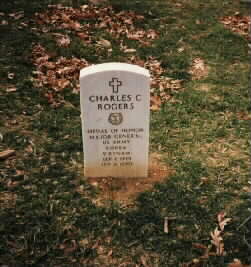
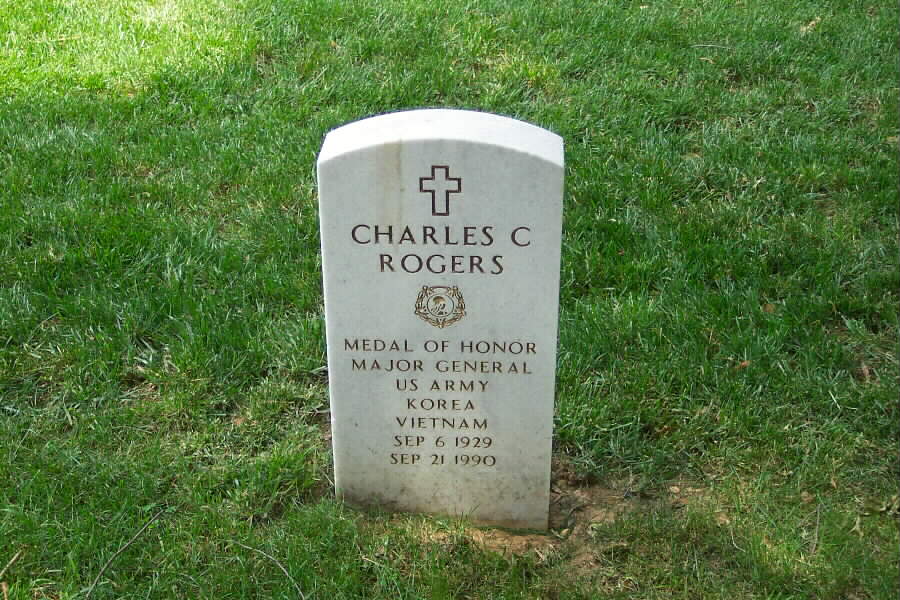
He was born on September 6, 1929 in Claremont, West Virginia and died in Germany on September 21, 1990. He is buried in Section 7-A of Arlington National Cemetery.
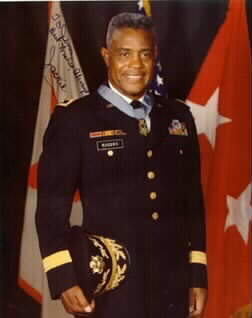
Photo Courtesy of James A. Manning, Colonel (Ret) AUS
Colonel Manning wrote: “I am submitting to you the attached photograph of my upper classmate Charles C. Rogers, MG USA who is listed in your website under the Medal of Honor recipients. Charles gave me this photo before he retired from Active Duty and I cherish it as a memorable keepsake of a fantastic schoolmate and leader. I would very much appreciate your sharing it with others through your website.”
ROGERS, CHARLES CALVIN
Rank and organization: Lieutenant Colonel, U.S . Army, 1st Battalion, 5th Artillery, 1st Infantry Division. Place and date: Fishhook, near Cambodian border, Republic of Vietnam, 1 November 1968. Entered service at: Institute, West Virginia. Born: 6 September 1929, Claremont, West Virginia.
Citation:
For conspicuous gallantry and intrepidity in action at the risk of his life above and beyond the call of duty. Lt. Col. Rogers, Field Artillery, distinguished himself in action while serving as commanding officer, 1st Battalion, during the defense of a forward fire support base. In the early morning hours, the fire support base was subjected to a concentrated bombardment of heavy mortar, rocket and rocket propelled grenade fire. Simultaneously the position was struck by a human wave ground assault, led by sappers who breached the defensive barriers with bangalore torpedoes and penetrated the defensive perimeter. Lt. Col. Rogers with complete disregard for his safety moved through the hail of fragments from bursting enemy rounds to the embattled area. He aggressively rallied the dazed artillery crewmen to man their howitzers and he directed their fire on the assaulting enemy. Although knocked to the ground and wounded by an exploding round, Lt. Col. Rogers sprang to his feet and led a small counterattack force against an enemy element that had penetrated the howitzer positions. Although painfully wounded a second time during the assault, Lt. Col. Rogers pressed the attack killing several of the enemy and driving the remainder from the positions. Refusing medical treatment, Lt. Col. Rogers reestablished and reinforced the defensive positions. As a second human wave attack was launched against another sector of the perimeter, Lt. Col. Rogers directed artillery fire on the assaulting enemy and led a second counterattack against the charging forces. His valorous example rallied the beleaguered defenders to repulse and defeat the enemy onslaught. Lt. Col. Rogers moved from position to position through the heavy enemy fire, giving encouragement and direction to his men. At dawn the determined enemy launched a third assault against the fire base in an attempt to overrun the position. Lt. Col. Rogers moved to the threatened area and directed lethal fire on the enemy forces. Seeing a howitzer inoperative due to casualties, Lt. Col. Rogers joined the surviving members of the crew to return the howitzer to action. While directing the position defense, Lt. Col. Rogers was seriously wounded by fragments from a heavy mortar round which exploded on the parapet of the gun position. Although too severely wounded to physically lead the defenders, Lt. Col. Rogers continued to give encouragement and direction to his men in the defeating and repelling of the enemy attack. Lt. Col. Rogers' dauntless courage and heroism inspired the defenders of the fire support base to the heights of valor to defeat a determined and numerically superior enemy force. His relentless spirit of aggressiveness in action are in the highest traditions of the military service and reflects great credit upon himself, his unit, and the U.S. Army.

Michael Robert Patterson was born in Arlington and is the son of a former officer of the US Army. So it was no wonder that sooner or later his interests drew him to American history and especially to American military history. Many of his articles can be found on renowned portals like the New York Times, Washingtonpost or Wikipedia.
Reviewed by: Michael Howard