
Charles Henry Muir of Michigan
Appointed from Michigan, Cadet, U. S. Military Academy, 1 July 1881 (8)
Second Lieutenant, 17th U. S. Infantry, 14 June 1885
First Lieutenant, 14th U. S. Infantry, 8 January 1892
Transferred to the 2nd U. S. Infantry, 9 February 1892
Captain, 2 March 1899
Major, 38th U.S. Volunteers, 17 August 1899
Honorably discharged from the Volunteer Service, 30 June 1901
Born in Erie, Michigan, July 18, 1860, Charles H. Muir received an appointment to the United States Military Academy in 1881, and received his commission as a Second Lieutenant four years later, graduating eighth in his class. This led him to active frontier duty in Dakota Territory and at Fort D.A. Russell.
At the outbreak of the Spanish-American War he served with the Army in Cuba and received the Distinguished Service Cross fro gallantry in action at Santiago de Cuba. On July 2, 1898, he had voluntarily exposed himself to heavy artillery and infantry fire in a successful attempt as a sharpshooter to silence a piece of Spanish artillery.
He was advanced to the rank of Captain March 2, 1899, and the same year was sent, as a Major, to the Philippines to aid in putting down the insurrection. With only ten companions he attacked Rosario on January 19, 1900, and broke up General Malvar's headquarters, releasing 300 Spanish prisoners, and taking possession of 25,000 pesos in his treasury.
As a Major he participated in the American expedition sent to China against the Boxers.
Having reached the rank of colonel July 1, 1916, he was made Brigadier General, National Army, August 5, 1917. On December 12, the same year, he was given command of the 28th Division of the American Expeditionary Force, a command which he held until October 22, 1918.
Under his command this division participated in the actions about Chateau-Thierry, Champagne-Marne defensive, and in the Thiaucourt sector.
Muir was advanced to the rank of Major General November 28, 1917, and when the American Army advanced across the Rhine into Germany he led the IV Corps. and served with the Army of Occupation from November 17, 1918, to April 13, 1919.
His final duty was as commander of the III Corps Area, with Baltimore as his headquarters. Here, now a Major General in the regular Army, he was retired for age, on July 18, 1924.
For conspicuous service with the American Expeditionary Force he received the Distinguished Service Medal and the Croix de Guerre with palms. He was also made a commander of the French Legion of Honor, and was made knight commander of the Military Order of St. Michael and St. George.
He was the holder of campaign badges of the Indian Wars, the Spanish-American War, the Philippine Insurrection, the China Relief Expedition, and of the Victory badge with six stars. In the course of his long Army career he won many medals as a sharpshooter.
On October 14, 1887, he married May, the daughter of Colonel C.E. Bennett, by whom he had three sons and a daughter.
At the age of seventy-three he was stricken with apoplexy while on a hunting trip, and never recovered, passing away December 8, 1933. He was buried in Arlington National Cemetery.
Muir, Charles H.
First Lieutenant , U.S. Army
Home: Erie, Michigan
2d Infantry
Date of Action: July 2, 1898
General Orders No. No. 10, W.D., 1924
Citation
The Distinguished Service Cross is presented to Charles H. Muir, First Lieutenant , U.S. Army, for extraordinary heroism in action at Santiago, Cuba, July 2, 1898.
At the risk of his life, Lieutenant Muir voluntarily exposed himself to a heavy hostile artillery and infantry fire in a successful attempt as a sharpshooter to silence a piece of Spanish artillery at the battle of Santiago.
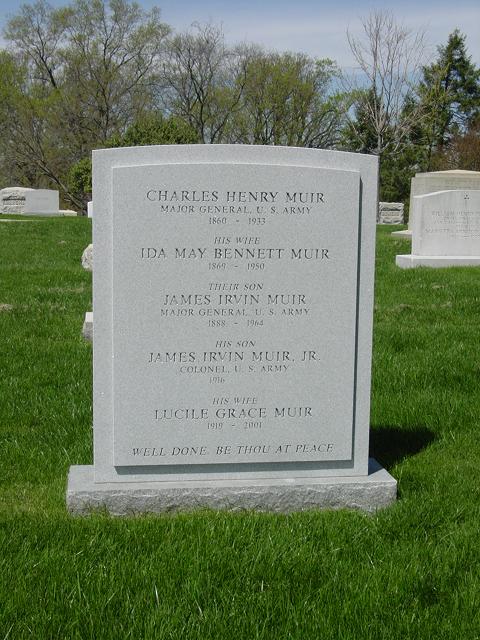
MUIR, CHARLES HENRY
- MAJ GEN USA, RET
- DATE OF DEATH: 12/08/1933
- BURIED AT: SECTION SOUTH SITE 1999
ARLINGTON NATIONAL CEMETERY
MUIR, IDA MAY BENNETT W/O CHARLES HENRY
- DATE OF DEATH: 06/04/1950
- BURIED AT: SECTION 3 SITE 1999 D H
ARLINGTON NATIONAL CEMETERY

Michael Robert Patterson was born in Arlington and is the son of a former officer of the US Army. So it was no wonder that sooner or later his interests drew him to American history and especially to American military history. Many of his articles can be found on renowned portals like the New York Times, Washingtonpost or Wikipedia.
Reviewed by: Michael Howard