
Emery Tritle Smith of Nevada
Appointed from California, Private, Corporal and Sergeant, Company I, 14th U. S. Infantry, 30 May 1898 to 15 August 1899
Second Lieutenant, 9th U. S. Infantry, 15 October 1900
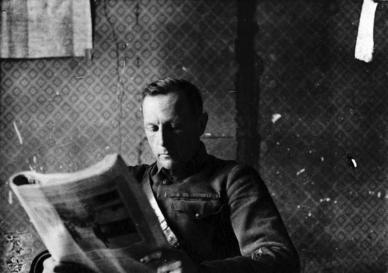
This was probably taken in France during World War I.
From: Truman house, album of 35th Division Clippings and snapshots
ARMY OFFICER A SUICIDE
Lieutenant Colonel E. T. Smith, Son-In-Law of General McCain, Hangs Himself
LEAVENWORTH, Kansas, December 4, 1924 – Lieutenant Colonel Emery T. Smith, Field Artillery, a student at the Command and General Staff Schools at Fort Leavenworth, committed suicide by hanging himself in the bathroom of his quarters last night.
No notive for the suicide is known. Colonel Smith was the son-in-law of Major General H. P. McCain, Detroit, who was the Adjutant General of the Army in the early months of the World War. Mrs. Smith is said to be visiting her father in Washington.
LIEUETNANT COLONEL E. T. SMITH TAKES HIS OWN LIFE
Hangs Himself In Apartment At Leavenworth, Kansas
Formerly Commanded The Boston Area’s Organized Reserves
LEAVENTORTH, Kansas –December 4, 1924 – Lieutenant Colonel Emery T. Smith, who had been in charge of 600 officers in the Officers Reserve Corps and who left New England only a short time ago, hanged himself today. No reason was assigned for the suicide.
The body was found by the janitor of Smith’s apartment dangling from a rope that was thrown across a steam pipe near the ceiling of the bathroom.
Lieutenant Colonel Emery T, Smith, when located in Boston, was Assisant Chief of Staff of the 11th Army Corps and officer in charge of Organized Reserves in this district. It was while Colonel Smith was in this city that the Distinguished Service Medal was pinned on his breast in recognition of “services of conspicuous merit and signal worth to the American Expeditionary Forces in apposition of great responsibility.”
The service of which the medal is recognition was outlined in a citation.
“As commander of the group of artillery supporting the 33rd Division in the attack on the East bank of the Meuse River, October 8 to 13, 1918,”it said, “he demonstrated professional attainments and ability of a high order. Later as a Regimental Commander, by his sound tactical judgment and special knowledge of artillery, he most successfully directed his unite in the support of the attacking infantry of the 79th Division in the operations north of Verdun from November 4to 11, 1918. By keeping his elements close to the attacking infantry, he contributed in no small measure to the success of these operations.”
The decoration was presented to Colonel Smith by Major Andre W. Brewster, in charge of the 1st Corps Area at an impressive military ceremony at the Army Base in South Boston, February 12, 1923.
Colonel Smith began his military career as an enlisted man n the 14th United States Infantry, which he entered in 1898 just in time t take art in the Spanish-American War. In 1898 and 1899 he served in the Philippine Insurrection and later in the Boxer Rebellion in China, a Second Lieutenant in the 9th Infantry. Some time afterward he was returnee to the Philippines and then he was sent to the Mexican Border. In April 1917, when American entered the World War, Colonel Smith was assigned to command the 106th Field Artillery of the 27th Division. He went overseas in October 1917 and remained in France until April 1919.
Returning to the United States he engaged with the War Plans Division at Washington, D.C. and later he was at the Leavenworth School of the Line. Then he came to Boston to take charge of the Organized Reserves affairs in the New England District.
Colonel Smith’s wife is the daughter of Major General Henry P. McCain, who was in command of the 12th Plymouth Division at Camp Devans during the war training days.
SMITH, EMERY T
- COL FIELD ARTILLERY
- DATE OF DEATH: 12/04/1924
- BURIED AT: SECTION D SITE 3033
- ARLINGTON NATIONAL CEMETERT

Michael Robert Patterson was born in Arlington and is the son of a former officer of the US Army. So it was no wonder that sooner or later his interests drew him to American history and especially to American military history. Many of his articles can be found on renowned portals like the New York Times, Washingtonpost or Wikipedia.
Reviewed by: Michael Howard