
Frank H. Newcomb, born 10 November 1842 in Massachusetts, served in the Navy as Acting Master's Mate during the Civil War, then entered the Revenue Cutter Service. Commanding cutter Hudson on blockade off Cuba in the Spanish-American War, he engaged Spanish gunboats in the harbor at Cardenas 11 May 1898 and towed Wilmington to safety after her steering gear had been shot away. His bravery and skill won him the Cardenas Medal of Honor. Newcomb subsequently served in the Coast Guard, successor to the Revenue Cutter Service, rising to Commodore. He died 19 February 1934.
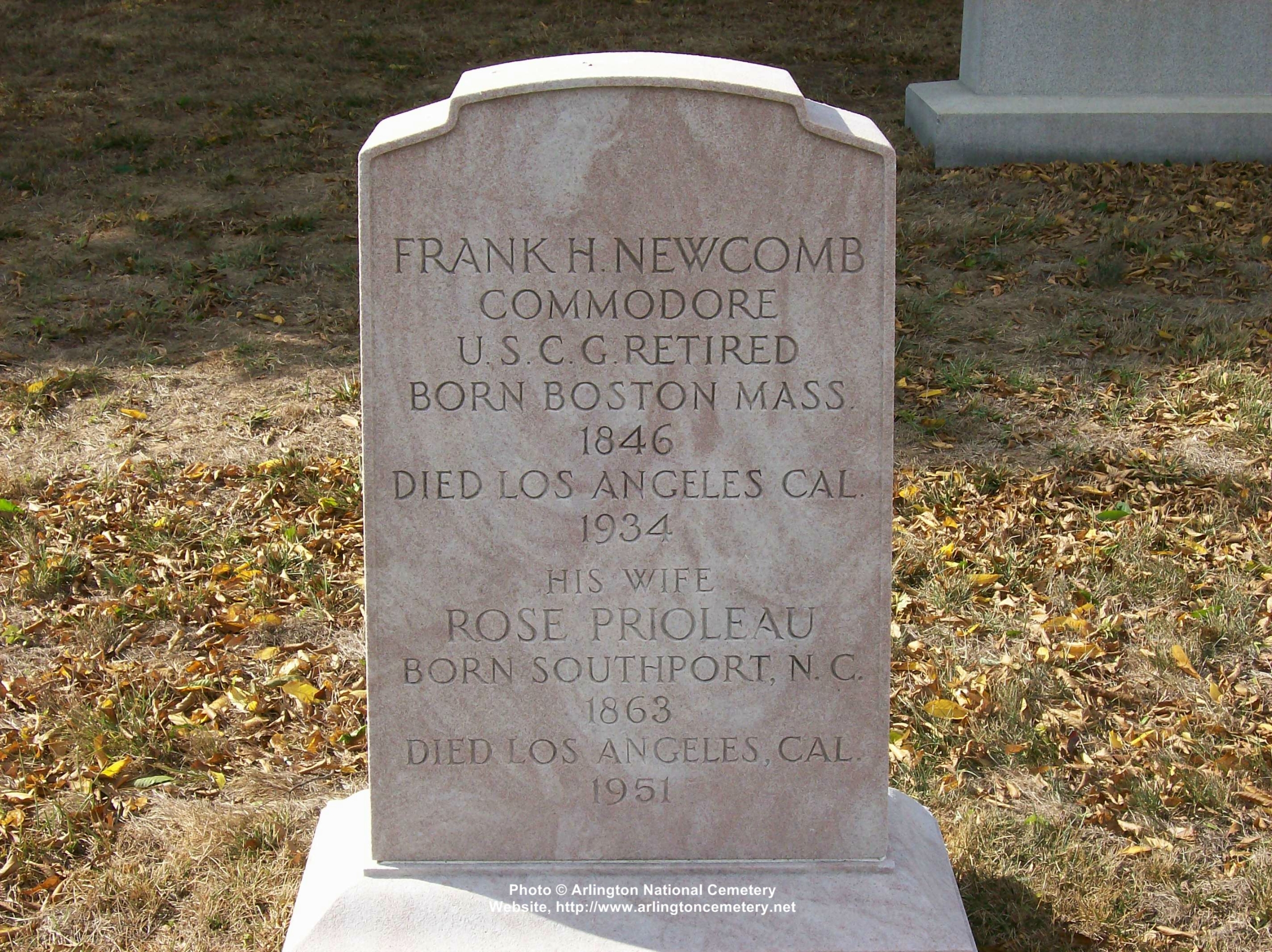
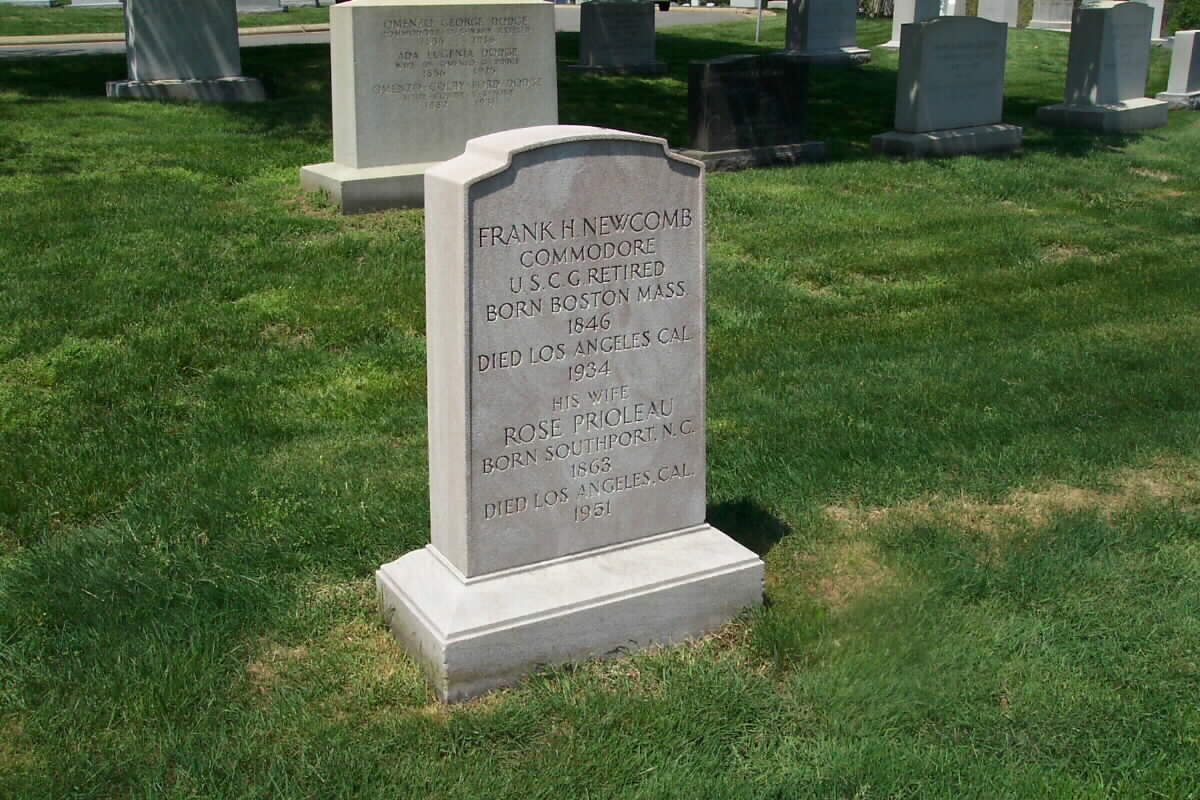
Commodore Newcomb was buried with full military honors in Section 4 of Arlington National Cemetery. His wife, Rose Prioleau Newcomb (1863-1951) is buried with him.
Frank Hamilton Newcomb
Born: Boston, Suffolk, Massachusetts, 10 November 1846
Died: Los Angeles, Los Angeles, California, 20 February 1934
Thursday, 3 May 1900
Joint Resolution Recognizing the gallantry of Frank H. Newcomb, commanding the revenue cutter Hudson; of his officers and men; also retiring Captain Caniel B. Hodgsdon, of the Revenue Cutter Service, for efficient and meritorious services in command of the cutter Hugh McCulloch at Manila.
Resolved by the Senate and House of Representatives of the United States of America in Congress assembled, That in recognition of the gallantry of First Lieutenant Frank H. Newcomb, of the Revenue Cutter Service, commanding the revenue cutter Hundson, his officers and the men of his command, for their intrepid and heroic gallantry in the action at Cardenas, Cuba, on the eleventh day of May, eighteen hundred and ninety-eight, when the Hudson rescued the United States naval torpedo boat Winslow in the face of a most galling fire from the enemy's guns, the Winslow being disabled, her captain wounded, her only other officer and half her crew killed. The commander of the Hudson kept his vessel in the very center of the hottest fire of the action, although in constant danger of going ashore on account of the shallow water, until finally he got a line made fast to the Winslow and towed that vessel out of range of the enemy's guns. In commemoration of this signal act of heroism it is hereby enacted that the Secretary of the Treasury be authorized and directed to cause to be prepared and to present to First Lieutenant Frank H. Newcomb, Revenue Cutter Service, a gold medal, and to each of his officers a silver medal, and to each member of
his crew a bronze medal.
That in recognition of the efficient and meritorious services of Captain Daniel B. Hodgsdon, United States Revenue Cutter Service, while in command of the United States revenue cutter Hugh McCulloch, under the orders and in cooperation with the fleet commanded by Rear Admiral George Dewey, United States Navy, at the battle of Manila, on May first, eighteen hundred and ninety-eight (the said officer being now in the sixty-third year of his age, and having served continuously for thirty-seven years as an officer of the Revenue-Cutter Service), he be placed on the permanent waiting orders or retired list of the Revenue Cutter Service, on the duty pay of his grade.
That the sum of one thousand dollars, or so much thereof as may be necessary, be, and the same hereby is, appropriated, out of any money in the Treasury not otherwise appropriated, for the medals above specified.
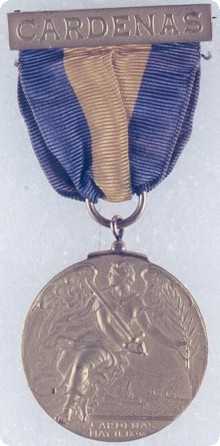
Cardenas Medal of Honor
(Coast Guard)
Establishing Legislation
The Cardenas Medal of Honor was established by Joint Resolution of Congress on May 3, 1900.
Event Commemorated
The Cardenas Medal of Honor commemorates the gallantry of the officers and men of the Revenue Cutter Hudson who, in the face of enemy fire during the Spanish-American War, towed the USS Winslow out of range of the enemy guns at Cardenas harbor on May 11, 1898.
Oder of Precedence
lthough the Coast Guard (successor to the Revenue Cutter Service) has not established an order of precedence for the Cardenas Medal of Honor, it would probably have been worn after the Civil War Medal and before the Sampson Medal.
Devices
No devices were authorized for this medal.
Designer
The Cardenas Medal of Honor was designed by Charles Morgan, Chief Engraver at the Philadelphia Mint.
First Recipient
The first award of the Cardenas Medal of Honor went to Lieutenant Frank M. Newcomb, who received his medal in gold (three were awarded in silver to other officers and sixteen in bronze were awarded to enlisted men).
Description and Symbolism
Obverse
In the center of a medallion three and one eighth inches in diameter, the draped winged figure of a woman is shown wearing a winged helmet and holding a sword in her right hand and a palm branch in her left. In the background, one ship is seen towing another. The exergue contains the words CARDENAS, MAY 11, 1898.
The two ships are the Hudson which is towing the Winslow, representing the event for which the medal was established (on May 11, 1898 while the torpedo boat Winslow was taking soundings and making observations in the harbor of Cardenas, Cuba, shore batteries opened fire and in the ensuing action the Winslow was disabled. The auxiliary tug Hudson came to the Winslow's rescue under heavy fire, secured a tow line, and pulled the ship to safety).
Reverse
In the center of a medallion three and one-eighth inches in diameter, a nude figure is portrayed with a mallet and chisel inscribing, JOINT RESOLUTION OF CONGRESS APPROVED MAY 3, 1900, IN RECOGNITION OF THE GALLANTRY OF THE OFFICERS AND MEN OF THE HUDSON WHO IN THE FACE OF A GALLING FIRE TOWED THE WINSLOW OUT OF RANGE OF THE ENEMY'S GUNS. To the left of the figure is a palm leaf, and at the base of the palm leaf is a small wreath of laurel.
Miniature
A “miniature” Cardenas Medal of Honor one and a quarter inches in diameter was struck to be worn with other service medals. It is identical in design to the original table medal, except that it is reduced in size and is fitted with a ribbon and suspension bar.
Ribbon
The ribbon to the Cardenas Medal of Honor is similar to that of the Dewey Medal and consists of a wide center stripe of gold flanked by dark blue (the gold center stripe in this ribbon is wider than in the Dewey Medal). The ribbon is pinned to the uniform by a pin bar with the name CARDENAS in raised letters. The bar has the same finish as the medal.
F. H. NEWCOMB DIES; SERVED IN 2 WARS
Guard Commodore After Career of 40 Years
Honored By Congress
Won Gold Medal for Rescuing Torpedo Boat Winslow in the Spanish-American War
WASHINGTON, February 20, 1934 – Commodore Frank Hamilton Newcomb, retired Coast Guard officer, Civil War veteran and Spanish-American War here, died in Los Angeles today at the age of 87.
Born in Boston on November 10, 1846, he served as an officer in the Navy from 1863 to 1865, when the Civil War was in progress. In 1873 he was a appointed a Third Lieutenant in the Coast Guard. He was retired November 10, 1910 after passing through the various grades.
Commodore Newcomb was the recipient of the Congressional Medal for service in the Spanish-American War. The medal was awarded in 1900 for heroic conduct in the battle at Cardenas, Cuba, on May 11, 1898, when the cutter Hudson, of which he was commander, rescued the United States Torpedo Boat Winslow in the face of a galling fire from the enemy’s guns, the Winslow being disabled, her captain wounded and her only other officer and half her crew killed.
Lieutenant Newcomb kept his vessel in the center of the action, although in constant danger of stranding in shallow waters, until he got a towline made fast to the Winslow and tower the vessel out of range of the enemy’s guns.
Congress, in awarding the gold medal to Lieutenant Newcomb, also awarded to each of his officers a silver medal and to each member of his crew a bronze medal.
Commodore Winslow is survived by a widow and a married daughter.
Commodore Newcomb was the senior commodore on the Coast Guard retired list, only one other officer, a rear admiral commandant, holding a higher rank. He was a Captain when he was retired for age, receiving the next higher grade. He spent five months attached to the navy during the Spanish-American War, although still a member of the Coast Guard.
NEWCOMB, FRANK HAMILTON
COMMODORE US COAST GUARD RET
- DATE OF DEATH: 02/19/1934
- BURIED AT: SECTION 4 SITE 3300
ARLINGTON NATIONAL CEMETERY

Michael Robert Patterson was born in Arlington and is the son of a former officer of the US Army. So it was no wonder that sooner or later his interests drew him to American history and especially to American military history. Many of his articles can be found on renowned portals like the New York Times, Washingtonpost or Wikipedia.
Reviewed by: Michael Howard