
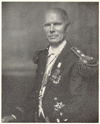
George Owen Squier was born in Dryden, Michigan, 21 March 1865 and graduated from the Military Academy in 1877. After first entering the Army as an artillery officer, Squier joined the Signal Corps, rising to Major by 1903. He commanded cable-ship Burnside during the laying of the Philippine cable from 1900 to 1902. He was appointed Chief Signal Officer of the Army 14 February 1917, and was promoted to Major General 6 October. He also served as Chief of the Army Air Service 1916 to 1918. General Squier was the author of numerous articles and papers on technical subjects, and is credited with several important inventions in the fields of radio and electronics. He took part in his later life in several international conferences on communications and attended the 1921 Washington Conference on Naval Limitations for the War Department. General Squier died 24 March l934.
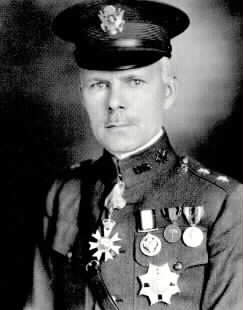
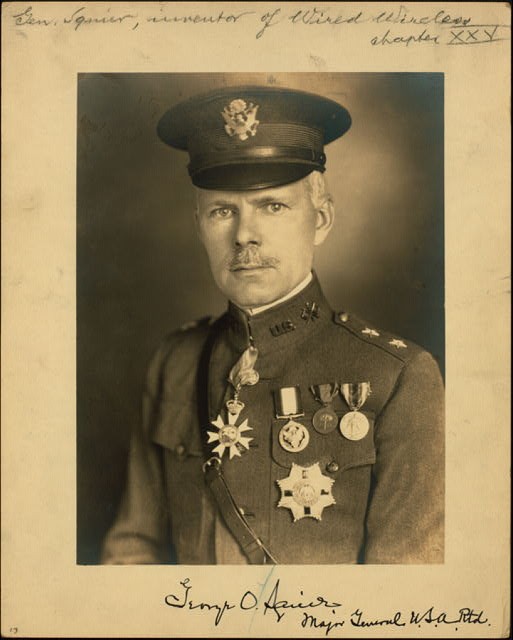
George Owen Squier's career spanned the Spanish American War and World War I. Because of him, the two most important technological developments of his era, the airplane and the radio, became integral parts of America's military arsenal.
After completing only the eighth grade and working for two years, Squier entered West Point. Graduating seventh in his class in 1887, Squier went on to complete his Ph.D. at Johns Hopkins in 1893.
With a first-class education in electrical science, Squier was transferred to Fortress Monroe where he helped found the Artillery Journal and used photography and electromagnetism to measure the velocity of artillery shells. By 1897, Squier had
proven the military application of radio through experiments that, for example, fired cannons and detonated mines by remote control.
After a tour of duty on the cable ship Burnside in the Philippines during the Spanish American War era, Squier established the first Signal School at Fort Leavenworth in 1905.
His interest in aeronautics was evidence by its introduction into the school curriculum. That interest in aviation intensified when Squier came to Washington in 1907 as Assistant Chief Signal Officer. Upon his recommendation, the Aeronautical Division was formed. He not only wrote the specifications for the first military aircraft, but witnessed acceptance trails of the Army's first Wright Flyer.
Squier's interest in radio never faltered. During 1909 and 1910, he applied for four patents in multiplex telephony, whereby, several verbal messages could be transmitted and received over a single wire, the basis for modern communications systems.
As Chief Signal Officer during World War I, Squier was responsible not only for radio, but also was charged with the entire aviation and communications mission of the United States Army. During the war, Squier succeeded in opening two great Army laboratories one at Fort Monmouth for radio and another at Langley Field, Virginia, for aviation. Squier can be credited with the Army's institutionalization of scientific research and development for military purposes.
Courtesy of the National Academy of Science:
George Owen Squier (1865-1934), was still Chief Signal Officer in the U.S. Army when he was elected to the National Academy of Science in 1919. His invention in 1910 of “multiplexing” allowed telephone wires to carry multiple messages for the first time; the carrier frequency principle involved was later adapted to other types of transmission, including FM radio. After graduation from West Point in 1887, Squier received his Ph.D. from ohns Hopkins University in 1893, making him perhaps the first member of the Army's officer corps to hold that degree. Assigned to the Army Signal Corps after serving in the Spanish-American War, he worked on improving the Army's wireless telegraphy and telephony. In 1908 he became the first passenger to fly in an airplane, and subsequently helped set up the Air Service, forerunner of today's US Air Force, within the Army's Signal Corps. His 1917 address to the National Research Council on military aviation problems was a virtual blueprint for the work the Research Council eventually performed in that area. Shortly before his retirement in 1924, Squier turned his attention to a new application of the transmission technologies he helped to develop: piped-in music. His idea led to the establishment in 1922 of the music service Wired Radio, which is much better known by its present name, given it by Squier shortly before his death: Muzak.
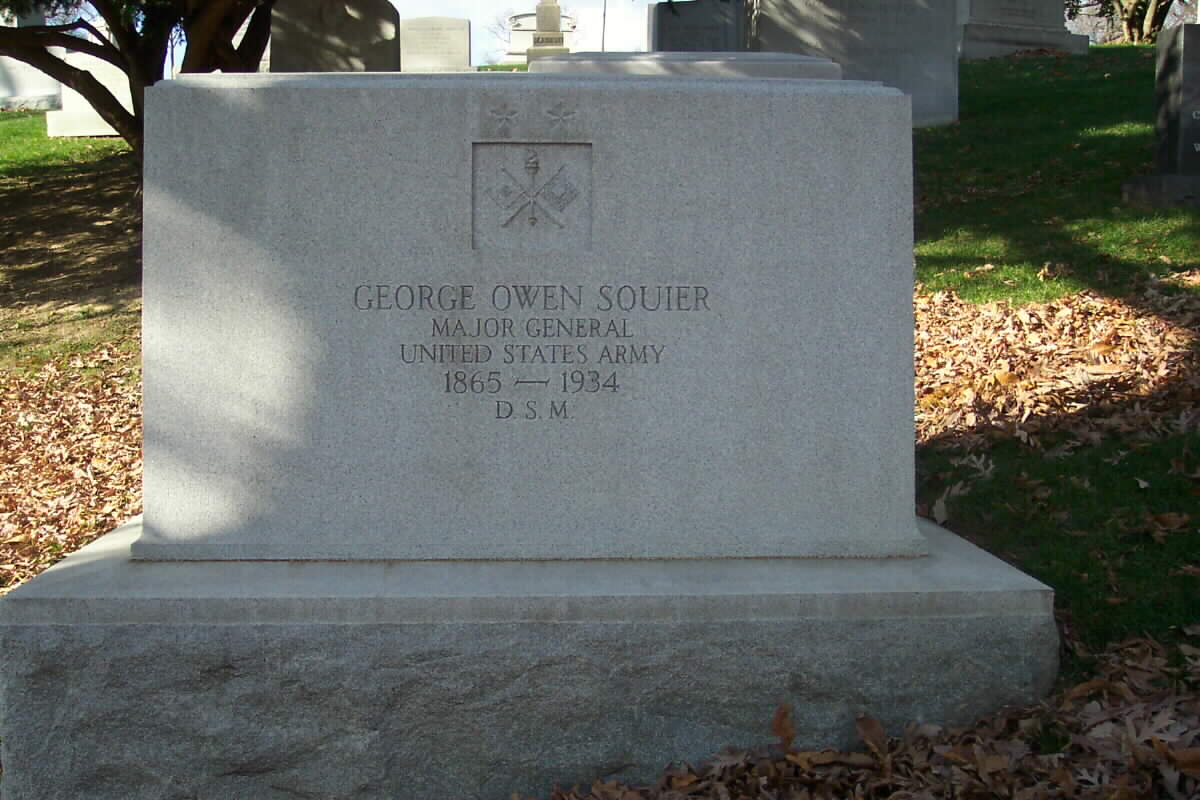

Michael Robert Patterson was born in Arlington and is the son of a former officer of the US Army. So it was no wonder that sooner or later his interests drew him to American history and especially to American military history. Many of his articles can be found on renowned portals like the New York Times, Washingtonpost or Wikipedia.
Reviewed by: Michael Howard