
Born at Independence, Iowa, November 23, 1867, he graduated from West Point in 1891. He served in Montana, North Dakota, Nebraska, 1891-97; as professor of military science and tactics, State University of Iowa, 1897-98; with a regiment at Camp Wikoff, New York, 1898; in the Philippines, 1899-1901.There he commanded General Funston's Mounted Scouts and later served as Regimental Adjutant and Adjutant General, 3rd District, Department of Luzon. He was an observer at the German maneuvers and studied European armies, 1906; in the Philippines, 1907-12.
He arrived in France in 1917 during World War I. He was appointed Colonel, 28th Infantry, 1918; commander, 3rd Infantry Brigade, 2nd Division, First Army Corps, 1918; was in command of the 28th when it captured Cantigny and the 5th Division when it forced the Meuse crossing.
He commanded a Battalion of Philippine Scouts during the Philippine Insurrection, later the 11th Battalion of Scouts and a battalion of the 7th U.S. Infantry at Vera Cruz in 1915. He retired from active duty in 1931 while commander of II Corps Area, Governors Island, New York.
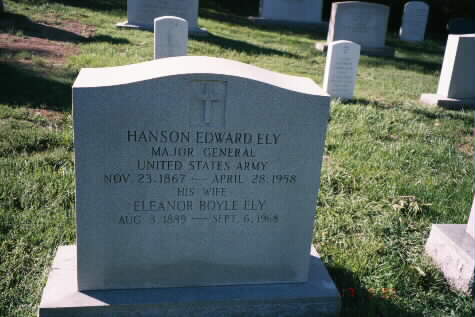
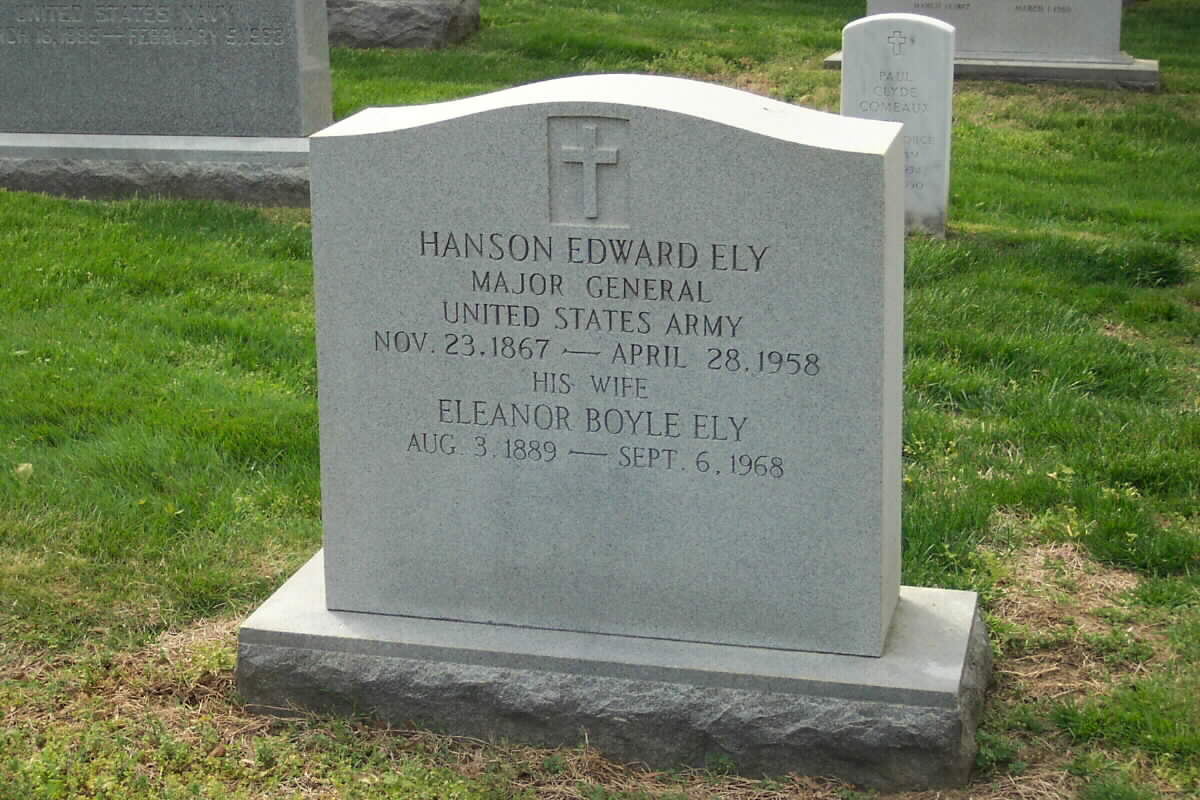
He died on April 28, 1958 and was buried in Arlington National Cemetery.
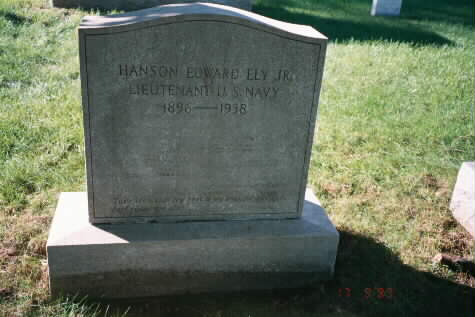
His sons, Hanson Edward Ely Jr., Lieutenant, United States Navy (1896-1938), John Ashton Ely, Colonel, United States Army (1920-2001), Louis B. Ely, Colonel, United States Army (1899-1986), and Eugene Barber Ely, Colonel, United States Army (1903-1966), are also buried in Arlington National Cemetery. His daughter, Margaret Hunter Ely Fuller, died at age 24, and is also buried in Arlington National Cemetery.
HANSON ELY DIES; RETIRED GENERAL
Commander of First Purely American Offensive in 1918 Succumbs at 90
Jacksonville, Florida, April 28, 1958 – Major General Hanson Edward Ely, retired Army officer who led the first purely American offensive in World War I, died here today. He was 90 years old.
He is survived by his widow, three sons, Colonel Louis B. Ely, USA, retired, Colonel Eugene E. Ely, USA, retired, and Major John Ashton Ely of Fort Benning, Georgia, and a daughter, Mrs. T. W. Glocker.
“Ely of Cantigny” held many awards for bravery. At his retirement in 1931 he possessed the Distinguished Service Cross, the Distinguished Service Medal, the Silver Star, the Croix de Guerre with five citations and other foreign decorations.
During his forty years in the Army he campaigned in the old West, Mexico, Cuba and the Philippines. In World War I he rose from the rank of Major to that of Major General. He received his “Cantigny” nickname on May 28, 1918, when, as a Colonel commanding the Twenty-eighth Infantry, First Division, he led his men at the battle of that name in France in the first purely American offensive of the war.
After the Armistice he commanded the Army War College in Washington, the Command and General Staff School at Fort Leavenworth, Kansas, and the Second Corps Area, which embraces this district, from 1927 to 1931. His headquarters in the latter period was on Governors Island, New York.
Born at Independence, Iowa, he was graduated from the United States Military Academy in 1891. He spent the early Spanish-American War period drilling volunteer regiments and in 1899 sailed for the Philippines, where he was promoted to brevet Captain for bravery under fire. He later became commander of the Philippine Mounted Scouts.
Returning home in 1904 he was graduated with honors from the Infantry and Cavalry School the following year, and in 1906 from the Army War College. After a tour in Europe observing the German Army on maneuvers, he returned to the Philippines, where as a Major of the Philippine Scouts he headed the unit that made the first complete map of the country.
He was one of the first American officers sent to France, in May 1917. His first work there was the study of the trench warfare methods of the Allies. Later he became Chief of Staff of the First Division, and still later, at the request of General of the Armies John J. Pershing, he organized the American forces’ Military Police unit.
ELY, HANSON E.
Brigadier General, U.S. Army
3d Infantry Brigade, 2d Division, A.E.F.
Date of Action: July 18, 1918
General Orders No. No. 15, W.D., 1923
Home Town: Iowa City, Iowa
Citation:
The Distinguished Service Cross is presented to Hanson E. Ely, Brigadier General, U.S. Army, for extraordinary heroism in action near Vierzy, France, July 18, 1918.
In order that he might personally direct the attack, General Ely attempted to enter Vierzy which was not yet cleared of the enemy; he was fired on at short range by enemy machine guns in the town. He then personally organized and directed an attack which resulted in the capture of the town and in the advance of the lines well beyond.
General Ely's indomitable bravery, disregard for his own safety, his devotion to his men, and his frequent presence with them in the front line, inspired them to deeds of great courage and enabled the troops to take the town, despite strong enemy resistance made by vastly superior numbers.
Courtesy of Michael T. Stein:
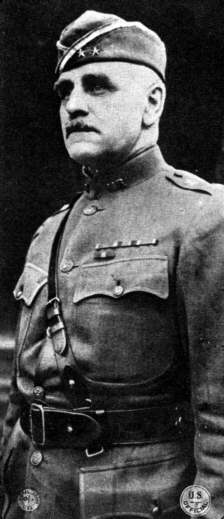
Major General Hanson Edward Ely
Born November 23, 1867 in Independence, Iowa
Died April 28th, 1958
Cadet US. Military Academy 1887-91
Graduated as No. 3447 Class of 1891
- Second Lieutenant 1891
- First Lieutenant 1898
- Captain 1901
- Major (Philippine Scouts) 1908
- Major 1913
- Lieutenant Colonel 1917
- Colonel 1917
- Brigadier General (National Army) 1918
- Major General (National Army) 1918
- Brigadier General, United States Army 1921
- Major General, United States Army 1923
- Served with 22nd Infantry Regiment 1891-01
- Served with 26th Infantry Regiment 1901-08
- Served with 19th Infantry Regiment 1912-13
- Professor (Military Science & Tactics), University of Iowa 1897-98
- Commander, Mounted Scouts, San Isidro, Northern Luzon May-June 1900
- Depot Commissary, Department of Northern Luzon 1900-01
- Regimental Adjutant & Adjutant General, 3rd District, Department of Southern Luzon June-October 1901
- Regimental Recruiting Officer at Des Moines (Ia) 1901-03
- Commanding Officer, Company A & 1st Battalion (26th Infantry) 1903-04
- Commander Rifle Camp, Leon Springs (Texas) April-May 1904
- Commanding Officer, Company A & 1st Battalion (26th Infantry), 1904
- Student Officer, Infantry & Cavalry School 1904-05
- Leave of absence 1905-06
- Commanding Officer, Company K, 26th Infantry 1906-07
- Regimental Adjutant 1907-08
- Commanding Officer, Company K 1908
- Commander, Scout Camp, Pasay (Philippines) 1908-09
- Commanding Officer, 11th Battalion, Philippine Scouts 1909
- Leave of absence 1909-10
- Commander, Post of Camp Connell & Battalion of Scouts 1910-12
- Company Commander, 19th Infantry Regiment 1912-13
- Battalion Commander, 7th Infantry Regiment 1913-15
- Student, Army War College 1915-16
- Chief of Staff, El Paso District 1916-17
- Inspector-Instructor, National Guard of Indiana 1917
- Senior Instructor, Officer´s Training Camp, Ft. Benjamin Harrison, Indiana 1917
- Provost Marshal, American Expeditionary Force 1917
- Member, General Staff, American Expeditionary Force 1917-18
- Chief of Staff, 1st Division September-December 1917
- Commanding Officer, 28th Infantry Regiment (captured Cantigny)
- Commanding General, 3rd Brigade, 2nd Division 1918
- Commanding General, 5th Division 1918-19
- Commanding General, 3rd Brigade 1920-21
- Commandant, General Service Schools 1921-23
- Commandant, Army War College 1923-27
- Commanding General, 2nd Corps Area 1927-31
- Retired 1931
- Distinguished Service Cross – Distinguished Service Medal – Croix de Guerre (w/5 Palms) – Victory Medal (5 battle Clasps) – Commander of Crown of Italy

Michael Robert Patterson was born in Arlington and is the son of a former officer of the US Army. So it was no wonder that sooner or later his interests drew him to American history and especially to American military history. Many of his articles can be found on renowned portals like the New York Times, Washingtonpost or Wikipedia.
Reviewed by: Michael Howard