
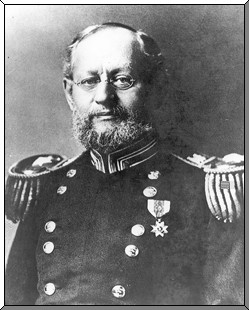
While General Robert was a career military officer, eventually rising to Chief Engineer of the Army, he is best remembered in history for his book “Roberts' Rules of Order,” which is still used to this day in order to conduct meetings. He wrote the book as a young military officer who, while preparing to hold a town meeting, found that no rules for such a meeting existed.
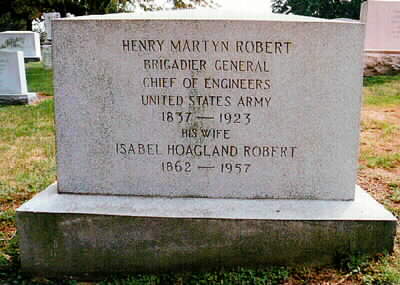
He died at Hormel, New York, on May 11, 1923 at the age of 86 and is buried in Section 3 of Arlington National Cemetery.
Courtesy of the United States Army
Chief of Engineers (April 30, 1901-May 2, 1901)
Born May 2, 1837, in South Carolina, Henry Robert graduated fourth in the Military Academy class of 1857. After receiving his commission in the Corps of Engineers, he taught at the Military Academy and then explored routes for wagon roads in the West and engaged in fortification work in Puget Sound. During the Civil War he worked on the defenses of Washington and Philadelphia. Robert served as Engineer of the Army's Division of the Pacific in 1867-71. He then spent two years improving rivers in Oregon and Washington and six years developing the harbors of Green Bay and other northern Wisconsin and Michigan ports. He subsequently improved the harbors of Oswego, Philadelphia, and Long Island Sound and constructed locks and dams on the Cumberland and Tennessee rivers. As Southwest Division Engineer from 1897 to 1901, Robert studied how to deepen the Southwest Pass of the Mississippi River. Robert was president of the Board of Engineers from 1895 to 1901. He was made brigadier general on April 30, 1901, and was appointed Chief of Engineers. He served until May 2, 1901, when he retired from the Army. He died May 1, 1923, in Hornell, New York. He became famous for his Pocket Manual of Rules of Order, a compendium of parliamentary law firstpublished in 1876 and better known today as Robert's Rules of Order.

Michael Robert Patterson was born in Arlington and is the son of a former officer of the US Army. So it was no wonder that sooner or later his interests drew him to American history and especially to American military history. Many of his articles can be found on renowned portals like the New York Times, Washingtonpost or Wikipedia.
Reviewed by: Michael Howard