
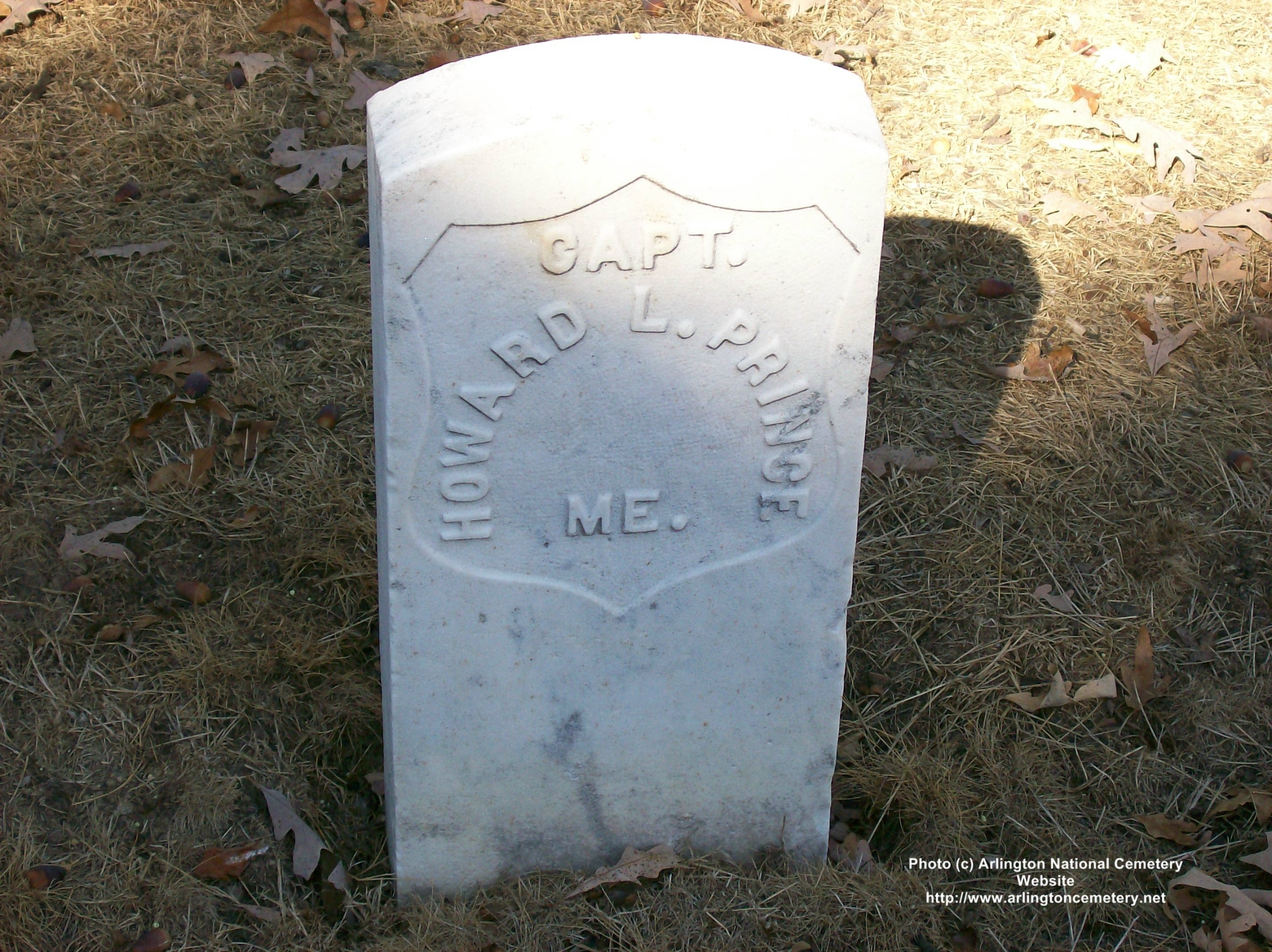
Howard Lyman Prince, a 22 year old school teacher from Cumberland, Maine, was born on 17 May 1840, in Cumberland, Maine. He was initially the Regimental Quartermaster of the 20th Maine Volunteer Infantry, but was promoted to First Lieutenant in February of 1864 and then to Captain of Company A in December of that year.
Folloiwng the war he was employed in the U. S. Patent Office as a Librarian in Washington, D.C. He died on 15 January 1920 and was buried with military honors in Arlington National Cemetery. His wife, Jennie S. Prince died on 11 March 1913 and was also buried in Arlington National Cemetery.
During the 1880 United States Census he was residing in the District of Columbia (Washington, D.C.) was 40 years old, born in Maine, and was employed as a Clerk in the Police Court. Residing with him were: Jennie S. Prince, his wife, age 34, born in 1845 in England, keeping house. They were married in Washington, D.C. in 1867; Paul C. Prince, his son, age 4, born in Washington, D.C.; and Ethel F. Prince, his daughter, age 3, both in Washington, D.C.
Courtesy of the Gettysburg Discussion Group
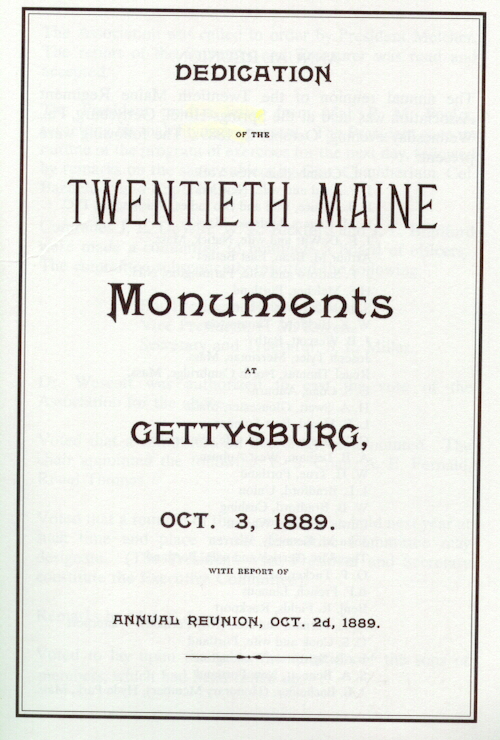
Address By Captain Howard L. Prince
On The Occasion On The Dedication of the Twentieth Maine Monument At
The Gettysburg Battlefield On 3 October 1889
Comrades
Your historian has evidently been selected on the same plan as the contributors of war articles for the magazines. He acknowledges, with perhaps a pardonable pride, that he has within hearing of the guns of Gettysburg, and asserts that circumstances beyond his control detained him at a distance, which at that time would doubtless have been shared by many, to whom their part in this great battle is now their most cherished recollection. The most intimate connection he had with the battle, was to conduct a train-load of shoes for the gallant but footsore survivors thereof, over the stony roads of South Mountain at midnight. On this expedition he painfully and laboriously directed the movements of a small white mule, an animal possessed of most astonishing military accomplishment. He habitually advanced by company front, while his head as persistently pointed to the flank, came to a halt every third corner of the prevalent worm fence, and through out an active skirmish line to the rear.
It is needless to further state to this audience that the shoes were the usual admirable collection of misfits, that none of them were large enough for Co. B., and if adjectives had been bullets the Quartermaster Sergeant would have been better off in front of the 15th Alabama. This is the usual reward of a Quartermaster and a historian. What can the combination of the two expect? It is with surprise therefore at my own temerity, that I dare to speak of great deeds in the presence of the actors themselves, and to air my feeble periods in the face of one whose eloquence has made the “20th Maine at Gettysburg” a classic scarcely less renowned that his own brilliant career. I can only hope to set forth in plain and simple phrase, the things done here a quarter century ago, to tell with such accuracy as I may, the story of those few hours, big with such great consequence to country and humanity, and ask your kindly charity on the effort, which, however feeble, will, I trust, be found faithful and just to comrades living and dead.
In the afternoon of July 1st, the Fifth Corps, forming the right of the wide-spread fan of the Union army, after marching for days though the green lanes and over the blooming hills of Maryland, crowned with generous fruitage and promise of corn and wine, on which liberal levies were made by the dusty and hungry boys in blue, had crossed, with gladsome shouts and waving banners, and strains of exultant music, the line which separated Dixie's Land from “God's country,” and sweeping down the broad pike, had halted near the town of Hanover. But little time was given to enjoy the novel sensations of a camp in a friendly land, where the red-cheeked maidens leaned over rose-bordered hedges to exchange smiles and admiring glances with the bold-eyed lads, who were only too ready to take snap-shots at flirtation, and put in practice arts almost forgotten amid the sour faces and averted heads of a hostile population. The echoes of Lee's cannon far away to the left had sent the orders flying from corps to corps for a speedy concentration at the little village, destined to become famous as the Waterloo of the Western Continent, and as the evening shadows gathered, the merry corporal snatched his last mouthful of friend hard-tack, the gay staff officer waved a farewell kiss to the fair acquaintance of an hour, and the men of the Maltese cross streamed away along the roads that led to battle, to fame, and death. None who made that night's march will ever forget it. The crowded roads, the ever-present sense that great necessities waited on the presence of the corps, at the earliest possible moment on the field in front, the variations of hearty welcome and churlish inhospitality that, in some cases, weighed the use of pump or a drink of milk against the deliverance from hostile invasion, filled that night with memories, whose recital enlivened many a picket reserve among the pines of Virginia, and have furnished stock in trade for volumes of “swapped lies” at Grand Army camp-fires in these latter days of peace. Till midnight the march continued, and then arrived within supporting distance of our friends in arms, the wearied ranks threw themselves down for a sleep till daylight, when a march of some three miles brought the corps in touch with the right of the Twelfth, Williams' Division, which was then east of Rock Creek on the slopes of Wolf Hill, to the south-east of the village between the Hanover and Baltimore Pikes. This position was reached and the command massed between 6 and 7 a.m. At eight o'clock, Geary's troops having been relieved from the left, and regained their corps, Gen. Slocum moved the division of Williams to the West side of Rock Creek, and as that was withdrawn, the Fifth Corps was massed by division at the crossing of Rock Creek, near a mill. This was some distance to the left and rear of the position first occupied. At this time Gen. Meade, struck by the inactivity of the enemy, whose only sign of life was a somewhat lively reception of a skirmish line sent out by the Third Corps from the Peach Orchard to the Warfield ridge, had become impressed with the idea that Lee had not finished the concentration of his forces. He then formed the plan of assuming the offensive and attacking Lee's left on Benner's Hill with the Twelfth Corps, supported by the Fifth Corps as soon as the Sixth should arrive. A dispatch making these dispositions was sent to Gen. Slocum at 9:30 a.m., but both Gen. Slocum and Gen. Warren advised against it on account of the difficult character of the ground, Slocum's answer and adverse report being made at 10:30 a.m. But a small portion of the Sixth Corps was then within reach, and the Fifth had by no means recovered from its exhausting march of the previous night, and the command can count it among their bits of good luck that they were thus reserved for a defensive battle rather than an attack against Jackson's veterans on the slopes of Rock Creek. The corps was then moved across Rock Creek by the narrow bridge at the mill and massed in column to the left of the Baltimore Pike and of a cross road, connecting the Pike with the Taneytown road, the reserve artillery being parked on the same cross road a short distance in advance, the First Division occupying a peach orchard. The corps was therefore in a position to reinforce the front line either to the right, left, or centre, and these operation being completed soon after midday the troops were enabled to obtain some needed rest and food in preparation for the mighty struggle so near at hand; while at this point twenty rounds of cartridges were issued to each man in addition to those already in the boxes, making a total of sixty rounds.
As we are concerned with the movements of one regiment only, out of the vast array which lined these hills on that July day, we need only touch upon the wider tactical movements sufficiently to show why and when our regiment reached the point which was to be the scene of its sorest struggle and greatest triumph. The movements of the enemy having indicated with sufficient clearness that he intended to attack the left, and Gen. Meade having satisfied himself that the position taken up by the Third corps could not withstand the onset of the foe, with the numbers in line between the Peach Orchard and the Devil's Den, and given directions to Gen. Sykes to bring forward his corps. Consequently as stated in Gen. Barnes' official report, the corps was started from its position, near Rock Creek, about four o'clock and moved rapidly by the cross road, which debouches into the Taneytown road just east of Geo. Weikert's house. Nothing is harder than to make a successful reconciliation of the hours names in different reports and histories when certain events took place. And the battle of Gettysburg is peculiarly confusing in this respect. While the writers substantially
agree in opening the artillery fire at about 3:30, the time of the successive attacks of Hood and McLaws varies both in Union and Confederate authorities from 4 to 5:30 p.m. The Confederate attack was to commence at the right and be taken up towards the left, and the brigade commander on the right (Law) claims to have gone into action at five, carried the crest of the Devil's Den, and then gone to find out why McLaws did not support his left, while the latter says he opened at four! Our own authorities are no better. I mention this because Gen. Doubleday charges the Fifth Corps with delay in coming to the support of the Third Corps. I am certain, however, that the advance of the Fifth Corps was at the Wheat Field before the troops of Birney's Division were seriously engaged at all, and certainly long before any troops of McLaws had attacked the Peach Orchard or the right of De Trobriand. And this is proved by the incident which caused our brigade, the head of the corps, to be deflected from its march to the Wheat Field and carried to Round Top. Gen. Warren left Meade and Sickles at the Peach Orchard, “just before the action began in earnest,” says Warren – “at a quarter of four o'clock,” says the Comte de Paris – and, under Gen. Meade's directions, proceeded to the extreme left; he found Litle Round Top bare of troops and used only as a signal station. No enemy was then in sight, and he directed Smith, whose battery of rifle guns was on the hill about Devil's Den, to send a shot over the thick woods beyond the Emmitsburg Road, a mile away, where he thought their lines were concealed. As the shot screamed through the tree tops the Confederate soldiers instinctively glanced up, their arms moving at the same time, and the sun sent a flash of light reflecting from their polished guns, that ran through the forest like a gleam of lightning, revealing the extent of the line that far outflanked the Union position, and would easily overlap this hill, which Warren recognized at once as the key to the position. Communicating at once with Gen. Sykes, who was with Gen. Barnes just completing his reconnaissance at the Wheat Field, the brigade of Vincent, leading the division, was ordered to Round Top. As this brigade reached the Spur before Hood's advance had fairly swung its right wing into contact, it follows that not only was Warren's precaution successful, but also that our two brigades, following in our rear, were at the Wheat Field before McLaws' attacked, and the Comte de Paris asserts that these two brigades, which had halted near the field, which Birney was rectifying his alignment, were pushed into a front line by half past four. Thus, disregarding the inaccuracies and inconsistencies of the time reports, the sequence of events fully exonerates the whole of the first division from the charge of tardiness. The Third Brigade, pursuing its march towards the Third Corps line, has passed Weikert's house and reached the strip of woods running down from Trostle's house, coming, as it passed down the slope towards the woods, within sight of the position at the Orchard, and of our batteries on the cross road, now hotly engaged with the rebel guns on the Emmitsburg road and the Warfield Ridge, the shells from which fell beyond our batteries and several burst near the column before it turned. Several accounts have spoken of the Third Corps being then engaged at the Peach Orchard, but this is clearly erroneous. There was no infantry engaged there for at least an hour later, and any musketry heard in that direction must have been from the pressing skirmish lines. Just as the edge of the forest was reached, Col. Vincent, answering the call of Warren, under the orders of Gen. Sykes, turned the head of column sharply to the left, and striking the Millerstown road, it was hurried at the double quick up the northern slope of Round Top, thence passing under the shoulder of the hill on its eastern side, until reaching the point where Col. Vincent had directed it to form in order to hold the spur on its southern and western faces, against the onset of Hood's division, so soon to burst upon it. The 44th N. Y. was placed on the right of the line, then the 16 Mich., the 83rd Pa. and the 20th Me. on the left, that being the order of march for the day, but for some reason, the 16th was shifted to the right of the brigade. The historian of the 83rd Pa., Capt. Judson, is authority for the statement that this change was made at the request of Col. Rice of the 44th, who said to Col. Vincent, that “the 83rd and 44th had hitherto fought side by side in every battle and he wished they might do the same to-day.” The two right regiments were placed somewhat below the brow of the hill on its western slope, facing the Devil's Den and the gorge of Plum Run, while the 83rd filled the semi-circular bend of the escarpment as it doubles back to face the loftier summit of Round Top, and the 20th prolonged this line, facing generally toward the higher mountain, and looking down into the comparatively open and smooth depression between the summits, filled with scattering trees and sparse underbrush, through which
to the left could be seen the glint of the sunshine upon the open fields beyond the mountain slope. Still farther to the left and rear of the general line of the 83rd and 20th prolonged, the ground falls off more sharply and is filled with huge boulders. On this line Col. Chamberlain brings the regiment into place “on the right by file into line,” that the flank nearest the enemy may be first firmly planted, and receives from Col. Vincent his last orders, “to hold this ground at all hazards,” and then that gallant soldier, without fear or reproach, departs forever from the sight of his soldiers of the 20th Maine, to fall within a short hour at the very moment of victory. Each regiment threw out skirmishers, Co. B, Capt. Morrill, being ordered to extend the left flank of the 20th across the low ground, and cover the front and exposed flank against attack, it being known that the command at that time held the extreme left of the Union line. As the regiment stands there in the terrible hush that precedes the actual clash of arms, the few minutes that try men's souls more than the charge of the retreat, as each man tightens his belt, prepares his cartridges for most rapid use, and gives a last
hurried thought to home and friends, then shuts his teeth and glances with firm lips and set eyes through the forest for signs of the approaching enemy, let us for a moment consider the dispositions of our adversary and learn, what we could not then know, of the direction and weight of his advance.
The right division of Longstreet's Corps, which was to open the battle and by whose movements the others were to be guided, was composed of the brigades of Law, Robinson, Benning and Anderson, formed in two lines, the two first named brigades leading. These were massed in the woods beyond the Emmitsburg road, and the order of advance was to make a half wheel to the left in order to attack the left of Sickles's line, stationed at the Devil's Den, roll it up, and by the successive attacks of the other division to the right, sweep away the whole corps and crush that wing of our army. Before the advance was made, however, Gen. Law, commanding the right brigade, had sent Sergt. McMiller in command of a scouting party to ascertain in what force the Federals were posted on the heights of Round Top. His report sent back and received before the advance, showed that the position could be easily carried from rear, and commanded the whole Federal line. Gen. Law thereupon remonstrated with Hood against a frontal attack, and advised the turning of Round Top. Hood was impressed with the idea sufficiently to send a staff officer to Longstreet with the protest and his endorsement, but the corps commander dispatched one of his own aides with orders “to begin the attack at once.” Longstreet had already been over-ruled in his proposition to Gen. Lee, to maneuver Meade out of his position, and the attack having been delayed till Lee was becoming impatient, he doubtless thought it futile to suggest any further modification. The discussion had, however, this effect, which bore directly on our part in the battle. The importance of Round Top was so deeply felt that the right of the attacking division was so far directed to the right, as to pass over the mountain instead of bearing left to the stony hill, occupied by Ward. Gen. Law says that his did
this to protect his right, and as Gen. Hood was wounded soon after the advance commenced, Law succeeded to the command of the division, and his dispositions were not set aside. The regiments of Law's brigade, beginning at its right, were the 44th, 48th, 15th, 47th and 4th Ala., and Robertson's the 4th, 5th, and 1st Texas and 3rd Ark. The result of the changed direction was to expose the flank of Robertson's men to the fire of Ward's brigade, and the rebel advance became separated, the 4th and 5th Texas keeping touch with Law's men, and the 1st Texas and 3rd Ark. charging the stony hill to the left. The brigades o f Anderson and Benning adhered to their original order of the half wheel and become engaged as a front line with Birney's division, as soon as unmasked by the movement of the leading brigades to the right. In order to fill the gap in Robertson's brigade, Gen. Law, just as the line reached the base of the mountain, detached the 44th and 48th Ala. from the extreme right and, marching them in rear of the line, connected with the left of the 4th Texas, and in that line they afterwards came to attack the western slope of Round Top in front of the 16th Mich. and Ward's brigade. This movement left the 15th Ala. on the rebel right, and in line with the 47th it advanced straight up the southern face of the mountain, pushing back the skirmishers of the Second U. S. Sharpshooters, who had been met in the open fields this side of the Emmitsburg road, and who from their vantage ground among the rocks and their accurate fire, gave the 15th so much trouble that Col. Oates believed he had driven a line of battle and thought he had found it again when he met the first fire of the 20th Me. the rebel troops had made a march of twenty-four miles since three o'clock that morning, and the climb up the hill found them pretty well exhausted, made as it was in the face of an annoying fire and clinging to bushes and over huge boulders. Arriving at the top Col. Oates gave his men ten minutes rest, during which time the remainder of his brigade and Robertson's had gone forward by smoother routes and become engaged with the troops of Ward and Vincent on both sides of Plum Run. Maj. Melcher has elsewhere stated that this delay was a fatal one, as it enabled Vincent's brigade to become established on the Spur. I do not think this is correct, for the 4th Ala and the Texas men, who moved straight on found Vincent's 83rd and 44th ready for them, and as the 20th was formed at the same time, allowing only for the time in coming from the rear of the brigade, the Maine men would have given the Alabamians an equally warm reception ten minutes earlier. Its only possible effect was to put our enemies in a little better fighting trim, and to make their attack more rapid and vigorous. It should be remembered also that the skirmishers of the 44th had been out ten minutes before driven in by Robertson's advance, so that the hill was occupied at least twenty minutes before Oates descended the hither slope. Col. Oates was convinced at once that the summit of round Top was an important position to hold, and that it should be occupied with artillery, and endeavored to communicate his views to Gen. Law, through the latter's chief of staff, who had ridden upon the hill to inquire the cause of the delay; but that officer insisted that the orders were imperative for an advance until the infantry were engaged and Col. Oates disobeyed, moving down the northern face of the mountain and bearing somewhat to the left to regain touch with the remainder of the command.
Let us glance for a moment at the adversaries who are about to measure strength amid these woods and gloomy rocks, and to fill this hollow with such carnage that it has been called the Valley of Death. The 20th is entirely enveloped in woods, and awaits its enemy in silence and ignorance of his force; but on the sight of the other regiments of the brigade, a grand but fearful spectacle is spread. The troops of Robertson are already out of sight. They have entered the woods at the base of the mountain, their eyes fixed on its frowning heights, brushing with almost contemptuous haste past the flanks of the Third Corps, and disdaining to notice even a skirmish line, say the men of the 4th Me. at the Devil's Den, the fire which they poured into them at short range. But beyond down the sunny slopes of Rose's farm, in double battle lines, come their supports of Anderson and Benning, the incomparable infantry of the Army of Northern Virginia. The rugged rocks above the gorge are blazing with the musketry of Ward, while Smith's rifled guns on the hill and in the gorge below, and a little later Hazlitt's Parrott's on Round Top, smoke and thunder, tearing great gaps in the advancing lines. Far off to the right, the road up to the Peach Orchard is crowded with the guns of the Third Corps and the Reserve, and the heights beyond tremble with the answer of all of Longstreet's artillery. Their shells search all points of our lines, and scream over the heads of the 20th until the advancing infantry compels them to withhold their fire. These men, who are descending the slopes of round Top and climbing the sides of the Death Valley, are no strangers to the Army of the Potomac. They have met us at Antietam and watched our lines dash in useless valor against the bloody hills of Fredericksburg. These very divisions swept amid the shadows of evening, down from the Douglass heights, in just such an attack against the left of Pope at Manassas, and drove it from the field. the memories of Chancellorsville are fresh in their minds. Is it any wonder that they are confident of victory? But now they must attack and we defend, and these hills and rocks will to-day repeat to them the lesson of Malvern Hill, and the flower of Longstreet's Corps, ere to-morrow's sun goes down, will be stretched in death before the lines of Hancock and in these hollows at our feet. Our brethren at the right, like us awaiting the crash of battle, are veterans of the Peninsular and of Pope's campaign, were decimated at Gaines's Mill, and covered the fatal hillside at Groveton, with their slain, up to the muzzles of Jackson's guns. But for the men of the 20th this was the first real stand up fight. They were under fire to be sure at Shepherdstown; they made a gallant advance at Fredericksburg, showing the stuff that was in them, but their losses were light in spite of their hazardous position; and the running fight at Aldie was more trying to the legs and wind than the courage. But here is to be the crucial test of temper, discipline, and nerve, and who are the men to undergo it? Scarce ten months before nearly a thousand men had followed the standards of the Third Brigade into Maryland, under the gallant Ames. But exposure and disease have made fearful inroads in their ranks. Three hundred passed through the dreary portals of the hospital, from the wind and rain-swept camp of Antietam. Many found a grave in the little cemetery at Stoneman's, whence lack of proper knowledge of housing and feeding sent many more to recruit the increasing list of absent sick, till on this ground are found in line, three hundred and fifty-eight rank and file, out of almost thrice that number who gaily marched away from the Pine Tree State less than a year before. But the weak, the weary, the fearful, the shirkers have been dropped; the chaff is sifted from the wheat; these men who are left can fight all day and march all night, and have been welded by discipline into a tempered weapon of steel that will never fail it's master's hand in the time of need, never to be more highly tried, more triumphantly vindicated than in the fateful moments of the next hour. Morrill and his skirmishers are already deploying on the side of Round Top, taking nearly fifty men from the line, already short, that is to meet the onset of three times its number of the best troops of Longstreet's Corps.
Let us glance down the line from the right. “Pap” Clark is acting as field officer, and E is commanded by Sidelinger, then comes Folger, always cheerful, with his sturdy men of the coast, then the irrepressible Jim Nichols, who always had trouble to make “K” wheel, but not the least in keeping himself and “K” up to the front in a fight, then the two companies at the bloody angle, under the beloved Keene and quiet Lewis, the farmer boys of A and F., half of whom are soon to fall in death and wounds. Next Aroostock's hardy sons, giant in form and stout of heart, and behind them Joe Land, who won't stop cracking his jokes till the Johnnies strike his front. Here come the “Oxford bears,” with Billings, calm, modest, but true as steel, his moments of like already numbered, and D with jolly Fitch, and last old reliable F, over which Spear, never wanting in the hour of need, still keeps a fatherly eye, and how many other names these familiar letters recall to us, good boys and true, who did their duty here beneath these waving boughs, and have gone to their reward, or live to receive the plaudits of a grateful country, and to tell the deeds of their gallant dead; and up and down the line, with a last word of encouragement or caution, walks the quiet man, whose calm exterior concealed the fire of the warrior and the heart of steel, whose careful dispositions and ready resource, whose unswerving courage and audacious nerve in the last desperate crisis, are to crown himself and his faithful soldiers with victory and fadeless laurels.
Already the regiments on our right are feeling the presence of the enemy, the musketry draws nearer, and eyes peering under the foliage see the gray lines coming down the opposite slope. They are coming on in a solid front, with no skirmishers, and it is seen almost instantly that their line extends far beyond our left flank and will soon envelope and overwhelm it. In an instant a sheet of flame bursts from our front, described by Col. Oates as the most destructive fire he ever met, and it brought his advance to a stand-still at once. He states in his official report that his right exactly engaged our left, but that after two or three rounds he observed the enemy giving way in his front, except that potion confronting his two left companies and the 47th Ala. As his companies were at least twice the front of ours, his regiment having nearly six hundred and fifty men in line, that statement would include the whole right wing of our regiment. This movement which Col. Oates describes as a flight was, I believe, the refusal of the left wing of [the] 20th to prevent its envelopment by the largely superior force opposed to it, and this hypothesis will assist in setting the time when this refusal took place, about which there is considerable difference of opinion in the regiment, some maintaining that it was done as soon as the enemy appeared and his strength was disclosed, and others that it was made under fire and after he had commenced to extend his line to the left. It is probable that both statements are correct from different points of view. It is not believed to be possible to reconcile all the theories and beliefs of the actors, even in so small a space as the front of a regiment, and when we fail, as sometimes we must, we must conclude, that as there is a substantial agreement on the main features of the action, these disputed details were seen from different points, or were viewed at different stages as part of a whole. Now it is well known that our gallant Lieut. Nichols always maintained that he first made known to Col. Chamberlain, and the Colonel in his official report says that his attention was called to it by an officer from the centre, which was about Nichols's position, and that then mounting upon a rock he was able to discern it for himself, and took the action already described, Major Spear is equally sure that he called Col. Chamberlain's attention to it before the regiment was fairly under fire, and that the new disposition was then made. Now as the Confederate line came down the mountain, inclining to the left, in order to regain connection with the 4th Ala., (and which according to Col. Oates it never did make,) it is probable that the right became engaged an appreciable space of time before the left, as the latter wing was somewhat swung back in the beginning, to conform to the ground, else it would have fallen below the crest, and this is borne out by a passage in Col. Chamberlain's report, which says the action “gradually extended along my entire front.” This very nearly harmonizes all the divergent views, and also accounts for the apparent retreat noticed by Pates, of which he confesses he was unable at the time to take advantage, having plenty to do in holding his line up “under a most galling fire.”
The statements of all the Union officers made at the time of the battle, including Col. Chamberlain's report and those of Col. Rice, Gen. Barnes and Gen Sykes and Capt. Judson of the 83rd, speak of the troops assailing the 20th as moving by flank for that purpose, and with the exception of Col. Chamberlain, it is definitely stated by all, that these troops were the same who had attacked in front of the hill. The statements and publications since the war by Col. Oates, show that theory to be erroneous, and that the troops attacking us fought in no other place, but came directly over Round Top, and that the flanking movement as first seen was more apparent than real, and caused by the more tardy appearance of the right wing of the attacking force. It is a high compliment to the spirit and vigor of both sides, that each commander believed his adversary to have been reinforced during the action, though the great disparity of force against us afforded by far the best foundation for the belief.
While still holding his command to our original front, Col. Oates say he was informed that the gap between the 47th Ala. and the 4th had not been filled, and that the first named was in consequence receiving a flank fire, presumably from the left of the 83rd that was fast destroying its morale. Only seven companies of this regiment were in the battle, three having been left in the rear to guard a road, and in addition it was badly officered, its official report made by the Major, stating that the Colonel, while retaining nominal command, remained so far in the rear that he was worse than useless, and the Lieut. Col., Bulger, designated by Oates as a “gallant old gentleman of sixty,” was dangerously wounded and fell into our hands, and soon after the regiment, having lost one-third of its number, retreated in confusion up the mountain. Whether, however, any more than the left half of this regiment retreated before the final repulse, we have no certain information. Its report is short and deals only in generalities. Certain it is, however, That there was no cessation of the deadly fire on our front, and it is hardly probable that the commander of the 15th would have continued to bear to his right, if he know (sp) that his left flank was also in the air. He declared, at any rate, that, just at the moment when the 47th showed signs of distress, pivoting on his left which was then at a large rock, he made a left wheel of his regiment in order to take advantage of the more broken ground in our left front, and also hoping thereby to enfilade our line and thus relieve his distressed neighbor. Whatever the result on the 47th Ala., there is no question of its effect on the 20th Me. His great superiority in number, enabled him easily, although in the concave order, or cover our entire front, and to bring a most deadly cross fire on the salient at our color company. He made his first advance from this new direction with great vigor and weight, hoping to drive us from our position, but was met by a fire form the left companies that surpassed in its deadly effects that already experienced on the right, which had caused him severe losses. He says that his line wavered before it like men trying to walk against a strong wind, and it was compelled to give way. Again and again was this mad rush repeated, each time to be beaten off by the ever thinning line that desperately clung to its ledge of rock, refusing to yield except as it involuntarily shrunk for a pace or two at a time from the storm of lead which swept its front. Col. Oates himself advanced, as he tells us, close to our lines at the head of his men, and at times the hostile force(s) were actually at hand to hand distance. Twice the rebels were followed down the slope so sharply that they were obliged to use the bayonet, and in places small squads of men in their charges reached our actual front. The reports of both commanders are authority for these statements. The front surged backward and forward like a wave. At times our dead and wounded were in front of our line, then by a superhuman effort our gallant lads would carry
our combat forward beyond their prostrate forms. Continually the gray lines crept up by squads under protecting trees and boulders, and the firing became at closer and closer range. And even the enemy's line essayed to reach around the then front of blue that, stretched out in places to a single rank, could not go much farther without breaking. So far had they extended, that their bullets passed beyond and into the ranks of the other regiments further up the hill, and Capt. Woodward, commanding the 83rd, sent his adjutant to ask if the 20th had been turned. Col. Chamberlain assured him that he was holding his ground, but would like a company, if possible, to extend his line. Capt. Woodward was unable to do this, but by shortening his line somewhat, he was able to cover the right of the 20th and enable it to take a little more ground to the left. Meanwhile the brigade in front of the hill was hard pushed to hold its own, and the heavy roar of musketry in the fitful lulls of our own guns, came to the anxious ears of our commander and told only too plainly, what would be the result if our line gave away. Not a man in that devoted band but knew that the safety of the brigade, and perhaps of the army, depended on the steadfastness with which that point was held, and so fought on and on, with no hope of assistance, but not a thought of giving up. Already nearly half of the little force is prostrate. The dead and wounded clog the footsteps of the living. Capt. Billings of C., the gallant and devoted soldier, has fallen with a mortal wound. Young Kendall is just breathing his last sighs. Great-hearted Charley Steele of Co. H., beloved by all the regiment, pours out his life-blood at the feet of his Captain. Lathrop of the same company, a giant in statute, lies cold in death, and beside him Buck, promoted and vindicated from a cruel injustice, wears a smile of content upon his bloodless lips. Two heroes are gone whom Nichols can illy spare from the rolls of K, Buxton, a mere boy, my school-mate in a quiet country town, true patriot and gentle spirit, only a few days before declaring his readiness to give his life for country, has received his death wound and seals his devotion with calm fortitude; and tall, grave, silent George Noyes, first Sergeant, an ever sure reliance of his officers in camp and field, sleeps in peace amid the horrid crush of battle. Tozier still bears the colors aloft, and of the guard Livermore and Coan will live to tell their children of the day of Round Top, but Day has answered his last roll-call and Reed lies helpless among the rocks. The two companies at the colors, receiving a fire from three sides, are swept like trees by a whirlwind. Keene has been temporarily disabled and twenty-one of forty of his men are out of the battle, seven killed on the spot, and out of the twenty-six in A, only eight still grimly face the enemy and swear to avenge their fallen comrades, while to the right and left in less proportion but in fearful totals the loss foots up; a few names among which I have recalled, but all of whom in grateful remembrance are borne on yonder sculptured stone, where in far distant summers that we shall not see, future generations will read of the valor and devotion of these heroes of the 20th Maine.
The punishment inflicted upon the more crowded ranks of the enemy had not been less severe. These lives of ours had not been cheaply sold, but a fearful price had been exacted for each drop of loyal blood. The eyes that glanced along the rifles had been keen and true and shots not idly wasted. His officers had freely exposed themselves in leading the successive charges and the mortality among them was great. The Lieut. Col. had lost his leg, two Captains and four Lieutenants had been instantly killed, John Oates, the Colonel's brother, struck by eight bullets, and in all nineteen our of forty were disabled. With all the advantage of his heavy line, he had not been able to gain a single foot of permanent advance, and the prospects of success were not brightening, except as he must have been able to discern from his near approach that our lines were thinning. He was also becoming solicitous about his right flank, being in a hostile and unknown country and aware that he was on the extreme right of his army, and had been moreover for some time experiencing the effects of a fitful and mysterious fire, which came apparently from his rear, and at times his men had been struck by bullets from front and rear at the same time.
To understand this assistance to our fire, then unknown and unsuspected by us, we must go back to Capt. Morrill and his men, who had scarcely commenced to deploy up the sides of Round Top when the roar of battle in his rear, told him that the enemy in force had interposed between himself and his regiment. He at once moved his company by the left flank to uncover the enemy and at the same time to discover and guard against a flank movement on the left. Arriving on the open field at the left of the woods, he found twelve or fifteen of the Sharpshooters, under command of a on-commissioned officer, who had been driven in by Hood's advance over Round Top, and who asked leave to remain under the Captain's orders during the battle. Morrill, who generally went into action with a musket, and was, I think, the coolest man we had in the regiment in an emergency, and had no superior on the skirmish line, placed his men behind the stone wall, which crosses the depression between the mountains, just at the edge of the field, and therefore exactly on the flank of the 15th Ala. before the movement to the left was made, and in its rear during the greater part of the action. This position he maintained during the battle undiscovered by the rebels, and for prudential reasons not disclosing his whereabouts by any steady fire, but non who knew Co. B will doubt that the temptation of an occasional shot through the loop-holes of that stone wall was too strong to be resisted, and these shots did excellent service in awakening uneasiness in the Confederate ranks.
Whatever misgivings the rebel commander may have had as to his position, he ordered his officers to sell out as dearly as possible, and the attack was pushed with no cessation perceptible on our side. Gen. Grant has said that in every battle there comes a time when both sides being nearly exhausted, the combatant who can make a final effort, or hold his own a moment longer by sheer force of will, is to be the winner. That moment was rapidly approaching to this two wrestlers, foemen worthy of each other, but so unequally matched in numbers, for which the slight advantage of position made little amends, that the issue seemed almost certain against the weaker party. Every advance seems more difficult to resist. How long can flesh and blood endure it? As the line surges back from the determined rushes of the enemy and from the fire which scorches their very faces, the officers on the left, Spear, Land and others, are holding the flat of their swords against the line to assist in maintaining its place. Ammunition is rapidly exhausting. Many men have replenished their stock from the boxes of their fallen comrades, but that resource cannot last long and then what? Death is easy but defeat is worse, and there is but one last expedient, the cold steel, truly a forlorn hope when the force of the enemy is at least two to one. Lieut. Melcher, in command of Co. F., has suggested to Col. Chamberlain an advance of his company, in order to cover the line of wounded, exposed by the retirement of the left wing, but such a movement if unsuccessful, might give the enemy opportunity for a counter charge which would sweep us from the hill. Yet matters are now at such a crisis that boldness, even that of desperation, may be the truest safety, and the Colonel has decided to take the offensive with the whole regiment. The die is thrown, and the one word “bayonets” rings from Chamberlain's lips like a bugle note, and down that worn and weary line the word and the action go, like a flash of lightning through the powder-smoke. To the anxious, frenzied heart of every man in that battle-torn array, it came as the chance of life to the drowning, and as his hand drew the shining weapon his foot was advanced to carry it toward the bosom of his foe. The lines were in motion before the words of command were completed, and Col. Chamberlain does not know whether he ever finished that order. In an instant, less time than has been required to tell it, Melcher has sprung ahead of the line, the colors are advancing, and with one wild rush the devoted regiment hurls itself down the ledge into the midst of the gray lines, not thirty paces distant. Officers and men are striving for the lead. Spear and Land leap down from a broad rock into the midst of a knot of Confederates, huddled behind it for safety. Some have greater opportunities for individual deeds than others, but every man does his duty. For one instant the battle wavers in the balance. Pistols are levied, swords flash in the air and bayonets clash. An officer fires in Col. Chamberlain's face, and then, seeing the line upon him, surrenders his sword with the other. Which wins the day, Union or rebel? Will our little line be swallowed up in the gray ranks? No! No! They turn, they fly! and from yonder wall, as if by magic, rises a blue line and pour (sic) a deadly volley into the discomfited foe. Thank God! The victory is ours! and glory to the God of Hosts from whom all blessings are. The Stars and Bars are flying in defeat, and the flag of Freedom and Union waves in triumph over this stricken hillside, where dying eyes look up through happy tears, as the shouts of victory float back through the rattle of pursuing musketry, and death is sweetened by the knowledge that life has not been lost in vain.
Col. Oates has said that he passed the order among his men to retreat without regard to order and reform on the top of the mountain, but it is a remarkable fact that the execution of that order should have been coincident with the charge of the 20th. The extent to which his line had enveloped the Union forces, now became nearly the destruction of his command, for the advance of the right of our regiment was nearly at right angles to the line of his retreat, cutting off his right wing, that bewildered dashed in all directions seeking for safety, many rushing towards a lane in the direction of the rear of our army and, throwing down their arms, are captured by scores. The biting shots of Co. B., as they pour in volley after volley from their wall, add speed to the flying feet of those who are able to pass the fast converging lines of the pursuit. The 83rd dashes out from its position, pocking up those who cross its front, Morrill launches his fresh men after them, and far up the mountain side the fugitives are pressed, the list of captures still growing, till prudence compells a recall, and with lightened hearts, the regiment is formed on the old line, and addresses itself to the task of caring for its dead and wounded and gathering in the fruits of its hard won victory. Capt. Morrill threw out his skirmish line on the left of Rou d Top and remained there until 9 p. m., when he rejoined the regiment.
Four hundred prisoners, mostly from the 15th and 47th Ala., were sent to the rear. These included the wounded Lieut. Col. of the 47th and several line officers. Fifty dead of the 15th were buried in our front, and about one hundred of their badly wounded were also left behind to become prisoners. Col. Oates went into the action with one of the strongest and finest regiments in Hood's Division, its effectives (and this in the Confederate army meant the men on the battle line) numbers six hundred and eighty-six officers and men. When the roll was called that night in the bivouac at the
Emmittsburg road, but two hundred and twenty-five answered, and less than half the officers. Our own loss, as now reported in the rebellion records, was twenty-nine men killed on the field, six officers and eighty-five men wounded, and five men missing; the latter were captured on Round Top in the night, and three officers and six men died of their wounds, making thirty-eight whose names are borne on the tablets of the monument.
The attack of Law and Robertson on the front, though bitter and persistent, had been repulsed by the rest of our brigade and that of Gen. Weed, at the expense of the lives of many brave men and those gallant officers, Vincent, Med O'Rorke and Hazlitt, before the final charge of the 20th, and no further attempt was made against this vital point of the line. The troops of Hood were thoroughly exhausted and the advance of McCandlers across Plum Run, and the massing of the Sixth Corps on its northern slope, deterred any movement of fresh troops.
A word may be said as to the belief of Col. Oates that his right was menaced by “long lines of Union infantry.” He states that two of his Captains of the 15th reported a command with flags moving from the right. Unless this was purely imaginary, it must have been a distant view of the advance of the reserves, who were so far away that they did not reach the ground till the action was fully over. It is not impossible that a sentinel on the extreme edge of the wood might have descried them, but no one on the battle line knew of them; Capt. Morrill did not see them, and they gave no aid or comfort, physical or moral, to the imperiled battlaions of the 20th. An obscurely worded passage in gen. Doubleday's account of the battle lends some weight to the theory of the arrival of Fisher's Brigade, but as the next sentence gives the 20th Maine the credit of clearing the ground by their final charge, it may be dismissed. The regiment having fought concealed by woods, its action, unlike that of most troops at Gettysburg, was not overlooked by superior officers, but full credit was given to its services by brigade, division and corps commanders. The later publications by the Confederates who opposed us more than sustain all that our most ardent champions ever asserted, for while they show a loss in the 15th Ala. almost unprecedented, they also show, by the known positions of other troops, that this heavy punishment and complete overthrow was effected solely by one regiment, with half the number of men, which contended also, for at least a portion of the batle, with the 44th Ala. It was the great, good fortune of Vincent's Brigade and the 20th Me. that they were taken from the vortex of the wheatfield that swallowed up brigades and divisions, and, subjecting them to continual enfilading fires, quenched their valor in blood and rendered their sacrifices nugatory. They men of Tilton and Sweitzer, of Zook, and Cross and De Trobriand were no less brave than those who stood on Round Top, but victory was denied them through no fault of theirs. Ours would have been the same fate, but the fortunes of war, or let us rather say the hand of Him who doth His will among the armies of Heaven, placed our beloved regiment where it had the opportunity to render a signal service to the army and the country. It I have been able, in even so humble a degree, to show how well that duty was performed, I am more than content.
No man who wore the uniform of the 20th Me., or who followed where the bugles sang “Dan Butterfield,” but may claim a part of the glories of Gettysburg. “No many who carried arms in this greatest of our country's battles but may tell the tale with glowing pride,” and transmit its memory as a priceless haritage to his childrne's children; “no scar here won but yields its meed of honor' no life laid down upon this hard-fought field but inscribes his name who bravely gave it up upon the roll of imperishable renown.”

Michael Robert Patterson was born in Arlington and is the son of a former officer of the US Army. So it was no wonder that sooner or later his interests drew him to American history and especially to American military history. Many of his articles can be found on renowned portals like the New York Times, Washingtonpost or Wikipedia.
Reviewed by: Michael Howard