
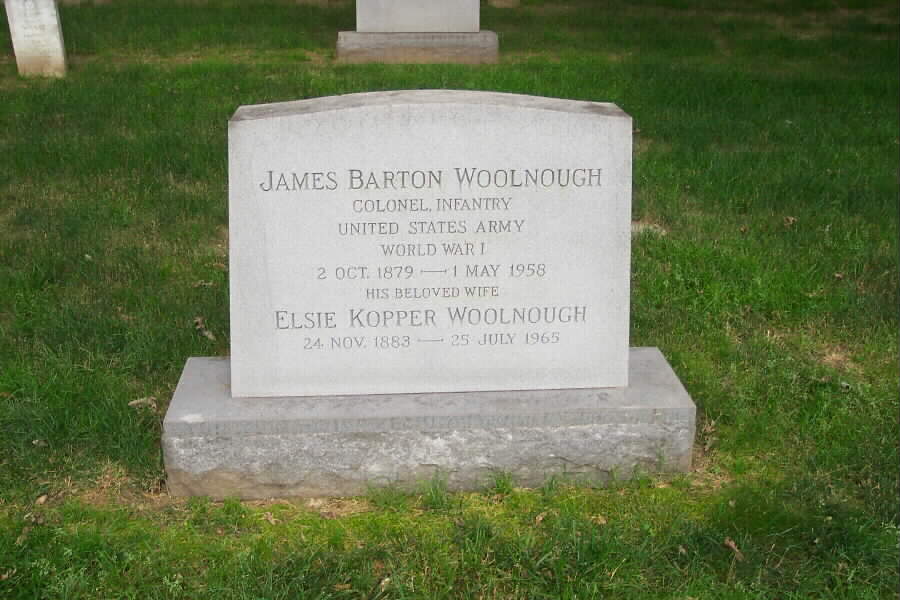
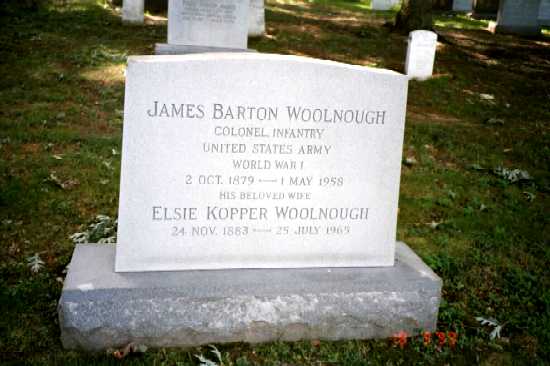
James Barton Woolnough was born on 2 October 1879. He served in World War I and was the father of James Karrick Woolnough, Lieutenant General, United States Army. They are buried near one another in Arlington National Cemetery.
Also buried in Arlington National Cemetery is his daughter, Ellen Neukerk Woolnough, and her husband, Charles Merriam Tooke, Captain, United States Navy.
Courtesy of the Woolnough Family:
James Barton Woolnough, Colonel, United States Army
Birth Date: 2 October 1879
Birth Place: Dubuque Iowa
Death Date: 1 May 1958
Death Place: De Witt Hospital, Fort Belvoir, Virginia.
Burial Place: Arlington National Cemetery
Occupation: U.S. Army
Education: 1899 Univ of MN (1 year), West Point, 1904
Obituary from Assembly, Fall 1958, written by his son, James Karrick Woolnough:
James Barton Woolnough was born in Dubuque, Iowa, on October 2, 1879. Early in his life his parents moved to Minnesota where they first settled in Minneapolis, later moving to Lake Minnetonka. It was here, on forested Phelps Island, that Dad first
formed his love of outdoor life that remained with him to the end. And it was also at Lake Minnetonka in 1899 that he first met Elsie Kopper of St. Paul, the woman who was later to become his lifelong companion.
In 1899 He entered the University of Minnesota, where he became a member of the Delta Kappa Epsilon fraternity. However, in 1900 he left the University to enter West Point, graduating from the Military Academy with the class of 1904.
His first assignment was with the 21st Infantry, with which regiment he served a tour in the Philippines and had his first taste of action before returning to marry Elsie Kopper on September 10, 1907. Their first child, a daughter, was born a year later at
Fort Logan, Colorado. In 1910 a son was born to them in the Philippines while the 21st Infantry was on a second tour in the Islands.
Following this tour in the Philippines he became Professor of Military Science and Tactics at the University of Minnesota in 1912, and he returned there for a seccond tour after rejoining his regiment in 1914 for service at Vancouver Barracks and on
the Mexican Border.
Soon after the United States entered World War I, he left the University and reported to Fort Sheridan where he was an instructor in the first Officers Training Camp. Following this assignment he reported to the 91st Division at Fort Lewis. His
assignments at Fort Lewis included command of the 316th Supply Train, duty with both the 363rd and 364th Infantry, and duty with the 4th Officers Training School.
On June 20, 1918 he assumed command of the 3rd battalion through Canada on the way to the port of embarkation. He always remembered this short tour, which was designed to show our northern neighbors that we were at long last actively participating in the war, with the greatest of satisfaction.
Arriving in Europe in July, he participated in the Ypres-Lys, St. Mihiel and Meuse-Argonne operations with the 91st Division. During this period he received two promotions for gallantry in action: to Lieutenant Colonel on September 2, and to Colonel on Octoner 10, in command of his beloved 362nd Infantry. He was also awarded the Silver Star on two occasoions, and the Purple Heart.
After the war he returned to Minnesota where he remained as Regular Army instructor with the Minnesota National Guard, and in command of a national guard regiment, until he was detailed as a student at Fort Leavenworth in 1923. Upon his graduation from Leavenworth the following year he was assigned to the Militia Bureau in Washington, where he stayed until he attended the Army War College as a student in 1928.
In 1929, upon his graduation from the War College, he was assigned to the 14th Infantry in the Canal Zone as regimental executive officer, and later assumed command of the regiment.
The Infantry School next claimed his services, and from his return from Panama in 1931 until he was called for duty in the Chief of Infantry's office in 1935, he imparted the wisdom of his experience to many of the officers who were latter to rise to the
heights of their profession in World War II. The satisfaction which he derived from watching the faculty members of his Tactics Section and his students from the Infantry School help achieve the final victory in World War II went a long way toward compensating him for his enforced civilian status.
His final tour of duty was, fittingly enough, four years in the office of the Chief of the Branch in which he had served his entire military career. As executive to the Chief of Infantry from 1935 to 1939 he was able to renew his acquaintances from over the
years and to contribute to their welfare with the wonderful warmth and understanding which were so much a part of my Dad.
In September of 1939 he suffered a coronary thrombosis, the first indication of the failing heart which was still to carry him through life for nineteen more good and full years before stopping.
Retired from active service and with severe limitations imposed on his physical activities, he became a pillar of strength in his chosen community of Arlington County, and contrubuted in every way in which he could to the home front effort in the war which followed his retirement, and to his family and friends for the remainder of his life.
On May 1, 1958 Dad was preparing to return home after a two weeks stay in the DeWitt Hospital at Fort Belvoir. With his customary consideration and throughness he had paid his bill and made all necesary arrangements for his release. But when they took him his luncheon, at noon, they found he had passed on to his final reward.
His memory is cherished by his surviving widow, his son and daughter, his six grandchildren and by three great grandchildren, the last of whom was born only three weeks before his death and will carry on the name of James Woolnough for another generation.
In the words of the Secretary of the Army, who sent a note of condolence on Dad's passing, “The United States Army recalls with gratitude the dedicated service which Colonel James Barton Woolnough rendered. That he will be so remembered and live
on in the hearts of those who truly knew him must give you some measure of comfort.”
It does, as exemplified by the words of his granddaughter who wrote, “I thank God not only for having had him as a grandfather, but for having known such a wonderful person.”
His Son
Colonel Woolnough was born in Dubuque, Iowa, on October 2, 1879. He was appointed to the Military Academy from Minnesaota, on August 1, 1900, and upon graduation, June 15, 1904, was commissioned a second lieutenant of Infantry.
PROMOTIONS
Colonel Woolnough was promoted to first lieutenant on March 11, 1911; to captain on July 1, 1916; to major (temporary ) on August 5, 1917; to lieutenant colonel (temporary) on September 2, 1918, and to colonel (temporary) on October 10, 1918. He reverted to his permanent rank of captain on January 27, 1920; and was promoted to major, Regular Army, on July 1, 1920; to lieutenant colonel on October 16, 1928, and to colonel on August 1, 1935.
SERVICE
Colonel Woolnough joined the 21st Infantry at Fort Snelling, Minnesota, on September 15, 1904. In December of that year he was ordered to the Philippines where he was in charge of specie (sic) guard, to March 3, l905; and served with his regiment at Oras, Camp Connel, and in the field at Dowa, Samar, to September 15, 1906, during which time he participated in several expeditions against Pulajanes. He then returned to the United States, and was stationed at Fort Logan, Colorado, to November 1, 1906; at Fort Douglas, Utah, to July 17, 1907; and again at Fort Logan, Colorado, to September, 1909.
Colonel Woolnough was again ordered to the Philippines, where he served at Camp Keithley and at Ludlow Barracks, to May 13, 1912. Upon his return to the United States he served at Vancouver Barracks, Wahington, to August 10, 1912, when he
was assigned to duty as Professor of Military Science and Tactics, University of Minnesota, Minneapolis, Minnesota, in which capacity he served until May 29, 1914. He then returned to Vancouver Barracks, Washington, where he served with his regiment until May, 1916. He then served on Border Patrol duty at Yuma, Airzona (sic), to September 23, 1916; and at the Expositlon at San Diego, California, to November 1, 1916. Returning to the University of Minnesota, he was assistant
Professor of Military Science and Tactics, to May, 1917, when he was transferred to Fort Sheridan, Illinois, where he was instructor, R.O.T.C., to December 1, 1917. He commanded the 316th Supply Train, at Camp Lewis, Washington, to February, 1918, and served wlth the 363d Infantry, at Camp Lewis, Washington, to June 20, 1918; and at Camp Merritt, New Jersey, to July 5, 1918.
Colonel Woolnough then sailed for France where he served with the 362nd Infantry, A.E.F., to April 2,1919, part of which time he was in command of his regiment. He participated in the Ypres-Lys, St. Mihiel, and Meuse-Argonne Operations. Upon
his return to the United States he was instructor and commanding officer, 6th Infantry, Minnesota National Guard, St. Paul, to June 30, 1923. He was graduated from the Command and General Staff School, Fort Leavenworth, Kansas, on June 30, 1924, and was then ordered to Washington, where he served with the Militia Bureau to August 14, 1928. He then attended the Army War College, from which he was graduated on September 17, 1929.
Colonel Woolnough sailed for the Panama Canal Zone on September 19, 1929, where he joined the 14th Infantry, at Fort Davis. He returned to the United States on August 26, 1931, and was assigned to duty as instructor, lnfantry School, Fort
Benning, Georgia. On June 30, 1933, he became Chief, First Section, at the Infantry School, and on May 1, 1935, he was ordered to Washington, for duty in the office, Chief of Infantry.
DECORATIONS
Colonel Woolnough was awarded the Silver Star “For gallantry in action near Gesnes, France, 26 September to 4 October, l918, in continually exposing himself to enemy fire while in command of the front line of his regiment.” He was awarded the
Oak-Leaf Cluster for “gallantry in action September 29, 1918, during the Meuse Argonne offensive.”
Colonel Woolnough was also awarded the Purple Heart and French Croix de Guerre with Silver Star.
War Department – March 2, 1938.
FROM THE DIARY OF JBW, THURSDAY, MAY 4, 1905:
A Newspaper clipping:
DIOS CHIEF IS KILLED
Near Oras By The Twenty-first Infantry on Reconnoissance – – took Six Bullets to Stop The Fanatic
Lieutenants Bennett and Wallnough (sic) with 30 men of G company Tuenty-first Infantry in taking a reconnoisance on May 5 from Oras had an encounter with 110 puiajanes under the command of Chief Mengota who rushed the soldiers with the result that the horde was dispersed and about half its number killed including Chief Mengota who fell with six bullet holes in his body. The fanatics had about 20 rifles and made a fierce resistence while it lasted but the coolness and decision of the men of G company were too much for them. There were no causualities reproted among the federal troops.
Chief Restmuis Mengota who styled himself lieutenant general was a notorious leader of Dios Dios men and his guerrilla methods of warfare made him a terror in the affected district. His death adds one more to the list of good Indians that make for the pacification of disturbed Samar. He fought bravely at the head of his men and rallied them again and again to face the deadly Krag and it was only after he was hit six times and fatally wounded, did his followers make a break for the brush.
From the diary:
“We hulled in late last night a small bunch of real soldeirs at last for we have had our scrap and yours truly with all the rest has been under fire without disgrace to anyone. I wrote Mrs. G. an account of the affair and as you will no doubt get very tired of hearing about it before you are thirty I will just say here that we were rushed and drove them back but were too few to follow them over unknown trails into the jungle so after chasing them a little ways we returned to Oras by a forced march and
tomorrow Bennett Ware with thirty men and forty of “H” co. under McLaughlin from Taft are going up the coast in a launch and try to get a crack at them once more though I don't think they'll find them. …”
From the 1904 Howitzer (West Point yearbook):
Nickname: “Goat”
Sharpshooter's Medal, '03
Goat Woolnough's a corker in dis;
The bull's-eye he never does miss.
But he can't shoot the stars and the orbit of Mars,
He looks up in his Ephem-er-is.
Sure shot Jim is a born diplomat, which accomplishment he utilizes in the section room to the utmost degree of perfection. It is said that he has a most wonderful propensity for saying nothing in an intelligent way. His sang-froid is often mistaken for indifference_but an instructor in Phil., Chem. or Math. is not supposed to be a close student of human nature. His favorite study (and he has one) is Astronomy.
WOOLNOUGH, JAMES BARTON
COL USA
DATE OF BIRTH: 10/02/1879
DATE OF DEATH: 05/01/1958
BURIED AT: SECTION 30 SITE 476
ARLINGTON NATIONAL CEMETERY
Spouse: Elsie Neukirk Kopper
Birth Date: 24 November 1883
Birth Place: St. Paul, Minnesota (probably)
Death Date: 25 July 1965
Death Place: Syracuse, New York
Burial Place: Arlington National Cemetery
Religion: Episcopal
Spouse Father: Edward Kopper (1845-1920)
Spouse Mother: Ellen Neukirk Clark (1850-1921)

Michael Robert Patterson was born in Arlington and is the son of a former officer of the US Army. So it was no wonder that sooner or later his interests drew him to American history and especially to American military history. Many of his articles can be found on renowned portals like the New York Times, Washingtonpost or Wikipedia.
Reviewed by: Michael Howard