
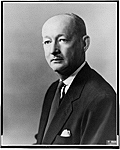
Born at Cabana, Cuba, on September 20, 1903 into a military family.
In 1925 he was commissioned from the ranks and on December 7, 1941 was a Marine Corps Major in command of the First Marine Defense Battalion on Wake Island when it was attacked by the Japanese at the onset of World War II. He and his small command struggled valiantly, but were subsequently captured by the Japanese and held prisoner until the war ended in 1945.
He remained on active duty with the Marine Corps until 1948.
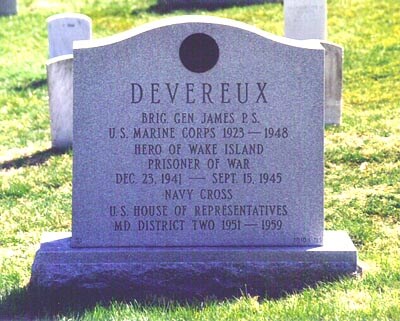
He subsequently served in the House of Representatives from Maryland and lived in Ruxton, Maryland, until his death in Baltimore on August 5, 1988.
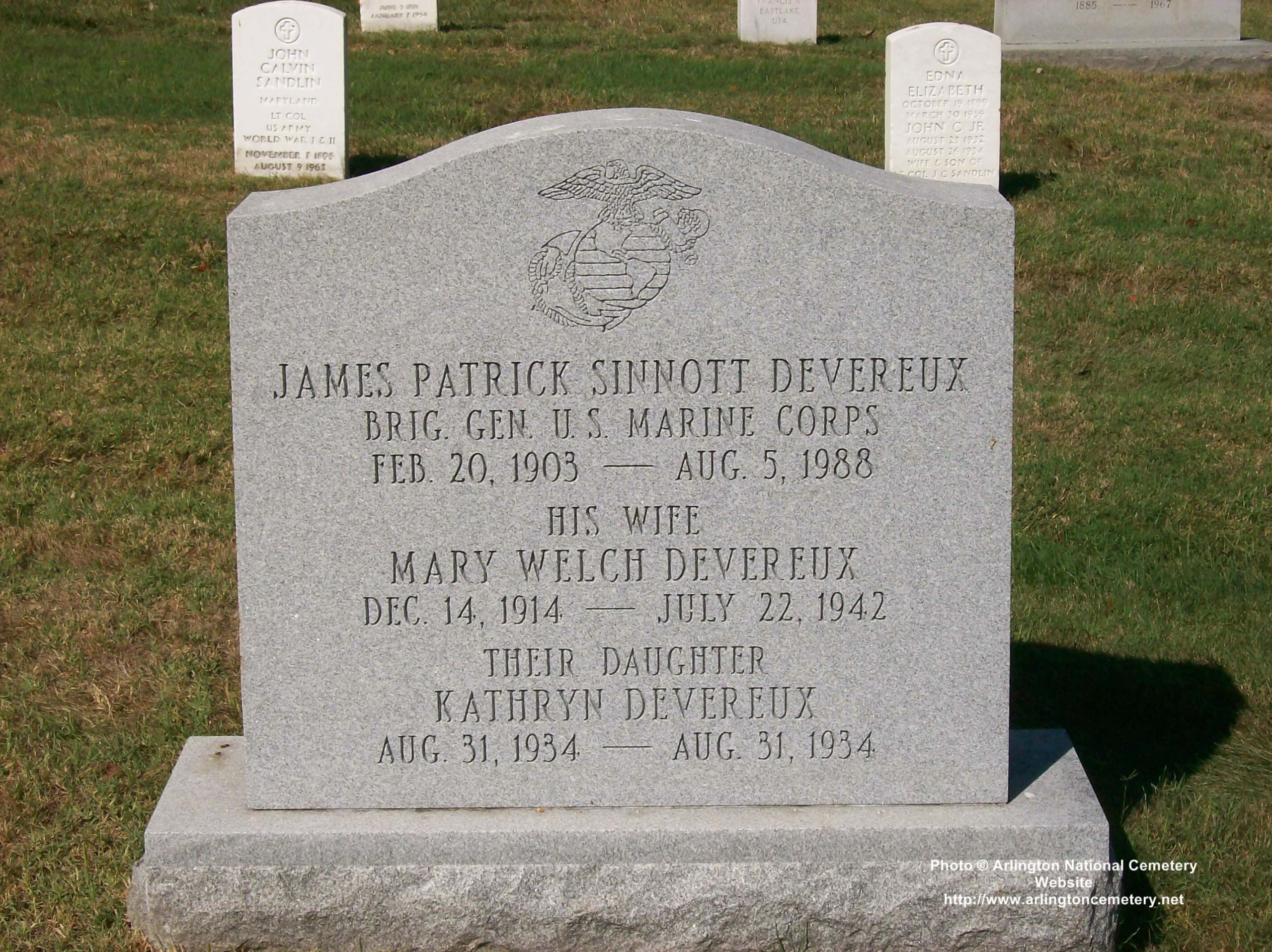
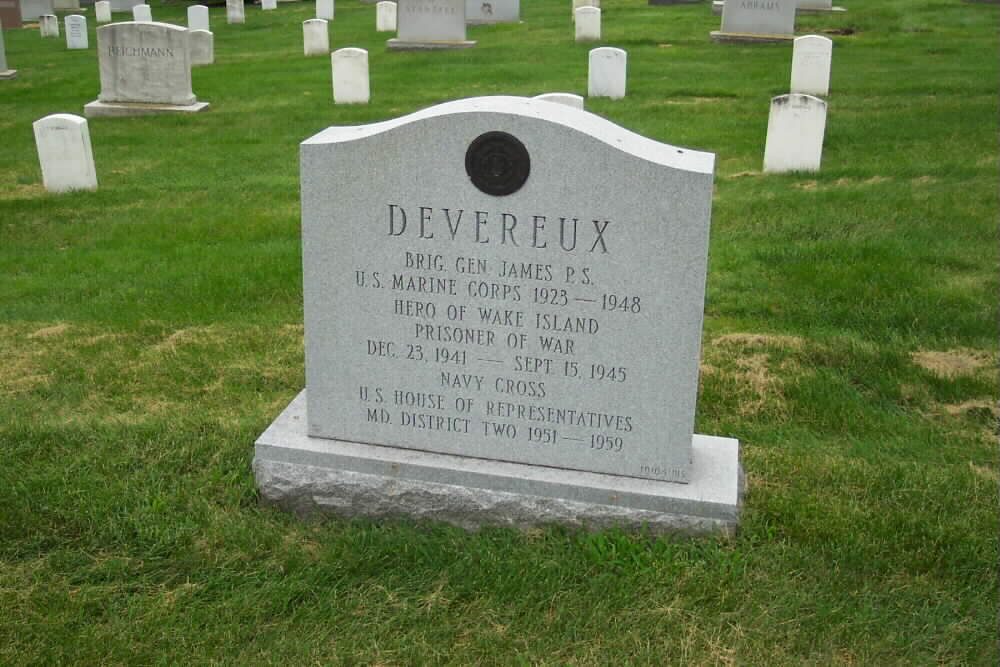
He and his wife and daughter are buried in Section 7 of Arlington National Cemetery, just a few feet from the gravesites of his father, mother and sister.
MRS. J. P. DEVEREUX,
HERO'S WIFE DIES
Stricken In Arlington, Virginia, After
Vain Attempt To Learn Fate
Of Wake Island Defender
DAUGHTER OF AN OFFICER
She Recently Left Governors
Island With Father For His
New Post In Richmond
Washington, July 24, 1942 – Mrs. James Patrick Sinnott Devereux, wife of Major Devereux, U.S. Marine Corps, who directed the epic fourteen-day defense of Wake Island, died yesterday at Doctors Hospital here. Her age was 27.
Long a sufferer from diabetis, Mrs. Devereux was stricken seriously ill on Monday and was taken to the hospital the next morning. She was then unconscious and remained so until the end. She died at 6:30 last night, without ever having heard from her husband since the fall of the Marine Detachment last December or knowing whethe ra message she had tried to send him through the International Red Cross had been delivered.
Devereux Reported In China
According to information received by the Red Cross last May, Major Devereux is a war prisoner of the Japanese in Shanghai.
With her were her son, James Patrick, 8 years old and her parents, Lieutenant Colonel and Mrs. John P. Welch, with whom she had been living on Governors Island, New York since October, when Major Devereux, because of her illness, sent her home from Honolulu for treatment in this country.
Under orders for duty in Richmond, Colonel Welch arrived with his family last Saturday and they were visiting relatives, Colonel and Mrs. Lionel Goudau, in Arlington, Virginia, on their way. Mrs. Devereux's fatal attack occurred on her return from the home of her husband's brother, Joseph S. Devereux, at 1 West Bradley Lanel with whose family she had spent the evening.
Family Tries To Locate Major
Members of the family today were making every effort to communicate through the Red Cross with Major Devereux.
As am Army girl and wife, Mrs. Devereux's life was spent “on station” and traveling from post to post with her father and husband.
The former Mary Welch was born at an Army post near Niagara Falls, New York, and lived on Bataan Peninsula and Corregidor Island from her fourteenth to her seventeenth year. When she was 17 she met Major Devereux, and instead of going to college, as her family had planned, she was married to him. Thereafter, in succession, she lived at Pearl Harbor, Quantico, Virginia, and San Diego, California, before making her last trip with Major Devereux to Honolulu.
Last Spring she came to Washington to visit Mrs. John Devereux, her husband's mother.
A funeral service will be held here tomorrow. Burial will be in Arlington National Cemetery.
The following message “to our men under arms” was delivered by Mrs. James Patrick Devereux when she appeared as guest of honor in New York on the “Women Can Take It” program under the auspicious of the Citizens COmmittee of the Army Behind the Army and Navy on June 22, over station WMCA.
“I say to them: You need not worry about your wives, your mothers, your daughters, or sweethearts. We women will do what we have to do. We will do the work we have to do. We will do without what we must do without. We will not complain that we are lonely, because we know you are not complaining – and all this for our country, for cus, for our very existence.”
Courtesy of the U.S. House of Representatives:
DEVEREUX, James Patrick Sinnott, a Representative from Maryland; born in Cabana, Cuba, February 20, 1903; attended the public schools of Maryland, the Army and Navy Preparatory School in Washington, D.C., the Tome School at Port Deposit, Md., LaVilla in Lausanne, Switzerland, and Loyola College, Baltimore, Md.; enlisted in the United States Marine Corps in 1923; commissioned a second lieutenant in 1925 and advanced through grades to brigadier general in 1948; served in Nicaragua, Cuba and China; prisoner of war from December 1941 to January 1945; retired from the service in 1948; engaged in farming near Glyndon, Md., in 1946; elected as a Republican to the Eighty-second and to the three succeeding Congresses (January 3, 1951-January 3, 1959); was not a candidate for renomination in 1958 but was an unsuccessful candidate for Governor; director of public safety for Baltimore County, December 1962 to 1966; was a resident of Ruxton, Md., until his death in Baltimore on August 5, 1988; interment in Arlington National Cemetery.
THE WHITE HOUSE
WASHINGTON
Citation by
THE PRESIDENT OF THE UNITED STATES
of
The Wake detachment of the 1st Defense Battalion, U.S. Marine Corps, under command of Major James P.S. Devereux, U.S. Marines and Marine Fighting Squadron 211 of Marine Aircraft Group 21, under command of Major Paul A. Putnam, U.S. Marines and Army and Navy personnel present.
“The courageous conduct of the officers and men who defended Wake Island against an overwhelming superiority of enemy air, sea, and land attacks from December 8 to 22, 1941, has been noted with admiration by their fellow countrymen and the civilized world, and will not be forgotten so long as gallantry and heroism are respected and honored. They are commended for their devotion to duty and splendid conduct at their battle stations under most adverse conditions. With limited defensive means against attacks in great force, they manned their shore installations and flew their aircraft so well that five enemy warships were either sunk or severely damaged, many hostile planes shot down, and an unknown number of land troops destroyed.”
FRANKLIN D. ROOSEVELT
Courtesy of the United States Marine Corps:
BRIGADIER GENERAL JAMES P. S. DEVEREUX, USMC (DECEASED)
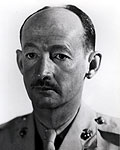
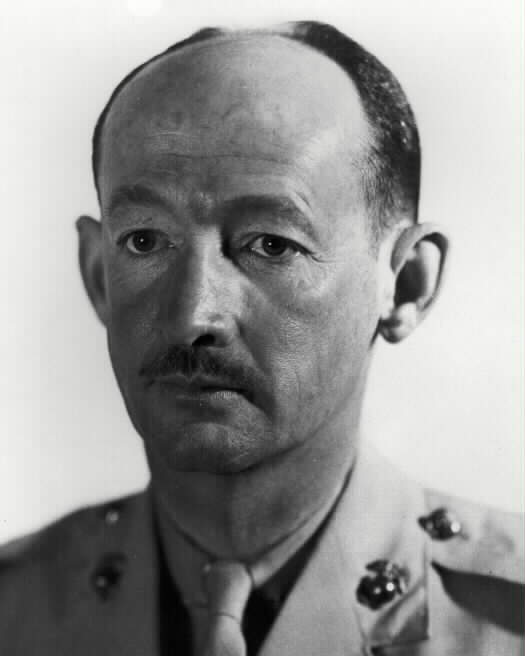
Brigadier General James P. S. Devereux, Commanding Officer of the 1st Defense Battalion during the heroic but futile defense of Wake Island in December 1941, died 5 August 1988 in Baltimore, Maryland.
For his gallant leadership in defending the tiny American outpost for 15 days against overwhelming odds, he was awarded the Navy Cross. His citation reads in part, “For distinguished and heroic conduct in the line of his profession in the defense of Wake Island…”
On the morning of 7 December 1941, (it was 8 December on Wake), he received the message that Pearl Harbor had been attacked by the Japanese. In the fight that followed, General Devereux, then a major, and his men added a brilliant page to the annals of the Marine tradition. They went down, but in doing so damaged two cruisers, sank two destroyers, one escort vessel, and destroyed or damaged a total of 72 aircraft, and probably sank one submarine. Two more destroyers were damaged the last day.
Born in Cabana, Cuba, on 20 February 1903, General Devereux attended the Army and Navy Preparatory School in Washington, D.C., Tome School, Port Deposit, Maryland, and later La Villa at Lausanne, Switzerland.
He served both as an enlisted man and as an officer. He enlisted in the Marine Corps in July 1923, was commissioned a second lieutenant in February 1925, and then was assigned to duty in Norfolk, Philadelphia, the Marine Barracks, Quantico, Virginia, and at Guantanamo Bay, Cuba. In 1926 he was detailed to the mail guard detachment in New York and later was transferred to the force of Marines in Nicaragua as a company officer.
Returning to the United States early in 1927, he was assigned to the USS Utah and subsequently was transferred ashore again to Nicaragua. Shortly thereafter he was ordered to the Orient and while in China was promoted to first lieutenant. Other duty in China included command of the Mounted Detachment of the Legation Guard at Peking. An expert horseman, he has always been associated with mounted activities at stations where he had been assigned.
In 1933, following a year's tour of duty at Quantico, he was assigned to the Coast Artillery School at Fort Monroe, Virginia. Following his promotion to captain in December 1935, he was ordered back to Quantico, where until 1936, he instructed in the Base Defense Weapons School and aided in the preparation of a Marine Corps manual on Base Defense Weapons. This knowledge was most useful later on the wind-swept coral atoll known as Wake Island.
Following a tour of duty with the Marine Detachment on board the USS Utah, General Devereux was transferred to the Marine Corps Base, San Diego, California, in 1938.
In January 1941, he was ordered to Pearl Harbor and later assumed command of the 449 Marines, who, after a bitter struggle, surrendered to the Japanese on 23 December 1941.
“After our capture we remained on Wake until January 12, when we were sent away on the Nita Maru,” stated General Devereux upon his release from the Japanese prison camp on Hokkaido Island in September 1945.
“We stopped at Yokohama where some of our officers debarked, but we continued to Woosung, China, downriver from Shanghai, arriving on the 24th of January 1942,” he added.”We remained there until December 9 of the same year, when we were transferred to Kiangwan, just outside of Shanghai, and there we spent 29 months… On that day we were sent to Fungtai, near Peiping, for five weeks and then were transferred to camps in central Hokkaido…”
While a prisoner of the Japanese, he was selected for promotion to lieutenant colonel, but it was announced that men who were listed as prisoners of war would not be able to assume their new rank. Therefore, it was not until shortly after his repatriation that his new rank became effective. He was promoted to colonel in January 1946, to rank from 10 November 1942, in order to assume his rightful place on the lineal list along with his contemporaries.
Upon returning to the United States following his release from prison camp in Hokkaido, General Devereux was ordered to Marine Corps Headquarters in Washington to narrate his personal account of the defense of Wake to General Alexander A. Vandergrift, then Commandant of the Marine Corps. He was given a rehabilitation leave, and late in 1945 was ordered to the Marine Corps Schools, Quantico, Virginia.
Later, from September 1946 to May 1947, he was assigned as a student in the Senior Course, Amphibious Warfare School at Quantico. Upon completion of his studies he was detached to the First Marine Division at Camp Pendleton, Oceanside, California, and was serving with that organization when he concluded his brilliant 25-year career on 1 August 1948.
General Devereux was advanced to his present rank upon retirement in accordance with law, having been specially commended for the performance of duty in actual combat.
In addition to the Navy Cross, General Devereux was awarded the Presidential Unit Citation with one star, Wake Island 1941; Second Nicaraguan Campaign Medal, Nicaragua 1927-29; Yangtze Service Medal, China 1930; Marine Corps Expeditionary Medal, China 1930; and Wake Island with Wake Island Clasp and Silver “W”; American Defense Service Medal with Base Clasp and one Bronze Star; Asiatic-Pacific Campaign Medal with one Bronze Star; and the World War II Victory Medal.
Brigadier General James P. S. Devereux, USMC
Citation:
The Wake detachment of the 1st Defense Battalion, U.S. Marine Corps, under command of Major James P.S. Devereux, U.S. Marines and Marine Fighting Squadron 211 of Marine Aircraft Group 21, under command of Major Paul A. Putnam, U.S. Marines and Army and Navy personnel present.
The courageous conduct of the officers and men who defended Wake Island against an overwhelming superiority of enemy air, sea, and land attacks from December 8 to 22, 1941, has been noted with admiration by their fellow countrymen and the civilized world, and will not be forgotten so long as gallantry and heroism are respected and honored. They are commended for their devotion to duty and splendid conduct at their battle stations under most adverse conditions. With limited defensive means against attacks in great force, they manned their shore installations and flew their aircraft so well that five enemy warships were either sunk or severely damaged, many hostile planes shot down, and an unknown number of land troops destroyed.
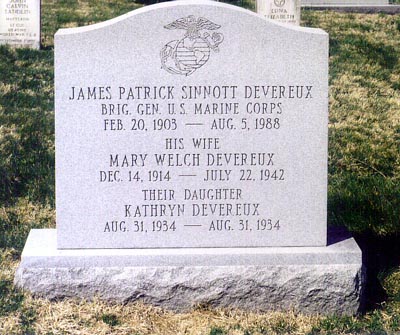
DEVEREUX, KATHRYN D/O JAMES P
- DATE OF DEATH: 08/31/1934
- BURIED AT: SECTION 7 SITE 10104
ARLINGTON NATIONAL CEMETERY - DAUGHTER OF JPS DEVEREUX, 1ST LT US MARINE CORPS
DEVEREUX, MARY WELCH W/O JAMES P S DEVEREUX
- DATE OF DEATH: 07/22/1942
- BURIED AT: SECTION 7 SITE 10104
ARLINGTON NATIONAL CEMETERY - WIFE OF JPS DEVEREUX, LIEUTENANT COLONEL US MARINE CORPS

Michael Robert Patterson was born in Arlington and is the son of a former officer of the US Army. So it was no wonder that sooner or later his interests drew him to American history and especially to American military history. Many of his articles can be found on renowned portals like the New York Times, Washingtonpost or Wikipedia.
Reviewed by: Michael Howard