
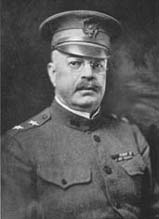
 Joseph Theodore Dickman was born on October 6, 1857, in Dayton, Ohio. He was commissioned in the 3rd Cavalry upon graduation from West Point in 1881. He served in the Geronimo campaign and on the Mexican border patrol in operations
against the Garza revolutionists and in the capture of the outlaws, Benavides and Gonzales.
While at Fort Riley, Kansas (1893-94) as an instructor at the Cavalry and Light Artillery School, his command was on duty in the Chicago railroad strike in 1894 before he was transferred to Fort Ethan Allen, Vermont.
During the Spanish-American War, Captain Dickman served in the Santiago campaign on the staff of General Joseph Wheeler.
He saw action against insurgents during the Philippine Insurrection in the Island of Panay in 1899-1900 and was promoted to major and lieutenant colonel in a volunteer infantry regiment.
He served as Chief of Staff to General Adna R. Chaffee during the Peking Relief Expedition which followed the Boxer Uprising in China in 1900. While there he saw action in the engagement at Pa-ta-Chao temples, near Peking, on Sept. 26, 1900.
In 1902 he was named to the first General Staff. He graduated from the Army War College in 1905.
He was promoted to Major in March 1906, Lieutenant Colonel in February 1912, and Colonel in December 1914. In May 1917 he was promoted to Brigadier General and in August he became a temporary Major General in command of the 85th Infantry Division, Camp Custer, Michigan.
In November 1917 he commanded the 3rd Infantry Division and took them to France in March 1918. The 3rd Infantry Division saw combat at Chateau-Thierry on May 31 and held the Marne crossings against tremendous offensives while French lines on either side fell back. For this, the 3rd became known as the “Rock of the Marne.”
In August 1918 he took over the IV Corps, participating in the St. Mihiel offensive. In October he commanded the I Corps during the Meuse-Argonne offensive.
In November he became the first commander of the Third Army, formed by General Pershing to hold the Coblenz bridgehead and to serve after the war as the Army of Occupation.
After the war, Major General Dickman turned over command of the Third Army to Lieutenant General Hunter Liggett and, as president of a board, prepared and submitted a lessons learned report before returning to the United States to take command of the Southern Department and the VIII Corps Area.
Major General Dickman retired October 6, 1921, but was recalled in 1922 to serve as president of the board charged with the removal of officers from active duty in conjunction with legislation enacted to downsize the force.
Major General Dickman died in Washington, D.C., October 23, 1927, at age 70. He was well-regarded as one of the ablest of officers of the World War, a military scholar, and a natural leader of men.
He was a member of the Military Order of the Loyal Legion, the Society of Indian Wars, the Society of Santiago de Cuba and the Military Order of the World War.
Included among his awards and decorations are: the Distinguished Service Medal; Croix de Guerre, France; Order of Leopold, Belgium; Grand Officer of the Crown of Italy; Commander of the Legion of Honor, France; Knight of the Bath, England; and La Solidaridad, Panama. The honorary degree of LL.D. was conferred on him by the University of Vermont.
- Cavalry School, 1883
- Apache War, 1885-86
- Geronimo Campaign
- Mexican border patrol
- operations against Garza revolutionists and the bandits,
- Benavides and Gonzales.
- Instructor, Cavalry and Light Artillery School, Fort Riley, 1893-94.
- Deployed to Chicago railroad strike in 1894.
- Fort Ethan Allen, Vermont, 1894
- Spanish-American War, 1898
- Battle of San Juan Hill-El Caney, Santiago de Cuba
- Service on staff of General Joseph Wheeler
- Philippine Insurrection, 1899-1902
- Battles on Island of Panay, 1899-1900
- Boxer Rebellion, 1900
- Chief of Staff to General Adna R. Chaffee, Peking Relief Expedition
- Battle at Pa-ta-Chao, Peking, 26 September 1900
- Army General Staff, Washington, D.C., 1902
- Army War College, 1905
- Inspector General, U.S. Army, 1912
- Commander, 2nd Calvary, 1915-17
- Brigadier General, May 1917
- Commanding General, 85th Infantry Division, Camp Custer, Michigan, August 1917
- Commanding General, 3rd Inf. Div., Nov. 1917
- Deployed 3rd Div. to France aboard the Leviathan at noon, 4 March 1918
- Chateau-Thierry, May 1918
- Marne II Offensive, July 1918. While allied forces on both flanks retreated, the 3rd Div. stood fast in the face of fantastic enemy offensives, thus becoming known as, “The Rock of the Marne.”
- Commanding General, IV Corps, Aug.-Sep. 1918
- Saint-Mihiel Offensive, Sep. 1918
- Commanding General, I Corps, Oct.-Nov. 1918
- Meuse-Argonne Offensive, Sep.-Nov. 1918
- Commanding General, Third Army, Nov. 1918-Apr. 1919
- Established by General Pershing in France to advance to the Rhein and hold the Coblenz bridgehead, then prepare to serve after the war as the Army of Occupation. The Third Army would have become the Army of Occupation whether or not the enemy signed the peace agreement. American fighting units not sent home were consolidated under Third Army and prepared to attack if Germany did not accept the terms of peace. The United States itself was not to sign the agreement but remained technically at war with Germany for two more years.
- President, Tactics and Organization Board, which reported on lessons learned during the war, April-July 1919.
- Commanding General, Southern Dept. and VIII Corps Area, 1919-21
- Retired 6 October 1921
- Recalled to preside over postwar-Army downsizing board, 1922.
GENERAL DICKMAN’S FUNERAL
He Will be Buried in Arlington Tomorrow With Military Honors
WASHINGTON, October 24, 1927 – Major General Joseph T. Dickman will be buried in Arlington National Cemetery tomorrow with full military honors. Chaplain John T. Axton, Jr. will officiate at the grave, in the southern section, near the tomb of General Nelson A. Miles. The escort will consist of the United States Army Band, Headquarters Troop of the Third Cavalry, Battalion C of the Sixteenth Field Artillery and the Thirteenth Regiment of Engineers.
The pallbearers will be Major General Merritte W. Ireland, Surgeon General of the Army; Brigadier Generals William J. Nicholson, Thomas H. Stevens and Joseph A. Gaston, all retired; Colonels Albert E. Saxton and William Shrunk, both retired; Colonel M. R. Hilgard of the Quartermaster Corps and Lieutenant Colonel A. B. Coxe of the Cavalry.
Regret of the Army over the death of General Dickman was official voiced today by F. Trubee Davison as Acting Secretary of War.
“The death of General Dickman,” he said, “must occasion regret to all who have knowledge of his eminent career. Not only is he the first to pass from the small group of our Army commanders in the World War, but his military service typified the highest degree of personal attainments. During his active duty in the Army for a period of over forty-five years he participated in every war to which his country was a party. By diligent application to study and by constant devotion to duty he demonstrated the highest attributes of the military profession.”
DICKMAN, JOSEPH T
- MAJ GEN USA RET OHIO
- VETERAN SERVICE DATES: Unknown
- DATE OF DEATH: 10/23/1927
- DATE OF INTERMENT: Unknown
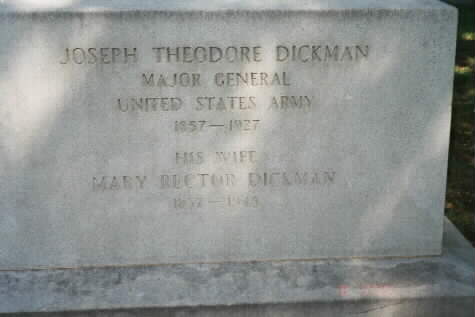
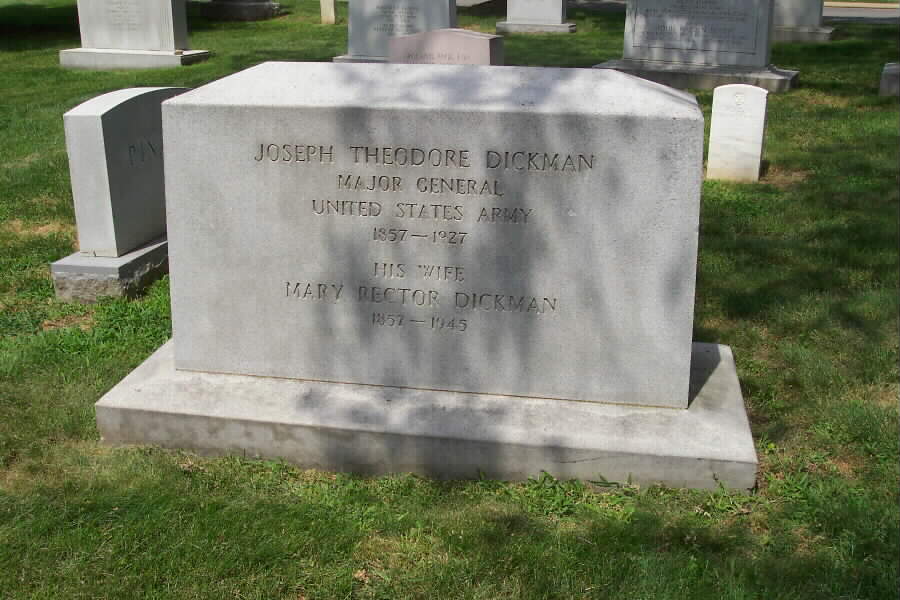
- BURIED AT: SECTION S.N. SITE LOT 2537
- ARLINGTON NATIONAL CEMETERY
DICKMAN, MARY RECTOR WIDOW OF JOSEPH T
- DATE OF DEATH: 12/11/1945
- DATE OF INTERMENT: 01/12/1946
- BURIED AT: SECTION SOUTH SITE 2537
- ARLINGTON NATIONAL CEMETERY
- WIFE OF JOSEPH T. DICKMAN – MAJOR GEN USA

Michael Robert Patterson was born in Arlington and is the son of a former officer of the US Army. So it was no wonder that sooner or later his interests drew him to American history and especially to American military history. Many of his articles can be found on renowned portals like the New York Times, Washingtonpost or Wikipedia.
Reviewed by: Michael Howard