
In the year 1811, Marines commanded by Captain John Williams operated with the Navy, Army, and Georgia volunteers in East Florida, participating in the so-called Patriots' War. Although Florida was at the time a Spanish possession, the United States Government feared that Great Britain was about to take possession of East Florida. The situation was complicated by the fact that our non importation laws had resulted in a considerable smuggling trade of British goods from East Florida into Georgia. Amelia Island, off the coast of Florida, was being used as the major haven for the smugglers.
When Congress authorized steps to be taken regarding the possible seizure of East Florida, the Navy sent a number of gunboats to the vicinity ostensibly to break up the smuggling trade. A detachment of two officers and 47 Marines went on the ship Enterprise to assist in the operations. On May 4 during the same year, Marines established a regular garrison at Cumberland Island, just off the coast of southeastern Georgia. Later, on March 17, 1812, American gunboats under Commodore Hugh Campbell, along with Marine and Army personnel, assisted local patriots, who had been organized and armed in Georgia and induced to fight by promises of land grants, in the capture of Fernandina on Amelia Island. As soon as the patriots had taken the garrison, held by 10 Spanish soldiers, Army and Marine personnel occupied the island. The patriots, followed by the Army troops, then advanced by marching and in boats furnished by the Navy on St. Augustine, leaving the Marines to hold Amelia.
Shortly thereafter, the Army and the patriots found themselves involved with maintaining a difficult line of communications through hostile Indian country and called upon Captain Williams' Marines to escort wagon trains and other convoys en route to their advanced position near St. Augustine. On September 12, 1812, while convoying a wagon train and some volunteer troops, Captain Williams and his men were ambushed by a large band of Indians. This action resulted in one member of the detachment being killed and scalped by the Indians and the wounding of seven others. Captain Williams was wounded eight times during the fight and later died on September 29. As a result of Williams' death, Lieutenant Alexander Sevier assumed command of the Marines and continued to fight the Indians in other engagements during the remainder of the year. By this time, the War of 1812 had begun, but Lieutenant Sevier and his men stayed on in East Florida until May 13, 1813, at which time they withdrew by sea and returned to Washington in time to take part in the effort to save the capital.
Another threat to Spanish control occurred in the Patriot Rebellion that started on March 13, 1812. John Houston McIntosh was the leader of this rebellion that was supported by the U.S. government. Governor Juan de Estrada stopped them at Fort Mose (almost the gates of St. Augustine). In June of 1812 the new governor, Sebastian Kindelan worked with the Seminoles to enlist them in a fight against the invaders. After an ambush of Captain John Williams (U.S.M.C.) by Seminoles and blacks the Americans pulled back to the St. Johns River. By May, 1813 the American troops were gone. Prince Witen the son-in-law of Biassou was the leader of the black militia that defeated Captain Williams.
The official report: Marines escorting a convoy of supply wagons were ambushed by an irregular force of Native Americans and African Americans in the Twelve Mile Swamp near the St. John's River, East Florida, on 11 September. 1812, Two Marines KIA, Seven Marines WIA.
In the little known War in Florida against the Spanish Colony therein, in mid-September, Captain John Williams, USMC, with Twenty men had tried to get to the St. Johns River of Florida to bring supplies to the beleaguered American Forces cut-off there by the Seminole Forces of Spain, these same forces were brought to near starvation by the Seminole Warriors.
As the wagon train of Captain Williams entered the large swamp west of St. Augustine, a band of Seventy Black Seminoles and Six Tribal Seminoles attacked the wagons. They killed two Americans, and they wounded seven of them. Captain Williams, a Marine in the grand tradition of the Corps, suffered Eight wounds before he fell: a broken right arm, a ball in his left thigh near the groin, a punctured stomach, three holes in his right hand, one in his shoulder, and one in his left leg. He lingered in great pain for two weeks before dying on September 29th, 1812.
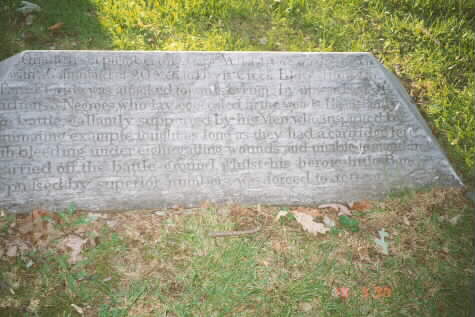
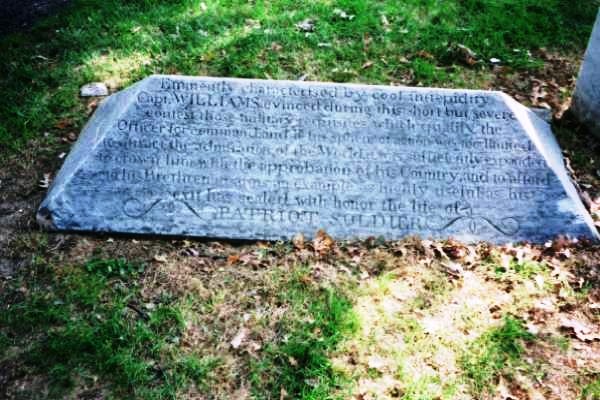
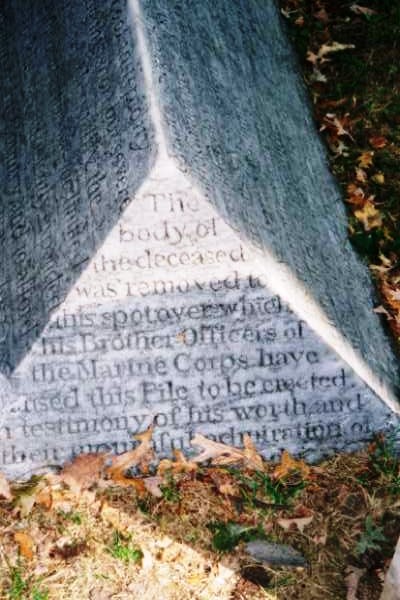
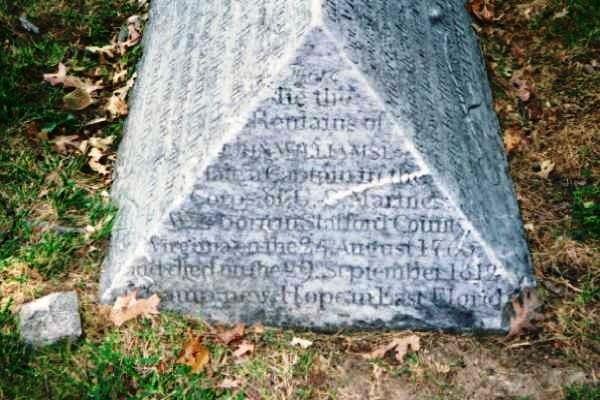
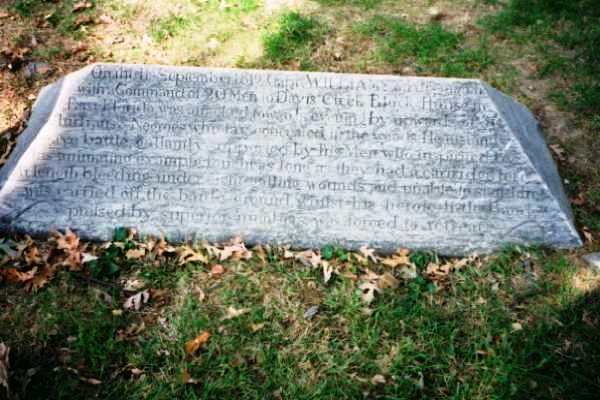
Killed in a battle with Indians on the Georgia-Florida border in 1812, he was originally buried by his men in Georgia and eventually moved to Arlington National Cemetery in August 1904, under a private memorial consisting of separate rocks in Section 1. Around the rocks is inscribed the following:
“Here lie the remains of John Williams, late a Captain in the Corps of Marines who was born in Stafford County, Virginia on the 24th of August 1785 and who died on the 29th of September 1812 at Camp New Hope in East Florida. On 29 September 1812, the Captain, on patrol with a command of twenty men to Davis Creek Block-House in East Florida, was attacked towards evening by upwards of 350 Indian and Negroes who lay concealed in the woods. He instantly gave battle gallantly supported by his men, who inspired by his animating example fought as long as they had a cartridge left. At length, bleeding under eight galling wounds, and unable to stand, he was carried off the battlefield whilst his heroic little band prefesed by superior numbers was forced to retreat. Eminently characterized by cool intrepidity, Captain Williams, envied, during this short but severe contest, those military requisites, which qualify the officer for command and if his sphere of action was too limited to attract the admiration of the world, it was sufficiently expanded to crown his with the approbation of his country, and to addled to his brethren in arms, an example as highly useful, as his exit was sealed with honor the life of a patriot-soldier. The body of the deceased was removed to this spot over which his brother officers of the United States Marine Corps, having used this pile to be entered in testimony of his worth and their eternal admiration of his gallant end.”
On July 25, 1812, two hundred Seminole warriors from the Alachua towns and Alligator Hole and forty black warriors attacked the plantations along the St. Johns River which were owned by Patriots. This attack caused fear in the Georgia militia and many desertions. More escaped slaves joined the Seminole forces causing Colonel Smith to write: “(The Seminoles) have… several hundred fugitive slaves from the Carolinas & Georgia at present in their towns & unless they are checked soon they will be so strengthened by (more) desertions from Georgia and Florida… (I)t will be found troublesome to reduce them.”
The Seminoles and Africans attacked a group of U.S. Marines and Georgia militia escorting two wagons from the Patriot camp near St. Augustine to the St. Johns River. In the Twelve Mile Swamp, Prince Witen, a free black, led a troop of fifty Africans in the attack. Marine Captain John Williams who commanded the U.S. force was hit eight times. Captain Tomlinson Fort and six privates were also wounded. Captain Williams abandoned the wagons, rallied his troops and escaped. The Seminoles had effectively cut the U.S. supply route.
When Congress authorized steps to be taken regarding the possible seizure of East Florida, the Navy sent a number of gunboats to the vicinity – ostensibly to break up the smuggling trade. A detachment of two officers and 47 Marines went on the ship Enterprise to assist in the operations. On May 4 during the same year, Marines established a regular garrison at Cumberland Island, just off the coast of southeastern Georgia. Later, on March 17, 1812, American gunboats under Commodore Hugh Campbell, along with Marine and Army personnel, assisted local patriots, who had been organized and armed in Georgia and induced to fight by promises of land grants, in the capture of Fernandina on Amelia Island. As soon as the patriots had taken the garrison, held by 10 Spanish soldiers, Army and Marine personnel occupied the island. The patriots, followed by the Army troops, then advanced by marching and in boats furnished by the Navy on St. Augustine, leaving the Marines to hold Amelia.
Shortly thereafter, the Army and the patriots found themselves involved with maintaining a difficult line of communications through hostile Indian country and called upon Captain Williams' Marines to escort wagon trains and other convoys en route to their advanced position near St. Augustine. On September 12, 1812, while convoying a wagon train and some volunteer troops, Captain Williams and his men were ambushed by a large band of Indians. This action resulted in one member of the detachment being killed and scalped by the Indians and the wounding of seven others. Captain Williams was wounded eight times during the fight and later died on September 29. As a result of Williams' death, Lieutenant Alexander Sevier assumed command of the Marines and continued to fight the Indians in other engagements during the remainder of the year. By this time, the War of 1812 had begun, but Lieutenant Sevier and his men stayed on in East Florida until May 13, 1813, at which time they withdrew by sea and returned to Washington in time to take part in the effort to save the capital.
WILLIAMS, JOHN
- CAPT U S M C
- VETERAN SERVICE DATES: 06/17/1804-09/29/1812
- DATE OF DEATH: 09/29/1812
- DATE OF INTERMENT: 08/1904 (Reinterred)
- BURIED AT: SECTION 1 (WEST) SITE 158
- ARLINGTON NATIONAL CEMETERY

Michael Robert Patterson was born in Arlington and is the son of a former officer of the US Army. So it was no wonder that sooner or later his interests drew him to American history and especially to American military history. Many of his articles can be found on renowned portals like the New York Times, Washingtonpost or Wikipedia.
Reviewed by: Michael Howard