
Born at Floyd Court House, Virginia, August 18, 1846, he grew up from the age of ten in Washington, D.C.
By means of a legal subterfuge, he was appointed to the United States Naval Academy from Utah Territory at 13 and in October 1863 was commissioned an Acting Ensign.
The spirit that later inspired his nickname in the Navy, “Fighting Bob Evans,” was first demonstrated at Fort Fisher, North Carolina, on January 15, 1865, when, at the head of a Company of Marines landed from Admiral David G. Farragut's squadron, he continued to fight after sustaining four bullet wounds and then prevailing upon Congress for reinstatement after he head been invalided out of the service. It was also reported that following his wounding, Naval surgeons recommending amputating his legs at the knees. He drew his pistol and threatened to kill any man who attempted to do so.
For over three decades that followed the Civil War, he made numerous and diverse contributions to the United States Navy, including the invention of a signal lamp, effective agitation for the construction of a steel Navy, and highly successful commands at sea which combined seamanship with practical diplomacy.
His most notable services came while he was commanding the Gunboat Yorktown in Chilean waters in November-December 1891, where his actions following the killing of U.S. sailors from the USS Baltimore, commanded by Captain Winfield Scott Schley, by a mob in Valparasio in October earned his nickname. In the Bering Sea Sealing Dispute in 1892, he again displayed both firmness and tact while in command of a flotilla patrolling an internationally sensitive area. At the opening of the Spanish-American War in 1898, he was in command of the USS Iowa, which began the attack on the Spanish Fleet at Santiago, Cuba.
Advanced to Lieutenant in July 1866; to Lieutenant Commander, March 1868; to Commander, July 1878; to Captain, June 1893 and to Rear Admiral, February 1901.
In 1902, he was named Commander of the Asiatic Fleet, a post that he held for two years. In 1905-7, he was the Commander of the Atlantic Fleet. In the latter year, he was chosen to command a around-the-world cruise of the U.S. Battle Fleet, ordered as a demonstration of U.S. Naval power by President Theodore Roosevelt. The Fleet consisted of sixteen battleships, and the Fleet sailed from Hampton Roads, Virginia, on December 16. At Magdalena Bay, California, he fell ill and on reaching San Francisco on May 6, 1908, he was compelled by his illness to relinquish his command. He officially retired from the Service in August. He was thereafter the author of “A Sailor's Log: Recollections of Forty Years of Naval Life,” in 1901 and “An Admiral's Log: Continued Recollections of Naval Life,” in 1910.
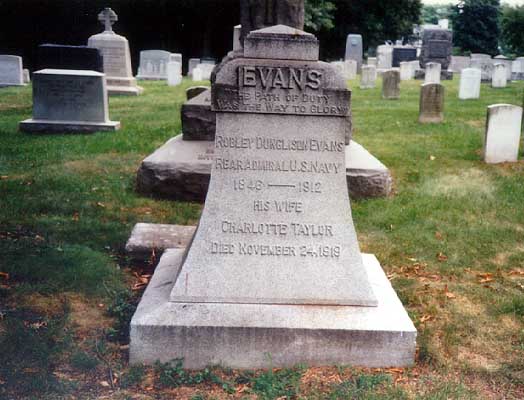
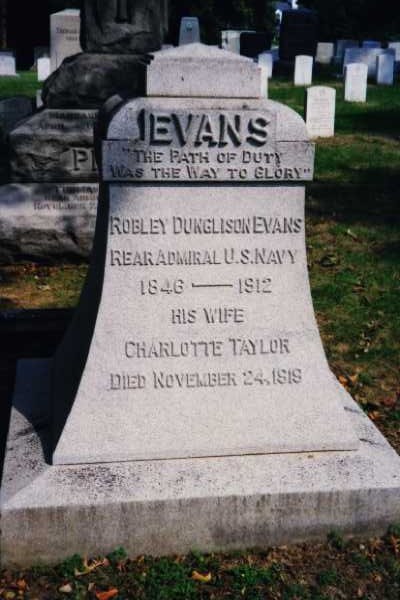
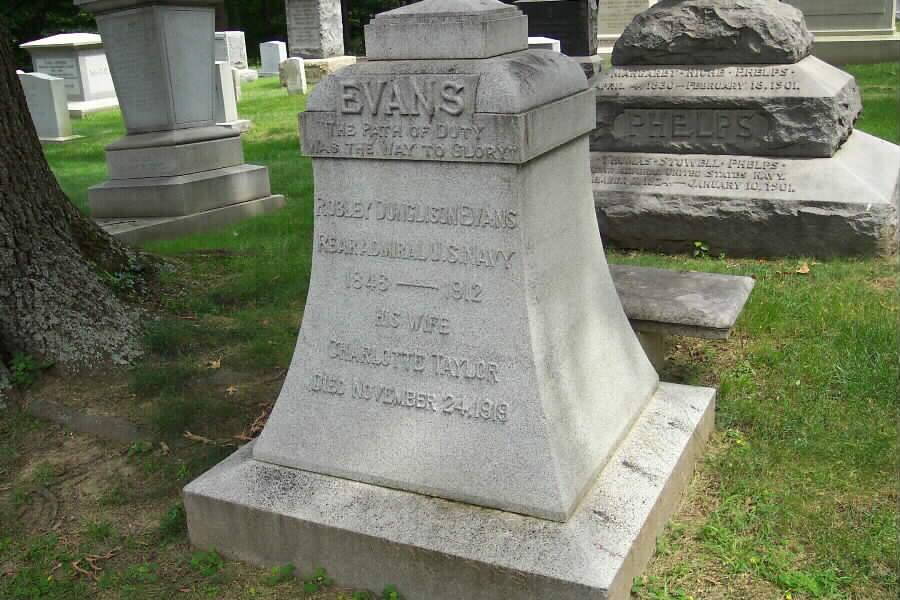
He died at Washington, D.C. on January 3, 1912 and was buried in Section 1 of Arlington National Cemetery among other members of his family, including his wife Charlotte Taylor Evans, who was the sister of Henry Clay Taylor, Rear Admiral, United States Navy.
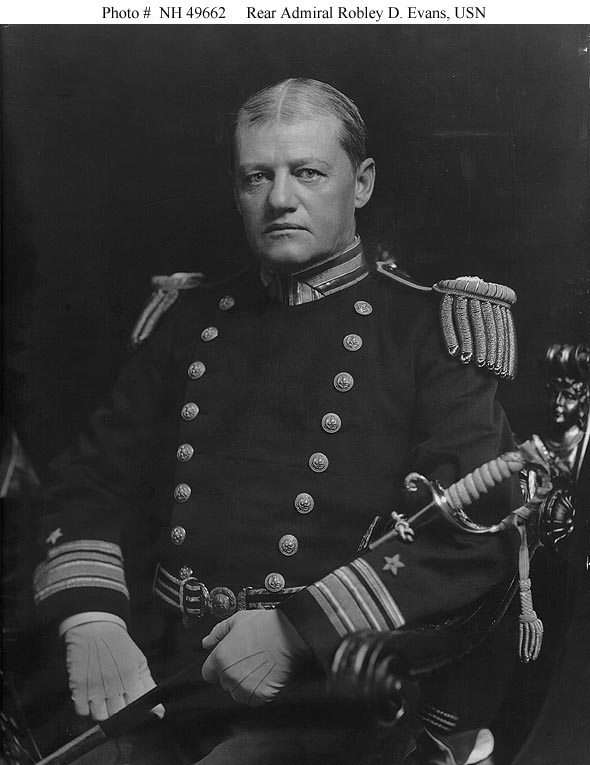
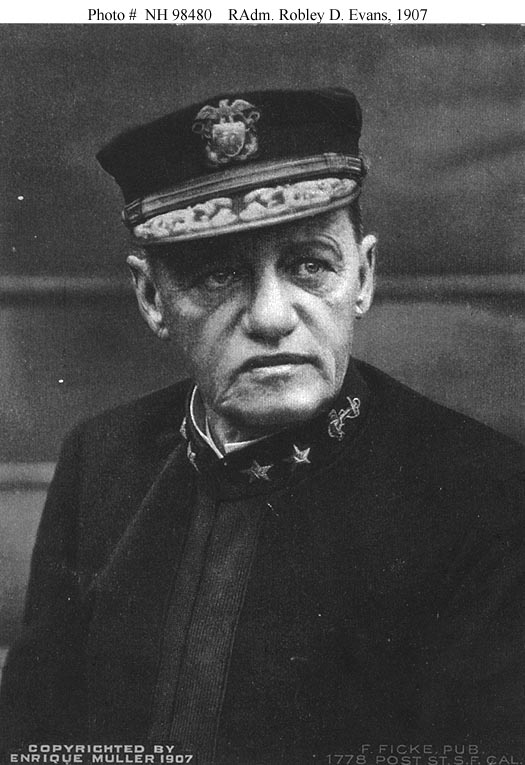
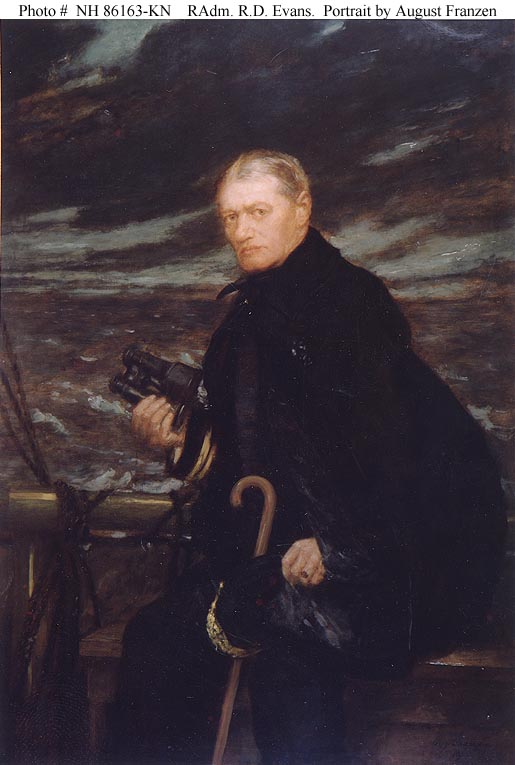
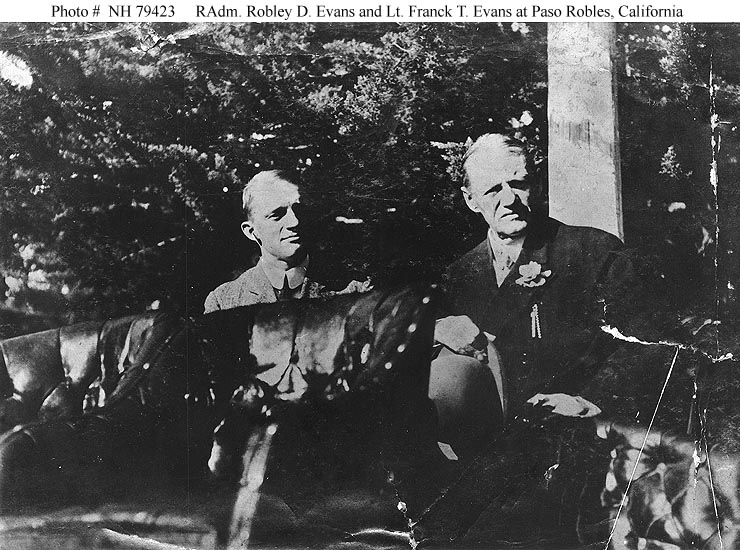
Evans died 3 January 1912. His obituaries described him as personal friends of Admiral Dewey, Admiral Prince Henry of Prussia, Admiral Prince Louis of Battenberg (British royalty) and British Admiral Lord Charles Beresford. Rudyard Kipling also knew him personally and wrote this poem as a tribute to Evans:
Admiral Evans
Zogbaum draws with a pencil,
And I do things with a pen.
And you sit up in a conning tower
Bossing eight hundred men.
Zogbaum takes care of his business
And I take care of mine.
And you take care to ten thousand tons,
Sky-shooting through the brine.
Zogbaum can handle his shadows
And I can handle my style.
And you can handle a ten-inch gun
To carry seven mile.
“To him that hath shall be given.”
And that's why these books are sent
To the man who had lived more stories
Than Zogbaum or I could invent
SEWALL, ROBLEY E C/O EVANS, R D
DATE OF DEATH: 05/03/1908
DATE OF INTERMENT: Unknown
BURIED AT: SECTION W DIV SITE 501
ARLINGTON NATIONAL CEMETERY
GRANDSON OF RD EVANS – R ADM U S N
EVANS, ROBLEY D
REAR ADM USN
VETERAN SERVICE DATES: Unknown
DATE OF DEATH: 01/03/1912
DATE OF INTERMENT: Unknown
BURIED AT: SECTION W SID SITE LOT 501
ARLINGTON NATIONAL CEMETERY
EVANS, CHARLOTTE TAYLOR WID/O ROBLEY D
DATE OF DEATH: 11/24/1919
DATE OF INTERMENT: Unknown
BURIED AT: SECTION WE SITE LOT 501
ARLINGTON NATIONAL CEMETERY
WIFE OR RD EVANS – REAR ADM USN
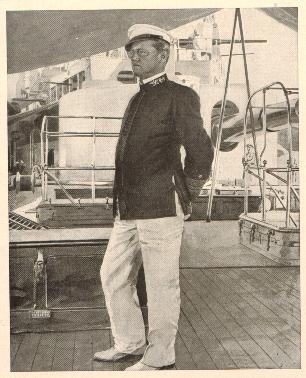
Photo courtesy of the National Archives
POSSIBLE RELATIVE:
Robley D. Evans (18 May 1907 – 7 Jan 1996) Nuclear Physicist.
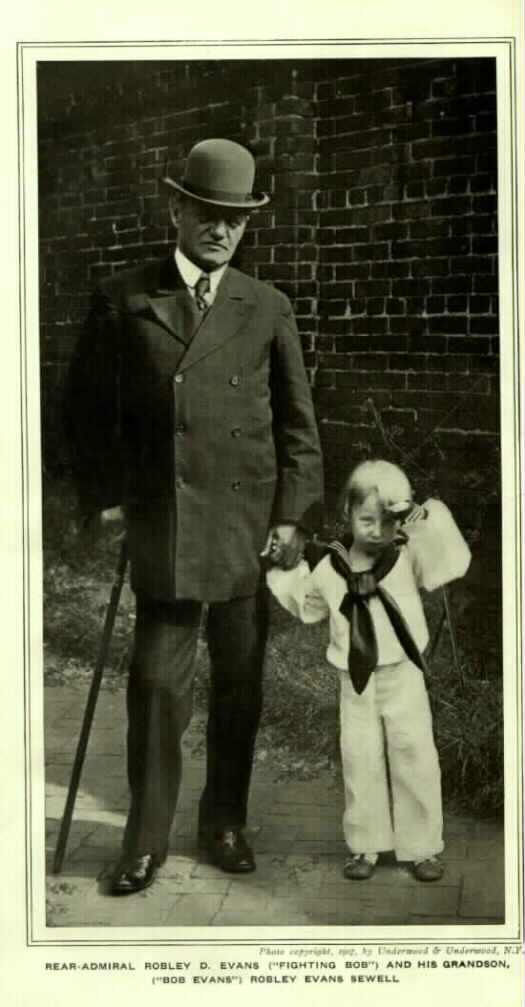
Thanks to Chris Rasmussen for the photo.

Michael Robert Patterson was born in Arlington and is the son of a former officer of the US Army. So it was no wonder that sooner or later his interests drew him to American history and especially to American military history. Many of his articles can be found on renowned portals like the New York Times, Washingtonpost or Wikipedia.
Reviewed by: Michael Howard