

Robert Frederick Sink, XVIII Airborne Corps, Strategic Army Corps and Fort Bragg Commander, was born in Lexington, North Carolina, on April 3, 1905. The General had a distinguished career in the Army both as a combat leader and administrator. His duties ranged from those of a second lieutenant of infantry to commanding general of the Strategic Army Corps.
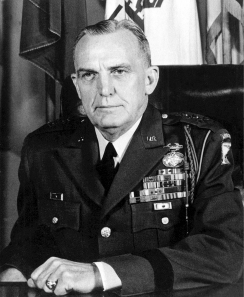
He graduated from the United States Military Academy at West Point, New York, June 14, 1927.
His first assignment as a Second Lieutenant was with the Eight Infantry at Fort Screven, Georgia. In November 1929, he was assigned to the 65th Infantry at San Juan, Puerto Rico. In March 1932, he joined the 34th Infantry at Fort Meade, Maryland and remained with this unit until July 1933 when he was assigned to duty with the Civilian Conservation Corps at McAlevy’s Fort, Pennsylvania until December of that same year. He then returned to the 34th Infantry.
Following graduation from the Infantry School, Fort Benning, Georgia, in September 1934, he was assigned to the 57th Infantry at Fort McKinley, Philippine Islands. He returned to the United States in November 1937, and was assigned to the 25th Infantry at Fort Huachuca, Arizona, where he served successively as company commander and regimental operations officer.
General Sink’s first encounter with the airborne took place in November 1940 when he was assigned to the 501st Parachute Infantry Battalion at Fort Benning. He later commanded the 503d Parachute Infantry Battalion and the 5033d Parachute Infantry Regiment. In July 1942 he was named as commander of the 506th Parachute Infantry Regiment at Toccata, Georgia; Fort Benning, Georgia; and Fort Bragg, North Carolina.
In September 1943, he moved to Europe with that regiment, commanding it until the end of hostilities there. On August 12, 1945, General Sink was named assistant division commander of the 101st Airborne Division.
In December 1945, General Sink returned to the United States, and the following month assumed command of the infantry detachment of the United States Military Academy. He entered the National War College at Washington, DC in August 1948, graduating in June 1949.
General Sink then was transferred to the Ruckus Command, and became chief of staff in October 1949. In January 1951, he was named assistant commander of the Seventh Infantry Division in Korea.
He returned to the United States and became assistant commander of the 11th Airborne Division at Fort Campbell, Kentucky, in December 1951. In February 1953, he assumed command at the Seventh Armored Division at Camp Roberts, California. In November 1953, he became commanding general of the 44th Infantry Division At Fort Lewis, Washington.
In October 1954, General Sink was assigned to the Joint Airborne Troop board at Fort Bragg, North Carolina. In early 1955, General Sink was transferred to Rio de Janeiro, Brazil, and in April 1955 assumed the dual functions of chairman of the United States Delegation to the Joint Brazil-United States Military Commission and chief of army section, Military Assistance Advisory Group, Brazil.
He returned to the United States and assumed Command of the XVIII Airborne Corps and Fort Bragg in May 1957. In May 1958, he was announced as commander, Strategic Army Corps (STRAC), United States Army.
His last major command was as commander of United States forces in Panama.
Lieutenant General Robert Frederick Sink retired in 1961. He died on 13 December 1965.
Date of Birth: 3 April 1905
Place of Birth: Lexington, North Carolina
Married and had three children, two step-children
Education:
United States Military Academy, West Point, New York, 1927
Chemical Warfare School, 1932
The Infantry School, 1935
The Parachute School, 1941
Armed Forces Staff College (Equivalent), 1947
National War College, 1949
List of Citations, Decorations and Awards:
Silver Star medal with two oak leaf clusters
Legion of Merit with one oak leaf cluster
Air Medal with one oak leaf cluster
Distinguished Unit Citation with one oak leaf cluster
American Defense Service Medal
American Campaign Medal
Occupation of Germany Medal
Combat Infantry Badge
Occupation of Japan Medal
Korean Service Medal
Korean Presidential Citation
Allied Decorations:
Croix de Guerre avec Palme (Belgium)
Belgian fourragere
Netherlands Orange Lanyard
Belgian L’Orde de Leopold, Grade de Officier, avec Palme
Brench Croix de Guerre avec Palme
Distinguished Service Order (Britain)
Bronze Lion Decree of the Netherlands
General Sink was a master parachutist who made two combat jumps.
Obituary from the Washington Evening Star, 15 December 1965.
Lieutenant General Robert F. Sink, Helped Form Paratroops
Retired Army Lieutenant General Robert F. Sink, 60, who helped form the paratroops in World War II, died at Womack Army hospital at Fort Bragg, North Carolina, Monday.
He became ill at his home in Lexington, North Carolina, and was taken to a hospital there before he was transferred to Womack.
Sink, a colorful general known for making parachute jumps with his troops in training exercises, commanded the Army’s STRAC (Strategic Army Corps) forces after it was formed in 1958.
STRAC, a four-division striking force of more that 125,000 men, was especially tailored to fight a limited war anywhere in the world. The force includes the 82nd Airborne Division at Fort Bragg, North Carolina, the 101st Airborne at Fort Campbell, Kentucky, the 1st Infantry at Fort Riley, Kansas, and the 4th Infantry at Fort Lewis, Washington.
Sink was former commander both of Fort Bragg and of its XVIII Airborne Corps. His last major assignment was as commander of United States Forces in Panama. He retired from the Army in 1961.
A West Point graduate in the class of 1927, Sink organized, trained and led the hand-picked 506th Airborne Regiment of the 101st Airborne during world War II.
The outfit, known to its members as the Five-Oh-Sink, was at Bastogne on 22 December 1944, when the Germans had surrounded American forces commanded by General Anthony McAuliffe and demanded surrender or face “annihilation by artillery.” Sink was one of the commanders to whom fell the duty of backing up McAuliffe’s famous reply: “Nuts.”
Sink was one of the four percent of the army’s paratroopers qualified as a master parachutist and celebrated his birthday each year by making another jump.
He was a native of Lexington, North Carolina and attended Trinity College, now Duke University, one year before going to West Point.
He was promoted to Lieutenant General in 1959 while commanding Fort Bragg.
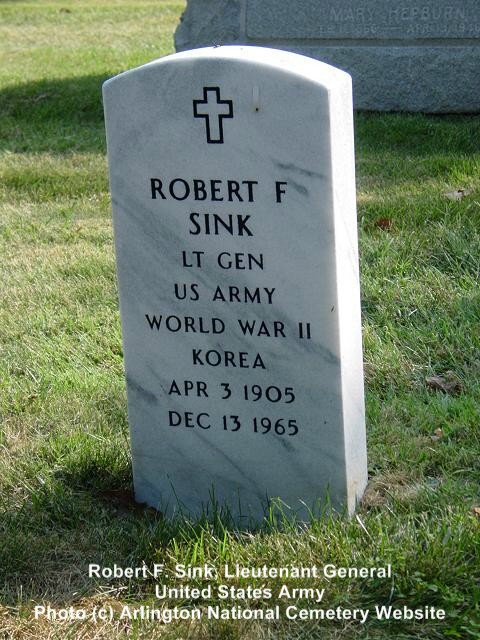
SINK, MARGARET C W/O SINK, ROBERT FREDERICK
DATE OF BIRTH: 12/01/1909
DATE OF DEATH: 04/29/1963
BURIED AT: SECTION I SITE 320-A
ARLINGTON NATIONAL CEMETERY
SINK, ROBERT FREDERICK
LT GEN US ARMY
WORLD WAR II, KOREA
DATE OF BIRTH: 04/03/1905
DATE OF DEATH: 12/13/1965
BURIED AT: SECTION 1 SITE 320-A
ARLINGTON NATIONAL CEMETERY

Michael Robert Patterson was born in Arlington and is the son of a former officer of the US Army. So it was no wonder that sooner or later his interests drew him to American history and especially to American military history. Many of his articles can be found on renowned portals like the New York Times, Washingtonpost or Wikipedia.
Reviewed by: Michael Howard