
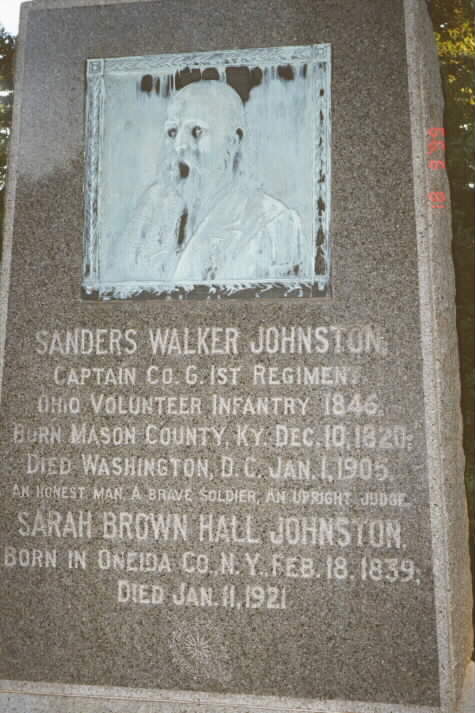
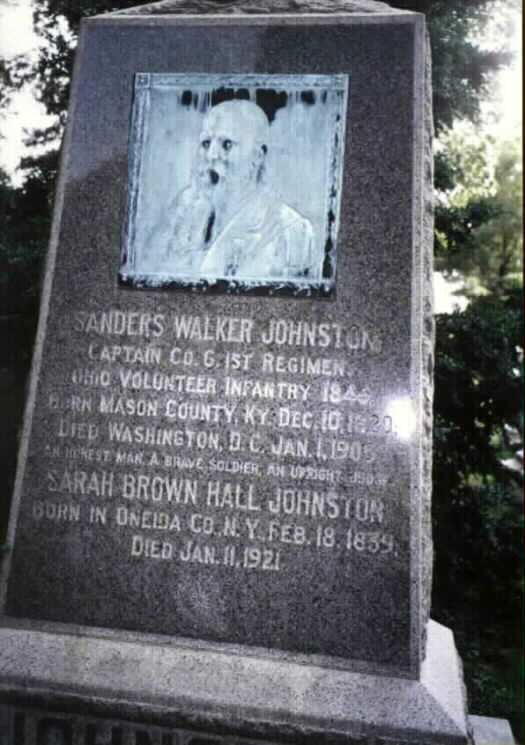
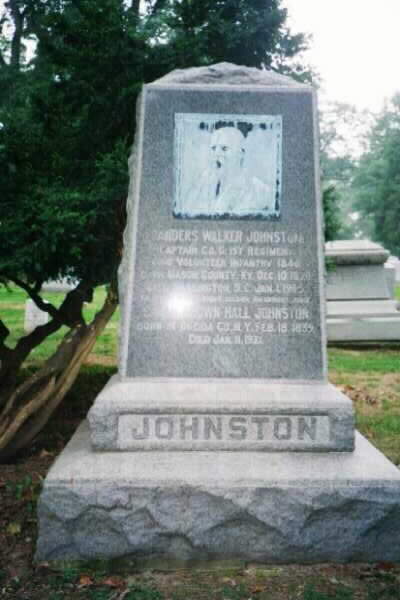
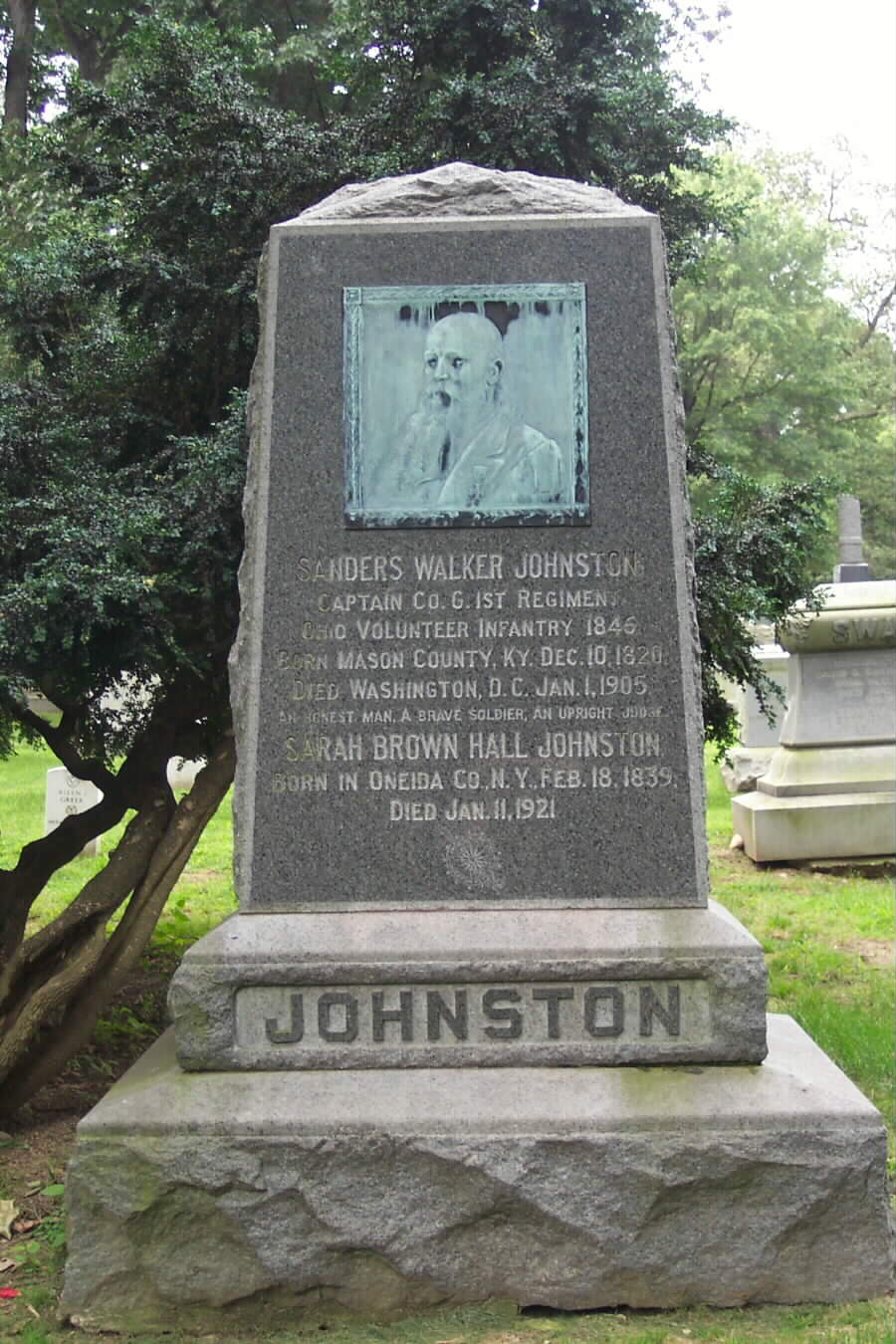
“Company G, 1st Regiment.
Born at Mason County, Kentucky, December 10, 1820.
Died: Washington, D.C. January 1, 1905.
An honest man, a brave soldier, an upright judge.”
His wife, Sarah Brown Hall Johnston, born in Oneida County, New York, February 18, 1832. Died: Washington, D.C. January 11, 1921) is buried with him.
AMANDA MELVINHAMER (THOMAS LYON, WILLIAM, THOMAS, ADAM, JAMES) was born October 11, 1823 in Brown County, Ohio, and died March 3, 1860 in Georgetown, Brown County, Ohio. She married SANDERS WALKER JOHNSTON February 29, 1844 in Brown County, Ohio, son of WILLIAM JOHNSTON and ASENATH CRAIG. He was born December 10, 1820, and died 1905 in Washington, D.C.
The 11th of October, 1854, the steamer F.X. Aubrey reached here early that morning from St. Louis bringing two of the three United States Territorial Judges for Kansas, Hon. Saunders W. Johnston, of Cincinnati, Ohio, and Hon. Rush Elmore, of Montgomery, Alabama. In the first judicial districting of the territory which took place some time after this date, Judge Johnston was assigned to the Third Judicial District, the extreme eastern portion of the territory,…” (skip part of page) “Some time after his retirement from the bench, he came to Leavenworth and followed his profession very successfully as the head of the law firm of Johnston, Stinson & Havens.” “He returned to Ohio afterwards, and the last information I had of him he was engaged in Washington practicing before the Departments”
“S.W. Johnston, the ninetieth name on the list of attorneys, came to Kansas early in 1854, as one of the United States territorial judges appointed by President Pierce. He was the Free State Judge and appointed from Ohio and was assigned to the extreme western district where there were but few settlers and little business to be done at that time. He remained as Judge of that district for some three or four years with but little judicial business to do, as the district was but sparsely settled at that time and it was during the most unsettled years in the history of the territory. He resigned his judicial position and came to Leavenworth to reside, opened a law office and in due course of time became the head of the law firm of Johnston, Stinson & Havens, one of the leading law firms in the city and territory. A short time after the dissolution of the above firm, Judge Johnston moved to Washington City and took up the practice before the departments and the U.S. Supreme Court. He died in the spring of 1905, having reached the ripe old age of eighty-three years, honored and respected by all who had the pleasure of his acquaintance.”
Marriage Notes for AMANDA HAMER and SANDERS JOHNSTON:
Marriage Index: Ohio, 1789-1850
Hamer, A. Malvina Sp : Johnston, S. W.
Married : February 29, 1844
County : Brown County
Sex : Female
In 1854 the Kansas-Nebraska Act established the Territory of Kansas. President Franklin Pierce appointed Samuel D. Lecompte, Rush Elmore, and Sanders W. Johnston as justices to a Territorial Supreme Court. With the arrival of Chief Justice Lecompte to the Kansas Territory in 1855, the court was organized at Leavenworth. In the next few years before Kansas became a state, several men served in this territorial supreme court, including Sterling G. Cato, Jerimiah M. Burrell, Thomas W. Cunningham, Joseph Williams, and John Pettit who replaced Lecompte as Chief Justice.
The territorial judges flouted the law as often as they impartially determined it. President Pierce had to remove two judges from office for the illegal acquisition of Indian lands. Another judge, Chief Justice Samuel Lecompte, devoted far more time to farming and promoting slavery than to judicial duties. He, too, was removed from office. Judicial replacements also furthered the cause of slavery at the expense of legal justice. One exception was Judge Joseph Williams who was more concerned with impartial justice and with protecting settlers from marauding outlaws. Judge Williams continued to press for law and order until his term expired in 1861, when Kansas became a state and territorial judgeships ended. A dual system of state and federal courts replaced the territorial court, and Congress established the U.S. District of Court of Kansas under Article III of the Constitution.
Mrs. Malvina H. Johnston, I.R. Mar 22, 1860. Died on the 3d inst., in Georgetown, Brown Co., Mrs. Malvina H. Johnston, wife of Hon. Sanders W. Johnston, of Kansas, and daughter of the late Gen. Thomas L. Hamer.
JOHNSTON, SANDERS W
- CAPT CO G 1ST OHIO INF
- DATE OF DEATH: 01/01/1905
- BURIED AT: SECTION N DIV SITE 705
ARLINGTON NATIONAL CEMETERY
JOHNSTON, SARAH HOLLY W/O SANDERS W
- DATE OF DEATH: 01/11/1921
- BURIED AT: SECTION WW SI SITE 705
ARLINGTON NATIONAL CEMETERY - WIFE OF SW JOHNSTON, CAPT CO G 1ST OHIO VOL

Michael Robert Patterson was born in Arlington and is the son of a former officer of the US Army. So it was no wonder that sooner or later his interests drew him to American history and especially to American military history. Many of his articles can be found on renowned portals like the New York Times, Washingtonpost or Wikipedia.
Reviewed by: Michael Howard