
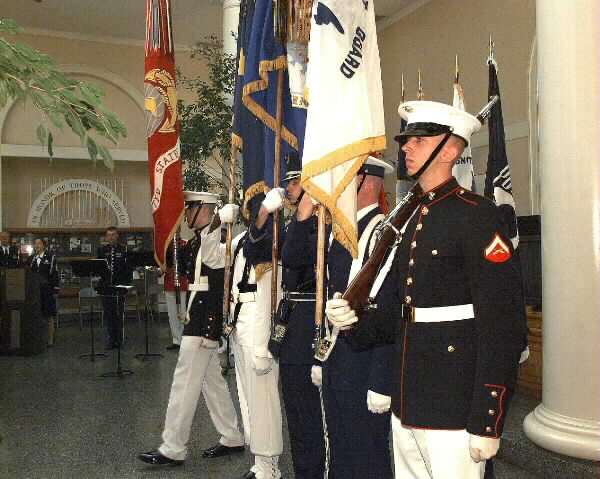
Joint Service Color Guard presents the colors at the Taps Project opening ceremony.
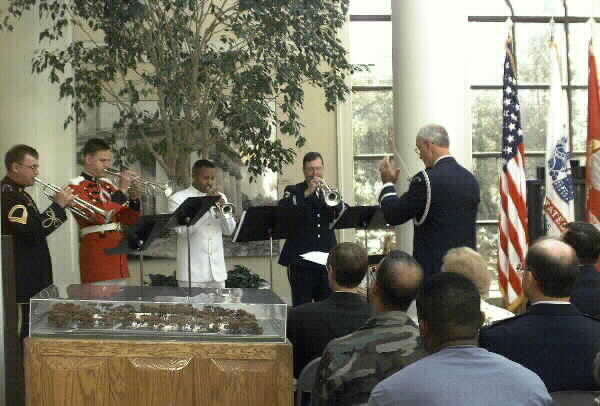
Major Frank Grzych, USAF Band Deputy Commander conducts a joint-service
trumpet quartet at the opening ceremony. Members are (left to right)
Army SFC James McKenzie, Marine SSgt. Scott Gearhart, Navy Chief
Musician Kevin Dines and Air Force SMSgt. John Pursell.
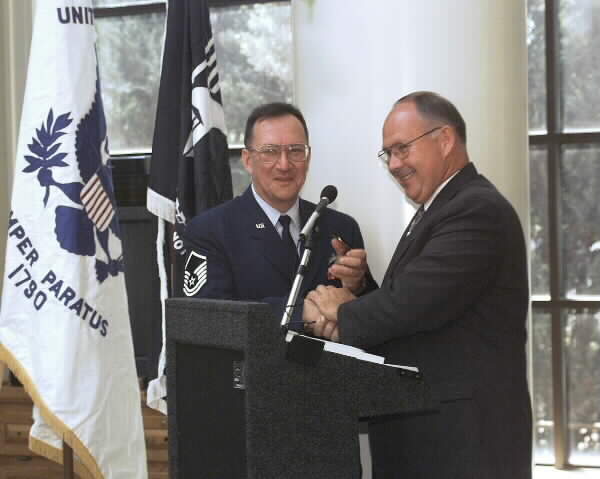
Master Sergeant Jari Villanueva receives a gold medal from Mr. John Metzler,
Superintendent of Arlington National Cemetery, for his efforts in connection with the
Taps Project.
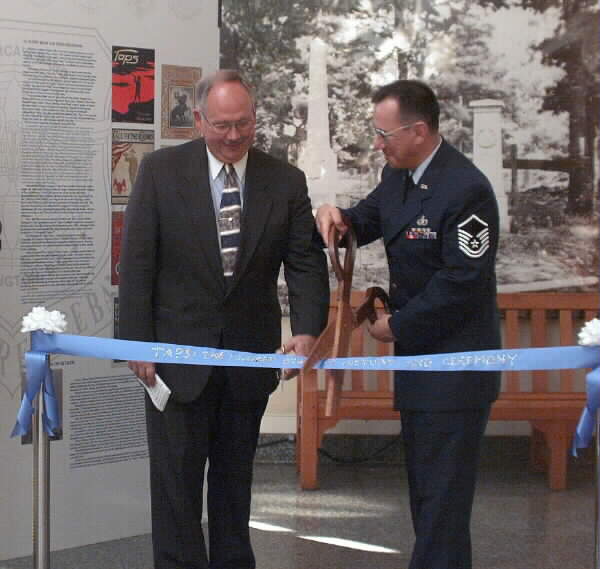
Mr. John Metzler and Master Sergeant. Villanueva cut the ribbon to open the Taps
Exhibit at Arlington.
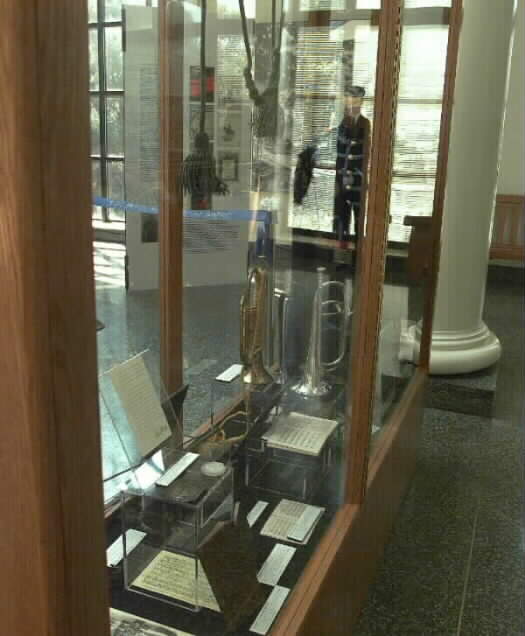
Taps Project Display Case, Arlington National Cemetery
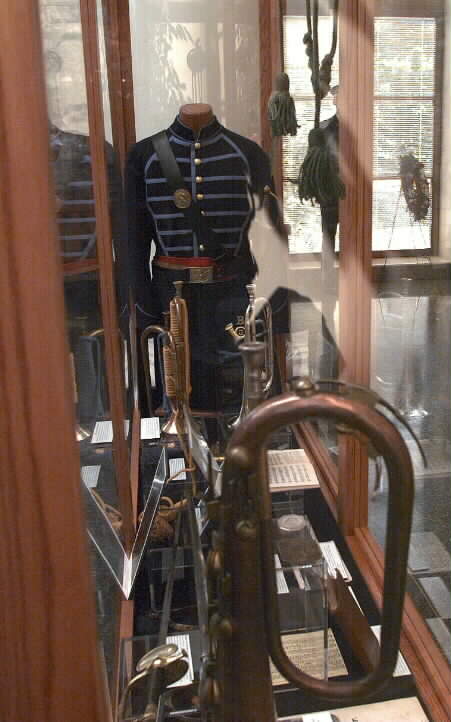
Taps Project Display Case, Arlington National Cemetery
Photos by SSgt. Joan Anderson-Brown, 11th Wing, Bolling Air Force Base
Courtesy of The United States Air Force
Photos Submitted By: Master Sergeant Jari Villanueva
Remarks Delivered By MSgt. Jari Villanueva
At The Opening Of The “Taps” Exhibit at Arlington National Cemetery May 28th, 1999
Thank you Colonel Deal. Mr. Metzler, distinguished guests, members of
the military musical community, friends and colleagues. It is my honor
to stand here and welcome you to the exhibit on this wonderful day. A
day which we honor not only the creation of a musical traditional unique
to our nation, but those who performed this solemn honor.
A project like this could not have been possible without the support,
cooperation, and advice from so many. Without their assistance, I could
not have succeeded. With it, I could not have failed. It is to each
and everyone of them I give my deepest and most heartfelt thanks.
The sound of the bugle made it possible to convey commands over a great
distance and even during a battle the sound could be heard above the
roar. Years after the Civil War, veterans could still recall images of
conflict when a bugle sounded. I think it safe to say that everyone
here today has at one time has been moved emotionally by those clarion
notes.
Oliver Norton in 1890 wrote, “That familiar sound echoing among the rocks where they had fought brought back, perhaps more vividly than words could do, the memories of the days when they had answered so often to its sound.”
Today we have on display not merely metal tubing, fabrics, and paper,
but also the memories of those who performed a vital task in our
military. We honor those men and women.
Most were ordinary, yet some found themselves in extraordinary
circumstances. All came from different backgrounds, but each possessed
the qualities we hold paramount in military life. The lofty ideals of
integrity, excellence, and service before self are, without question,
values held by those men and women long before they were ever set down
as guidelines. They are the ones who set the standards.
For each bugler, then as today, the most sacred duty one performs is the
sounding of “Taps.” The twenty-four notes, created on a hot and humid
July afternoon in 1862, comprises our nation’s most eloquent melody.
Playing for a nationwide audience, or playing at a ceremony for a few
people, it is performed with the utmost care and perfection.
We celebrate the lives of some of the musicians…
Gustav Schurmann, a twelve year-old who served two Civil War generals
and befriended Tad Lincoln, the son of the president.
John Cook, a fifteen year-old who put his bugle down to man an artillery
piece during the Battle of Antietam, then sounding the charge at
Gettysburg.
Louis Benz, who left his homeland of Prussia to serve as chief bugler at
his beloved West Point for forty years.
Oliver Norton, a twenty-two year-old who on that hot summer night in
1862 started a tradition that still remains to this day.
John Martin, who changed his name from Giovanni Martini so he could be
more American, who became George Custer’s bugler and was the last
American soldier to see Custer alive.
Frank Witchey, whose bugle rendition of “Boots and Saddles” had
cavalrymen running and whose “Taps” was heard on November 11, 1921 as
the World War One Unknown was buried at Arlington.
Calvin Titus, who during the siege at Peking during the Boxer Rebellion,
responded to a request for volunteers to scale the wall, with the words
“I’ll try Sir!” entering that phrase into the Army lexicon.
George Myers, who played for “Black Jack” Pershing, Hap Arnold,
Jonathan Wainwright and the interment of the World War Two /Korean
Unknowns and whose love of the bugle, placed the honor of sounding
“Taps” above all his musical duties.
And then the quiet, Christian man from Grand Rapids, who on a chilly day
in November, 1963 sounded the nations farewell to President Kennedy
before a worldwide audience, the largest ever to hear those twenty-four
notes.
The instrument has undergone changes over the years as has the use of
the bugle in today’s military. While at one time it was a major means of
communication, it is now relegated to ceremonial duty. A recording has
replaced “Taps” on most military installations around the world and sad
to say even at some funerals for those who served our nation. It is my
hope that with this exhibit, there will be a new awareness in the
tradition that is practiced here at Arlington everyday.
It is to every person who answered the clarion call to duty, that I
respectfully dedicate this “Taps” exhibit.
Invocation Delivered by Chaplain (Colonel) Edward Brogan at the Taps Project Opening
Ceremony 28 May 1999
Lord of our lives, our hope in death,
We cannot listen to TAPS without our souls stirring.
Its plaintive notes are a prayer in music – of hope, of peace, of grief, of rest.
Lord, please honor this TAPS exhibit that it might focus attention on the
reverence shown in funerals at Arlington National Cemetery and the
sacrifices of the U.S. veterans we recognize on this Memorial Day.
Prepare us too, Lord, for our final bugle call when you summon us home!,
“When the trumpet of the Lord shall sound and death will be no more.”
Amen
A Call That Lingers in the Heart
Arlington Cemetery Opens Bugle Exhibit That Traces the Origin of Taps
By Steve Vogel
Washington Post Staff Writer
Saturday, May 29, 1999
The baleful strains of taps echoed across sunlit Arlington National Cemetery yesterday, as they have many thousands of times before.
The sad bugler's call is heard at Arlington more than any other place in the world, an average of 30 times a day. Coming at the end of funerals and memorial services, taps almost never fails to draw tears from mourners. It will be sounded again on Monday, Memorial Day, when President Clinton
lays a wreath at the Tomb of the Unknowns.
“There's nothing I can think of more appropriate than the notes of taps to symbolize Arlington National Cemetery,” said Jack Metzler Jr., superintendent of the cemetery.
But the rendition yesterday morning was different from most. Taps was being played for the sake of the music, rather than the memory of a fallen soldier.
With a flourish of trumpets in the cemetery's visitors center, officials cut the ribbon to open a three-year exhibit that tells the story of taps, a call that originated during the Civil War and is now perhaps among the most recognizable of all American tunes.
Wood and glass display cases and information panels in the center's atrium describe taps' origins and its role in historic ceremonies. A myriad of trumpets and paraphernalia is on display, from the Civil War era and later, including a plastic bugle made during World War II when brass was scarce.
The centerpiece is the bugle played at Arlington on November 25, 1963, at the funeral of President John F. Kennedy. Also featured are the sword and spurs worn by Union General Daniel Butterfield, credited with creating taps during a campaign in Virginia.
The idea for the exhibit was born on Memorial Day last year by a bugler who has sounded taps hundreds of times at Arlington. Master Sergeant Jari Villanueva, trumpeter for the U.S. Air Force Band at Bolling Air Force Base, suggested it to Metzler. “The one thing that is common to every
ceremony at Arlington is that taps is sounded,” said Villanueva, a Baltimore native.
Villanueva's interest in taps began soon after he became an Air Force musician 14 years ago. Questioned about its origins by a superior, Villanueva realized he knew nothing and began researching the topic. He found a great deal of confusion. “A lot of stories associated with it are
myths,” Villanueva said.
One of the most popular and melodramatic involves a Union captain on a battlefield who comes across his son, terribly wounded, wearing the uniform of the Confederacy. The father drags his son to safety, but the young man succumbs to his wounds. Inside his son's pockets, the father finds a sheet of music upon which the notes to taps are written. A bugler sounds it at the soldier's funeral, and the rest is history, supposedly. “It's a great story, just not true,” Villanueva said.
The real story, according to research by Villanueva and historical documentation, is that Butterfield, a Union brigade commander during the Peninsular campaign in 1862, grew tired of the “lights out” call sounded at the end of each day. Butterfield thought it was too formal.
With the help of the brigade bugler, Oliver Wilcox Norton, Butterfield made some changes. The resulting “taps” was adapted from an existing tattoo call to notify soldiers to knock off drinking for the evening and prepare for bedtime roll call.
Although intended as a new “lights out” call, taps was quickly put to use at a funeral for the first time during the same campaign in July 1862, when a battery commander ordered it played in lieu of a rifle volley for the burial of a cannoneer who had been killed in action. With his battery close to enemy
lines, the commander was worried that firing three volleys over the grave — as was customary — would alarm the Confederates and spark renewed fighting.
Sounding taps at funerals was taken up throughout the Army of the Potomac, first by custom and then by order. Even the Confederates picked it up. By 1891, taps was written into drill books as mandatory.
“There is something singularly beautiful and appropriate in the music of this wonderful call,” Norton wrote years after the Civil War. “Its strains are melancholy, yet full of rest and peace. Its echoes linger in the heart long after its tones have ceased to vibrate in the air.”
Villanueva said it is never easy to play taps at a funeral. “You wouldn't be human if you didn't get nervous,” he said. “The call itself is not that difficult, but given the circumstances of when you have to play it, it can be kind of trying. Every time you sound taps, you want to do your best, especially if
it's someone killed in the line of duty.”
TAPING THE EMOTIONS
Dan Rodricks : SUN STAFF
May 30, 1999
“Taps: The Military Bugle in History and Ceremony” features bugles, photographs, uniforms, sheet music and a wide assortment of historical items, including Gen. Daniel Butterfield's sword and spurs and the bugle used to sound taps at President Kennedy's funeral. It is open every day
from 8 a.m. to 7 p.m. at the Arlington National Cemetery Visitors Center, off Jefferson Davis Highway at the Memorial Bridge.
Sometimes mourners forget it's coming. They're distracted, of course, not really thinking about the fine points of ceremony. The 24 haunting notes are familiar: They've heard them countless times at funerals for soldiers and police officers, during Memorial Day services, in the nationally televised burials of presidents, and in the movies. Yet nothing really prepares them for the moment.
A man or a woman in uniform and white gloves raises a horn, then sounds the nation's official farewell to the honored dead. And all emotional dams break.
Last month, in a Catholic church in Oil City, Pa., few of the mourners of Airman William Joseph Mohr III noticed the uniformed trumpeter seated near the front. They were still in shock from Mohr's death a few days earlier in a car accident in Texas. He had completed basic training and was on his way to his first station, in Louisiana. He died 10 days short of his 19th birthday.
Now, in the church where Mohr had served as an altar boy, not a seat was empty. The crowd was full of young faces.
When, at last, Master Sgt. Jari Villanueva stood to sound taps — so familiar, yet oddly unexpected — the sobbing started with the first note and built as he played. The sound came from all corners of the church — a deep, heavy, physical sobbing that almost distracted Villanueva from his mission.
But he hit all 24 notes perfectly. One wonders: Isn't the death of a loved one hard enough to bear without the addition of such powerful music? Does the bugler, or the trumpeter, ever feel a tad guilty?
“No,” says Villanueva, of Catonsville, a trumpeter with Ceremonial Brass, a unit of the U.S. Air Force Band in Washington. “When people cry as I play taps, I think that it's probably a good emotional release for them.”
A tribute to taps, perhaps the most emotionally powerful and evocative 24 notes in American music, opened Friday at the Arlington National Cemetery Visitor Center. “Taps: The Military Bugle in History and Ceremony” is a salute to the men and women who've sounded taps and other military calls over two centuries. And for Villanueva, it's the result of 14 years of research.
A passionate student of music and the Civil War, Villanueva has sounded taps hundreds of times since joining the Air Force in 1985. Like many of his colleagues in the Ceremonial Brass, and similar units in the Army, Navy and Marine Corps, he has been summoned to military funerals in several states over the years. Sounding taps at Arlington National Cemetery, where the call is heard up to 30 times a day, is part of his regular duties.
The exhibit he helped establish pays homage to musicians Villanueva never knew but for whom he obviously has great respect — men and women whose names are mostly unknown to the public but whose bugle and trumpet calls were heard by thousands over the years, in war and in peace, at
Arlington and in national cemeteries and small graveyards across the country.
“I've sounded taps so many times,” he says. “But I take it very seriously each time. I want it to be the best it can be. It's very important to the families of the deceased. When it's my time to play I want to make sure it's perfect.”
No matter how hard the emotional environment might be. Most of the time, Villanueva and his colleagues in the military brass units sound taps without flaw. It's rare to hear a note crack.
Ironically, the most memorable sounding of taps in modern times was perfect only in some metaphorical sense.
On a chilly November day 36 years ago, at the burial of John F. Kennedy, U.S. Army Band Sgt. Keith Clark, who had played hundreds of funerals and ceremonies at Arlington, cracked the sixth note. One writer took it as a metaphor for the moment — a sob or whimper through a B-flat Bach bugle. In the weeks following JFK's funeral, other buglers at Arlington missed the same note.
“We all thought it must be psychological,” Clark, retired and living in Florida, recently told Villanueva.
Clark's bugle and an account of his role in the Kennedy funeral comprise the centerpiece of the Arlington exhibit. It also features sheet music, manuals, uniforms and a kind of bugler's hall of fame: photographs of Army Staff Sgt. Victor Christensen sounding taps in 1939 as Franklin Roosevelt lays a wreath at what was then called the Tomb of the Unknown Soldier; Army Sgt. Henry Screcci sounding the call in the rain; Marine Sgt. Christian Ferrari and Navy Band Musician 1st Class Patrick Puckett, trumpets raised to their lips; and, in a photograph from the 1980s, Army Staff Sgt. Tammy Leverone, the first woman to do so, sounding taps at a ceremony at the Tomb of the Unknowns.
Where credit is due
Taps came out of the Civil War, though the history of its origin is misty. Union Gen. Daniel Butterfield, camped with his brigade at Harrison's Landing, Va., in the summer of 1862, asked his bugler to try a new tune. The bugler, Oliver Wilcox Norton, did not know so at the time but the simple call Butterfield scratched on an envelope and asked him to sound came from an early version of “Tattoo,” a bugle call used to alert troops to prepare for bedtime roll call. This particular “Tattoo” had gone out of use by the time of the Civil War.
“Butterfield knew the tune, however, from his days before the war as a colonel in the New York militia,” says Villanueva. “It's the `Tattoo' by Winfield Scott, composed in 1835, also known as the `Scott Tattoo.' The last five-and-a-half measures are distinctly taps.”
According to Villanueva's research, Norton worked out the call with Butterfield, then sounded it in camp. “The music was beautiful on that still summer night, and was heard far beyond the limits of our brigade,” Norton later wrote. “The next day I was visited by several buglers from neighboring brigades, asking for copies of the music, which I gladly furnished. I think no general order was issued from army headquarters authorizing the substitution of this for the regulation call, but as each brigade commander exercised his own discretion in such minor matters, the call was gradually taken up through the Army of the Potomac.”
Of the call, Norton wrote: “Its strains are melancholy, yet full of rest and peace. Its echoes linger in the heart long after its tones have ceased to vibrate in the air.”
Though its use at military funerals became mandatory with the publication of the U.S. Army Infantry Drill Regulations for 1891, taps might have been heard graveside for the first time shortly after the
Butterfield-Norton collaboration. At a funeral during the Peninsula Campaign in Virginia, a captain in the Union artillery ordered it played for the burial of a cannoneer.
“A popular myth is that of a Northern boy who was killed fighting for the South,” writes Villanueva, in notes for the exhibit. “His father, Robert Ellicombe, a captain in the Union Army, came upon his son's body on the battlefield and found the notes to taps in a pocket of the dead boy's Confederate uniform. When Union General Daniel Sickles heard the story, he had the notes sounded at the boy's funeral. But there is no evidence to back up the story or the existence of a Capt. Ellicombe.”
Butterfield gets the credit for taps. A few years after the Civil War, he resigned from the Army and spent his retirement at a country home in Cold Spring, N.Y., overlooking the Hudson River, within earshot of West Point. He could hear a bugler at the military academy sound taps each evening.
For more than a century, taps has been used for lights-out at American military bases, and it has been heard thousands of times at funerals of military personnel and veterans. It's not played on the bugle much anymore. (On military bases, lights-out is usually a recording, not a live performance.) At
Arlington, Villanueva and his colleagues use a trumpet or cornet for taps at funerals. But the U.S. Army Band insists on the valveless bugle during ceremonies at the Tomb of the Unknowns.
“First time I played it?” Villanueva wonders aloud. “Boy Scouts. I guess I was 11 or 12. I was studying trumpet and my parents bought me a Boy Scout bugle.”
On Scout Sunday at Augustana Lutheran Church on Manasota Avenue in Baltimore, he'd “play a military church call. I'd spend two weeks at Broad Creek Boy Scout camp in the summer and I played taps there, and I'd play it at the end of troop meetings. `Sound it,' I should say. You don't `play' taps. You `sound' taps.”
Striking up the band
During the last two decades, Villanueva has worked tirelessly on behalf of music in Baltimore. He helped found the popular Peabody Ragtime Ensemble and directed the Water Street Swing Society. He served as music director of the Young Victorian Theater Company. He also helped the city
launch its Midtown Music Series in Hopkins Plaza and taught history of musical theater at Goucher College.
In 1985, he had an opportunity to become a military musician. “I had to audition, and I had to join the Air Force. I got my six weeks of basic training at Lackland, and then I was permanently assigned to the Air Force Band.”
He's the assistant drum major and chief arranger for all the ceremonial music performed by the U.S. Air Force Band. In fact, the band performed Villanueva's arrangement of “Going Home” during a remains-arrival scene at Andrews Air Force Base in the 1994 Harrison Ford film, “Clear and
Present Danger.”
He sounded taps in Arlington for the burial of Gen. Godfrey McHugh, who served as Air Force aide to JFK. He performed the same service for James H. Barrett, the retired Air Force lieutenant colonel and former Annapolitan who was killed in 1994 by an anti-abortion zealot as he escorted a doctor to a Florida abortion clinic. He has traveled, too — to Missouri for the burial of a congressman, to Pennsylvania for the young airman's funeral in Oil City.
And back home, in Baltimore, he has fought the emotional pull of the music while among friends.
He recalls one service in particular, in Rosedale, playing for the funeral of a friend's father.
“He'd been a bombardier in World War II, and as I played, I looked over at my friend and noticed that she was wearing her Dad's bombardier pin, his wings. “That really got to me.” But he still made it through taps, perfectly.

Michael Robert Patterson was born in Arlington and is the son of a former officer of the US Army. So it was no wonder that sooner or later his interests drew him to American history and especially to American military history. Many of his articles can be found on renowned portals like the New York Times, Washingtonpost or Wikipedia.
Reviewed by: Michael Howard