
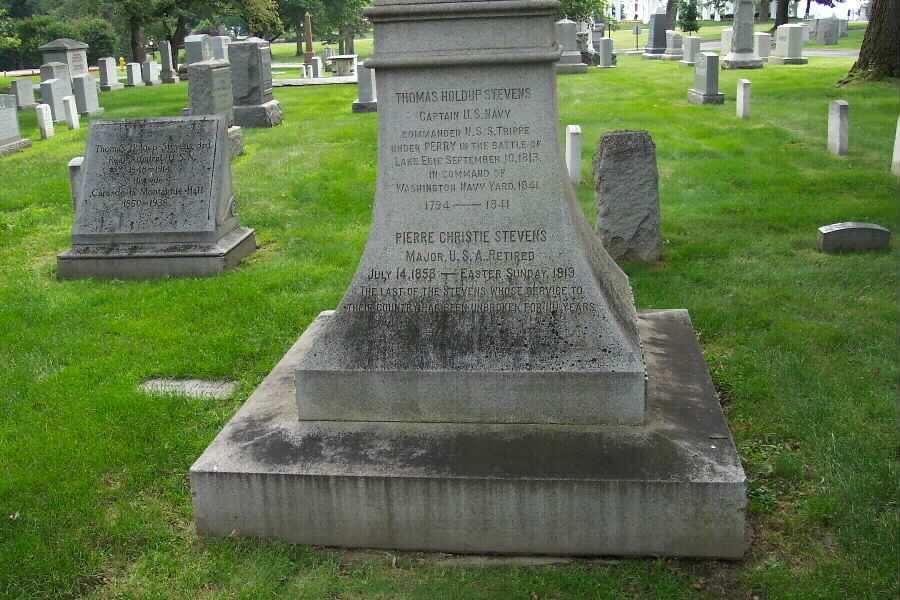
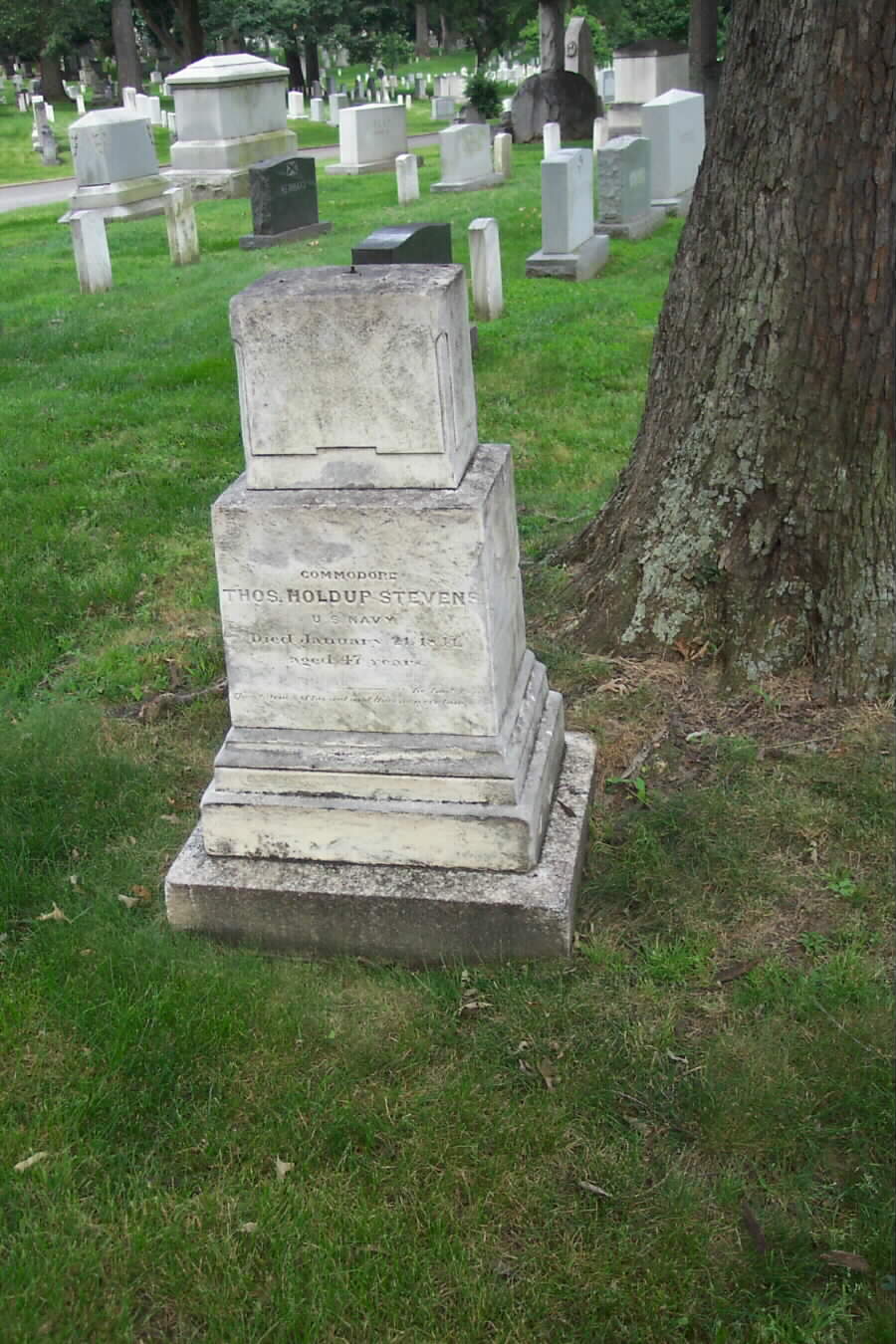
The originator of the Stevens name in United States Military history, he died on active duty, at age 47, on January 11, 1811.
He was originally buried in Congressional Cemetery in Washington, but was subsequently moved to Section 1 of Arlington National Cemetery, where he rests among many other family members.
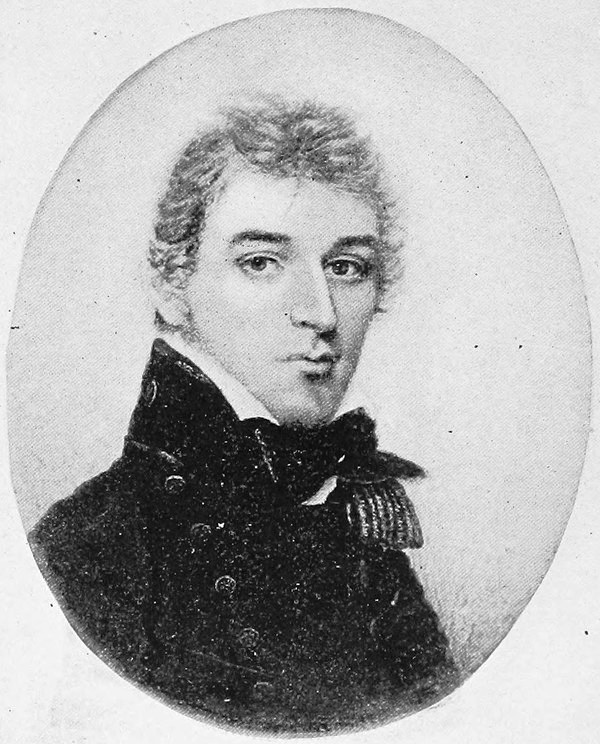
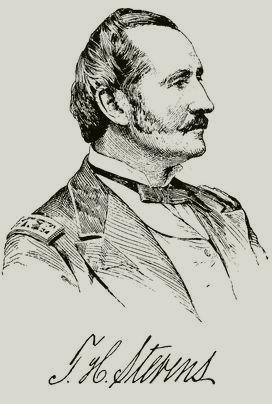
Stevens, Thomas Holdup, February 22, 1795 – January 21, 1841, naval officer, was born in Charleston, South Carolina. Left an orphan in early childhood, he was adopted by Colonel Daniel Stevens of Charleston, and was also greatly befriended by Lieutenant Ralph Izard, of the Charleston family of that name, the warm affection between the youth and these older officers being evident in letters still retained by the family. In place of his original surname Holdup, in 1815 by legislative enactment he took that of Stevens.
He was warranted midshipman in the U.S.S. Hornet at Charleston in February 1809, and at the outbreak of the War of 1812 was in the John Adams at New York. Volunteering for lake service, he went to the Niagara frontier, and in a night assault on the enemy works opposite Black Rock, November 27-28, 1812, was one of the leaders of a detachment which captured two enemy guns and dislodged an enemy force by firing their barracks. A canister shot through his right hand in this action inflicted permanent injury. Remaining after the retreat of his main party, he later with seven others recrossed the Niagara at great hazard in a leaky canoe. In recognition of his gallantry, Commodore Isaac Chauncey made him acting Lieutenant (confirmed July 24, 1813).
In April 1813 he joined Oliver Hazard Perry at Erie. In the battle of Lake Erie he commanded the sloop Trippe (one long 32-pounder), last in the line, which passed the Tigress and Porcupine to engage the Queen Charlotte, and after the action assisted the Scorpion in the pursuit and capture of two escaping enemy vessels. That he was not specifically mentioned in Perry's dispatches, Stevens attributed to differences with Jesse Duncan Elliott, second in command, under whom he had served previously in the Niagara. He received the silver medal awarded by Congress to officers in the action, and a sword from his native city.
In the summer of 1814 he was First Lieutenant in the Niagara on Lake Huron, and in the autumn he was selected by Perry to join him in the Java, fitting for the Mediterranean. Her departure being delayed till after peace, however, he did not sail in her, but secured a furlough and was married in November or December 1815 to Elizabeth Read Sage, daughter of Ebenezer Sage, a prominent merchant of Middletown, Connecticut. His home in later years was in Middletown.
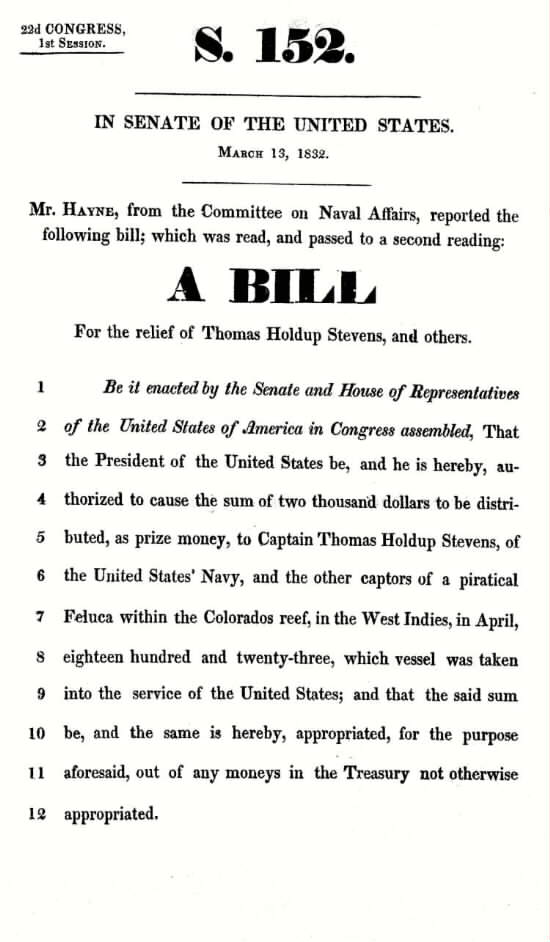
In 1818-20 he had duty in the Alert and the Constellation at Norfolk, and from January 1823 to June 1824 he commanded successively the schooners Jackal and Shark of the West India Squadron under David Porter in energetic campaigns against the West Indies pirates. Made Master Commandant, March 3, 1825, his next and last command afloat was the Ontario, Mediterranean Squadron, 1829-31. He had charge of the Boston naval rendezvous, 1832-36; was made Captain, January 27, 1836; and at the time of his sudden death had held command of the Washington navy yard for nearly a year.
A miniature by Peale, owned by his descendants, pictures him as of strong and pleasing features, marked by a scar on the right cheek. Surgeon Usher Parsons, a friend and fellow-officer of the lake campaign, speaks of him as “the very soul of chivalry, generous, high-minded,” lively in conversation, being a “loud and free talker,” and with “literary talent . . . of a high order”. He had three daughters and three sons, but of the sons only one, Thomas Holdup, 1819-1896, lived to mature years. Buried first in the Congressional Cemetery, his body was later removed to Arlington.
Courtesy of Congressional Cemetery:
Interments in the Historic Congressional Cemetery:
Stevens, Thomas Holdup b. 1793 – d. 21 Jan 1841 48 yrs
Removed to Arlington Cemetery, June 1905
Stevens
Suddenly on Thursday morning, the 21st instant at his residence in the Navy Yard, Commodore Thomas Holdup Stevens, Commandant of the Navy Yard in this place in the 47th year of his age. The friends and acquaintances of the deceased are requested to attend his funeral on Saturday, January 23 at 11 o'clock.
National Intelligencer, Friday, January 22, 1841
Death of Commodore Stevens
The Naval Order which appears in another column will announce to our readers the decease–sudden and unanticipated as it is afflicting–of Commodore Thomas Holdup Stevens, of the Navy. In the meridian of life, and in the enjoyment of the highest health, he retired to bed on Wednesday night, and before morning the angel of death had stricken him from the number of the living. We know not when any instance of those solemn dispensations which Providence orders, as it were, as admonitions of the uncertain tenure of existence, has struck upon us more painfully. Open-hearted, frank, and generous, we knew not a man who made his way so directly to the affections of all to whom he became known as this gallant and lamentedofficer; and proportionately keen is the sorrow for his loss and the sympathy which is universally felt for his large and estimable family.
Commodore Stevens was a native of Charleston, South Carolina, and entered the Navy in 1808, at the early age of fifteen. Young as he was, he had distinguished himself in the War of 1812, even before Perry's brilliant victory on Lake Erie, and he commanded one of the vessels in that ever-memorable battle. As a man, he was without reproach; and, as an officer, he was regarded as one of the brightest ornaments of the Navy in peace, as he had been one of its most gallant sons in war.
National Intelligencer, Monday, January 25, 1841
Funeral of the Late Com. Stevens
The remains of the late much-respected Commandant of the Washington Navy Yard were conveyed from the latter place to Congress Burial Ground, on Saturday last, for interment. The funeral service was performed by the Rev. Mr. Ryland, chaplain to the yard, amidst a large concourse of mourners and citizens, who united in paying the last tribute of respect to a brave officer and much esteemed fellow-citizens. Besides the officers of the Navy, the Marine Corps, and the Army, who attended in full uniform, the corpse was followed to the grave by the Marine Corps, under the command of Capt. Twiggs, and the Washington Light Infantry, under the command of Capt. France, preceded by the Marine Band, playing a solemn dirge. After the funeral service, the usual military honors were paid by the Marine Corps to the departed Commodore.
The pall-bearers on the solemn occasion consisted of the Secretary of the Navy, Commodores Morris, Warrington, Wadsworth, Nicolson, General Towson, Colonel Henderson; the Mayor of Washingt on, General Weightman, and General Keim of Pennsylvania. The funeral was also attended by the Secretary of War and several Members of Congress, who, together with many citizens, the great body of mechanics, and others attached to the Navy, were anxious to testify their sincere and cordial respect for the memory and character of the late Commodore Stevens.
Commodore Thomas Holdup Stevens
United States Navy
Was born in Charleston, S.C., February 22, 1795. Lost parents, whose name was Holdup, in early life, and was adopted by a citizen of Charleston who procured for him a midshipman's warrant in 1809. Volunteered for service on the Lakes in the beginning of the war of 1812, and was assigned to duty under Capt. Samuel Angus on the Niagara frontier. Was one of the leaders that captured the enemy's artiller in a night attack opposite Black Rock, Morgan's Run. Was one of a scaling party that dislodged the British grenadiers by burning their barracks at Fort Erie, and although wounded in the right hand, remained after the naval force had retreated, and with two other midshipmen and five seamen spiked the enemy's guns and recrossed Niagara River at a great risk in a leaky canoe; was made lieutenant for his bravery in this action on July 24, 1813. Commanded the sloop Trippe in the battle of Lake Erie and fought against the rear of the enemy's line, passing ahead of the Tigress and Porcupine and firing at the Queen Charlotte until she struck her colors, and, with Stephen Champlin, chasing and bringing back two of the enemy's vessels when they tried to escape. For these achievements was given a silver medal by Congress, and the citizens of Charleston presented him with a sword. In 1814 was ordered to command the frigate Java on a cruise to the Mediterranean. In 1815 changed his name to Stevens, which was that of his early benefactor. In 1819-20 attached to the frigate Constellation. Performed valuable service in suppressing piracy in the West Indies. Promoted to master commandant March 3, 1825. His last command was the Ontario sloop of the the Mediterranean squadron in 1830-32. Was made captain, at that time the highest rank in the service, on January 27, 1836. In command of the station and navy yard at Washington until his sudden death on January 22, 1841.
Thomas Holdup Stevens, Naval Officer, born in Charleston, South Carolina, 22 February, 1795; died in Washington, D. C., 22 January, 1841.
He lost his parents, whose name was Holdup, in early life, and was adopted by a citizen of Charleston, who procured for him a Midshipman's warrant in 1809. In the
beginning of the war of 1812 he volunteered for service on the lakes, was assigned to duty under Captain Samuel Angus on the Niagara frontier, and took part in a night attack on the enemy's works opposite Black Rock, preparatory to the contemplated descent of General Alexander Smythe on the Canada shore. He was one of the leaders of a detachment that captured the enemy's artillery, and of a scaling-party that dislodged the British grenadiers by burning their barracks, and, although wounded in the right hand by a canister shot, remained after the naval force had retreated, and, with two other midshipmen and five seamen, crossed Niagara river at great risk in a leaky canoe. For his bravery in this action he was made a lieutenant, 24 July, 1813, while he was with Commander Oliver H. Perry at Erie, Pennsylvania, assisting in the building and equipment of the lake squadron. In the battle of Lake Erie he commanded the sloop “Trippe,” and fought against the rear of the enemy's line, passing, ahead of the “Tigress” and “Porcupine,” pouring grape and canister into the “Queen Charlotte” until she struck her colors, and, with Stephen Champlin, chasing and bringing back two of the enemy's vessels when they tried to escape. For these chievements he was voted a silver medal by congress, and presented with a sword by the citizens of Charleston.
He was ordered in 1814 to the frigate Java,” which Commander Perry was fitting out for a cruise in the Mediterranean. In 1815, by legislative enactment, he changed his name to Stevens, which was that of his early benefactor. In 1819-'20 he was attached to the frigate ” Constellation.” He performed Valuable service in the cruise of Commander David Porter for the suppression of piracy in the West Indies, commanding successively the “Asp,” the “Jackal,” and the schooner “Shark,” of the Mosquito fleet, being promoted Master Commandant on 3 March, 1825.
His last command afloat was the “Ontario” sloop, which was attached to Commander James Biddle's Mediterranean squadron in 1830-‘2. He was made a Captain, at that time the highest rank in the service, on 27 January, 1836, and commanded the navy-yard and station at Washington until his sudden death.
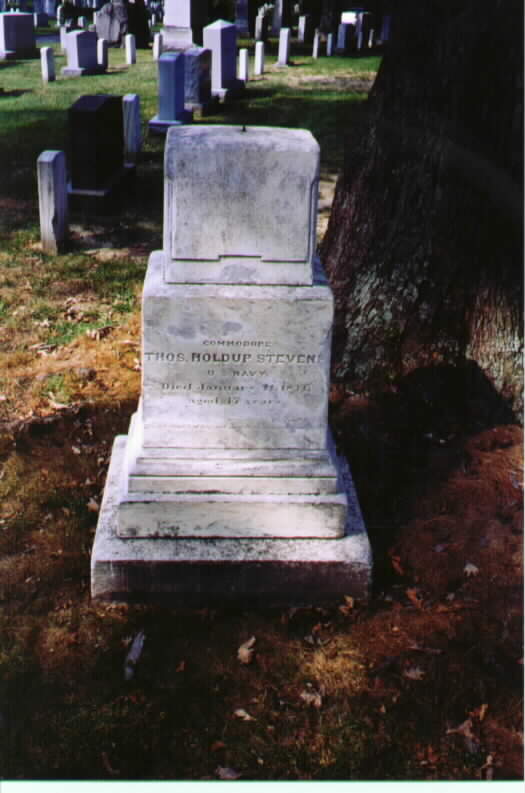
STEVENS, THOMAS H
COMODORE US NAVY
- DATE OF DEATH: 01/22/1841
- BURIED AT: SITE 183 SOUTH
ARLINGTON NATIONAL CEMETERY

Michael Robert Patterson was born in Arlington and is the son of a former officer of the US Army. So it was no wonder that sooner or later his interests drew him to American history and especially to American military history. Many of his articles can be found on renowned portals like the New York Times, Washingtonpost or Wikipedia.
Reviewed by: Michael Howard