
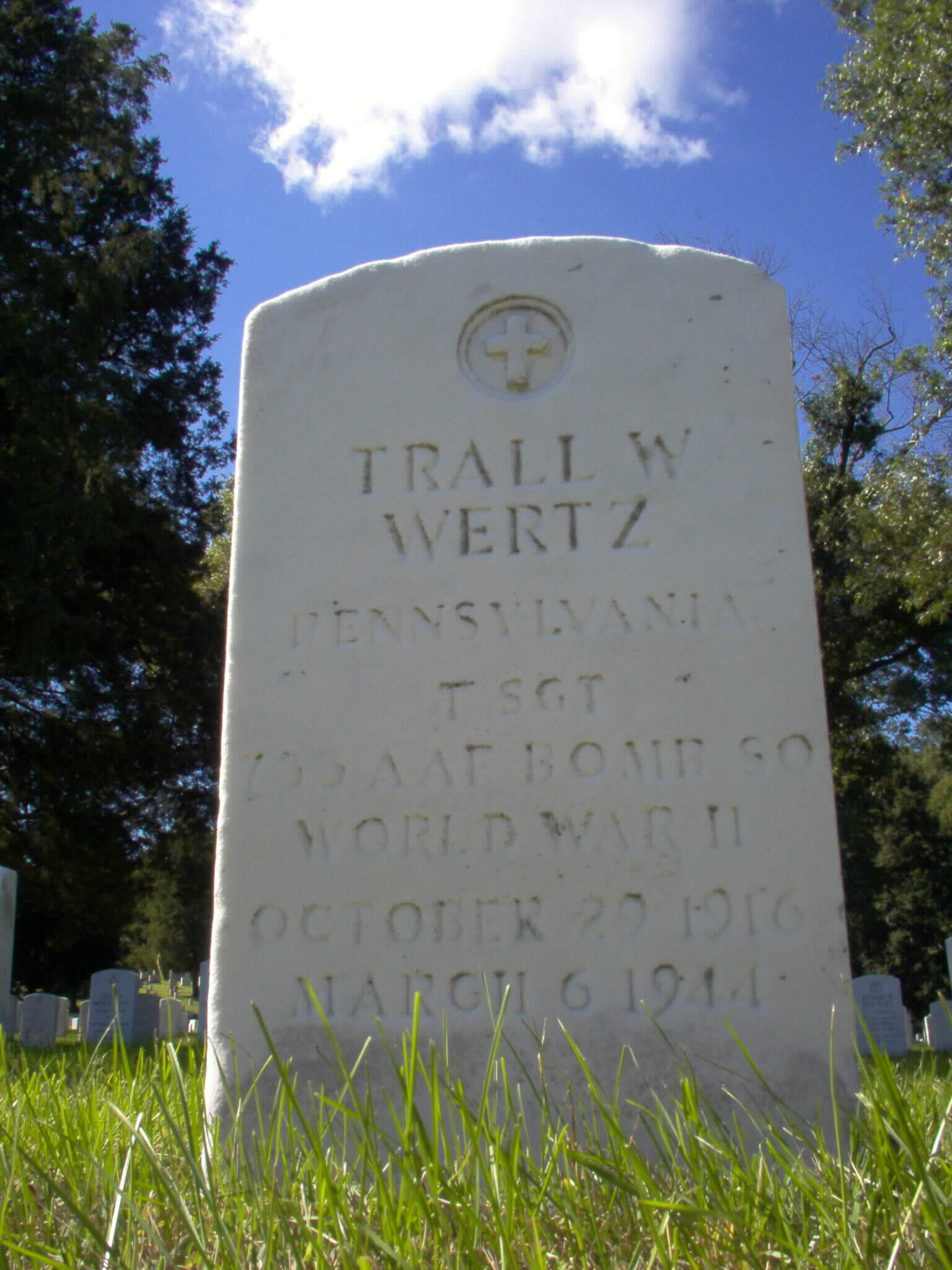
Here is the information I've research on T/Sgt Trall W. Wertz ser # 13089659 I added a few extra items use them if you want but the day he died March 6, 1944 was the first Daylight bombing raid on Berlin by the 8th AFF. If you need anything else let me know. I don't have a photo of T/Sgt Wertz yet but I do have his engraved Purple heart medal.
Rick Malerba, October 2005
Trall W. Wertz was born on October 29, 1916 and was both raised and educated in Jeanette Pennsylvania. He enlisted in the United States Army Air Force on February 10, 1942 at Greenburg Pennsylvania.
After completion of training he was assigned to the 733rd Bomb Squadron 453rd Bomb Group Heavy The group arrived at Old Buckenham, England, 23 December 1943. The 453rd Bomber Group began its first mission on 5 February 1944.
On March 6th, 1944 Sergeant Wertz was a crew member of B-24 H-10-CF Plane # 42-64457.
Official AAF report of Mission first daylight bombing raid on Berlin, Germany, by the 8th Army Air Force:
6 Mar 1944: Berlin was the target for all three 8th USAAF Divisions this date, which would see a turning point in the daylight air battles over Europe. A total of 672 B-17s and B-24s fought their way to the German capital. Hundreds of German fighters rose to meet them and in one of the biggest air battles of World War Two, 69 U.S. bombers were lost.
The 100th Bomb Group at Thorpe Abbotts, Norfolk, lost 15 B-17s in this action, reinforcing their nickname: “The Bloody Hundredth.” For the Luftwaffe however, it marked the beginning of a decline. Over 800 fighters escorted the American bombers, and the German interceptors had to fight their way past these. A total of 82 enemy fighters were shot down in combat with the P-47s, P-51s and P-38s, while others fell to bomber-crew return fire.
The flood of replacement aircraft and personnel arriving in the UK from America meant the 8th USAAF quickly made good their losses; the Luftwaffe however, while it could to some extent replace the aircraft, could not make up the loss of some its most experienced pilots killed or seriously wounded in the ferocious air-battles. Their numbers were being whittled down by fighters which now ranged across Germany and escorted the bombers all the way to and from targets as distant as Czechoslovakia and Poland.
At 1553 hours, B-24 Liberator 42-64457 of the 453 Bomb Group from old Buckenham, Norfolk, crashed in the sea off Corton, at a position 3 miles NE of Lowestoft. Damaged in the flak barrage over Berlin, the B-24 was further damaged by fighters on the return flight, and finally abandoned by the crew as they neared the Suffolk coast. RAF HSLs (High Speed Launches) from Gorleston and Lowestoft were quickly on the scene, along with an ASR Walrus aircraft, but of the 10 crew, only 5 survivors and a body were pulled from the icy water. Four crewmen were never found.
NOTE: The Body refered to in the last part of the report was Trall Wertz. His remains were temporally interned in the Cambridge Cemetery in England. On or about July 20, 1948 his remains and 56 others were interned at Arlington National Cemetery Fort Myer Virginia.
First Strike on Berlin
“No bomb shall fall on German soil” was the brash claim made by Reichmarshal Hermann Goering before the start of World War II.
A couple of years into the war the Luftwaffe's boastful commander updated his arrogant statement with “If enemy bombers ever appear over Berlin you can call me Meier.” On March 6, 1944 they called him Meier. The German supreme would have kept his head well down on that day, for it was the day the Eighth Air Force arrived overhead the German capital.
Berlin – Big B to the bomber crews – was protected by the cream of the Luftwaffe, and by thousands of anti-aircraft batteries strategically positioned around the city. To approach Berlin from the air was the bomber pilots nightmare. Of the 700 bombers that set out that historic day, 69 would not return; but the B-17 gunners and their escort fighters gave as good as they got.
On that first successful daylight raid, and on the many missions to Berlin that followed, losses were high, but the daytime bomber strikes against the heart of Nazi Germany had an incalculable effect on enemy morale, to say nothing of the disruption to the German war machine. They did more: they signalled to Goering and his Führer that their fate, and that of the Third Reich, was sealed; and the 140,000 USAAF aircrew who flew the torturous attacks to Berlin earned themselves a special place among those who have endeavoured against tyranny.
The following was provided by Bruce Wertz Great nephew of Trall Wertz:
I never knew Trail – he was killed 8 years before I was born – but I feel a responsibility to keep his memory his and military contribution alive. Both Trall and My Father served in the 8th AAF as T/Sgt.’s on B-24 crews stationed in England. My Father was Trall’s nephew, but they were only a few years apart in age.
I can tell you that on March 6, 1944, Trall was a replacement crew member on another plane. Apparently, several crews had been decimated by members Killed In Action and remaining crew members were split up to form complete crews for this important mission to bomb Berlin in daylight. Trall’s original Pilot was Lieutenant George Wear who piloted another plane on March 6, 1944. Trall was part of a crew piloted by Lieutenant Elmer Crockett who survived the crash and in fact was shot down a second time on another mission in late April, 1944, again surviving. As you know, Crockett’s plane was #42-64457. This was not Trall’s normal aircraft, however. Three other planes from the squadron were lost on March 6, 1944 – #42-64460, #42-52226, and #42-5219. Trall’s original crew pilot, George Wear, apparently, is still alive and living in Monroe, Louisiana, at least that’s what I have been told.
I have attached a picture of Trail’s original crew put together in the States and sent to Old Buckenham Air Base in East Anglia, England. As I mentioned several crew members were Killed In Action prior to March 6, 1944. Golbski, Diederich and Anderson had already been MIA on a mission February 22, 1944. Trail’s Co-Pilot, Gilbreath was MIA March 6, 1944 flying with another crew, and a member from Crockett’s crew by the name of Santora was MIA ironically in the same plane as Gilbreath. The names below were written on the back of the photo in Trail’s handwriting:
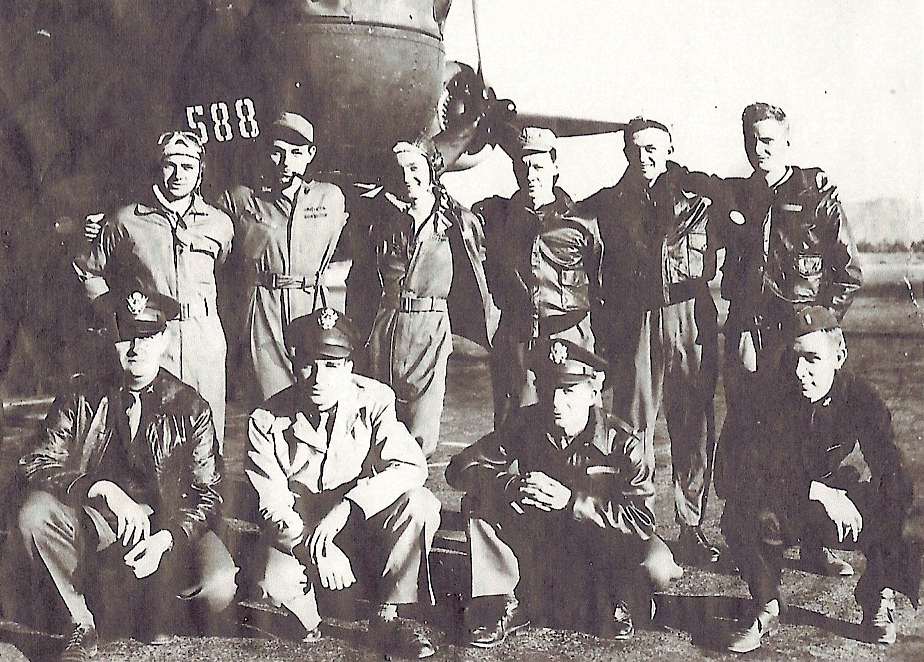
Front Row from Left to Right: Pilot, Lieutenant George Wear (Colombia, Louisiana), Seymour Cohen, Navigator (New Jersey),
Ralph J. Swafford, Bombardier (St. Louis, Missouri), Co-Pilot, Second LieutenantLt. Ray Gilbreath (Massachusetts)
Back Row from Left: T/Sgt. Trail W. Wertz, Radioman (Jeannette, Pennsylvania), Jim Meyers, Nose Gunner (Buffalo, New York)
Staff Sergeant James Golbski, Lower Gunner (Biddendorf, Iowa), Raymond J. Diederich, Top Gunner (St. Joseph, Michigan),
Staff Sergeant Richard Anderson, Tail Gunner (North Canton, Ohio), Robert B. Williams, Engineer (Sheibourne, Massachusetts)
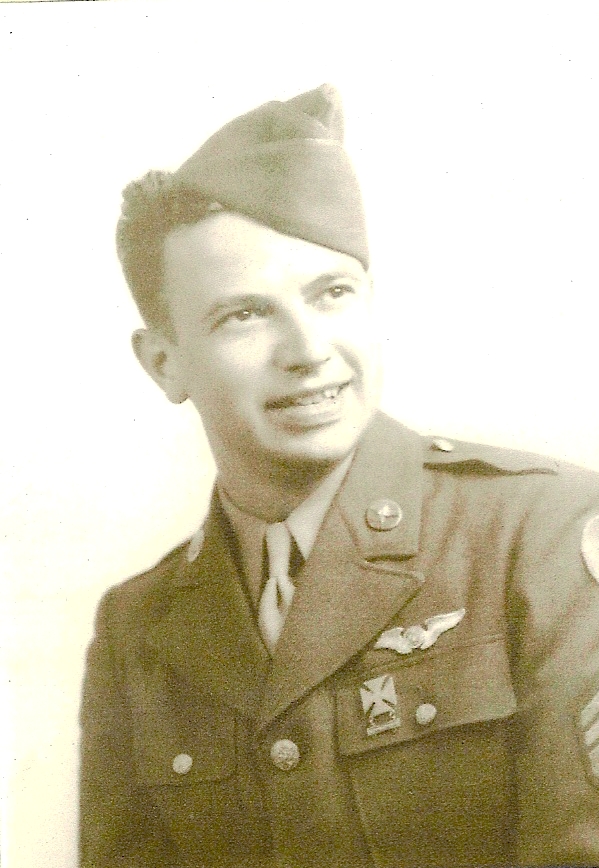
Trail W. Wertz
Another interesting footnote for Trail Wertz is that his Mother, Adele (Della) Werner Wertz, was born in Germany and emigrated to the U.S. at age 16. Trail grew up bilingual speaking German and English.
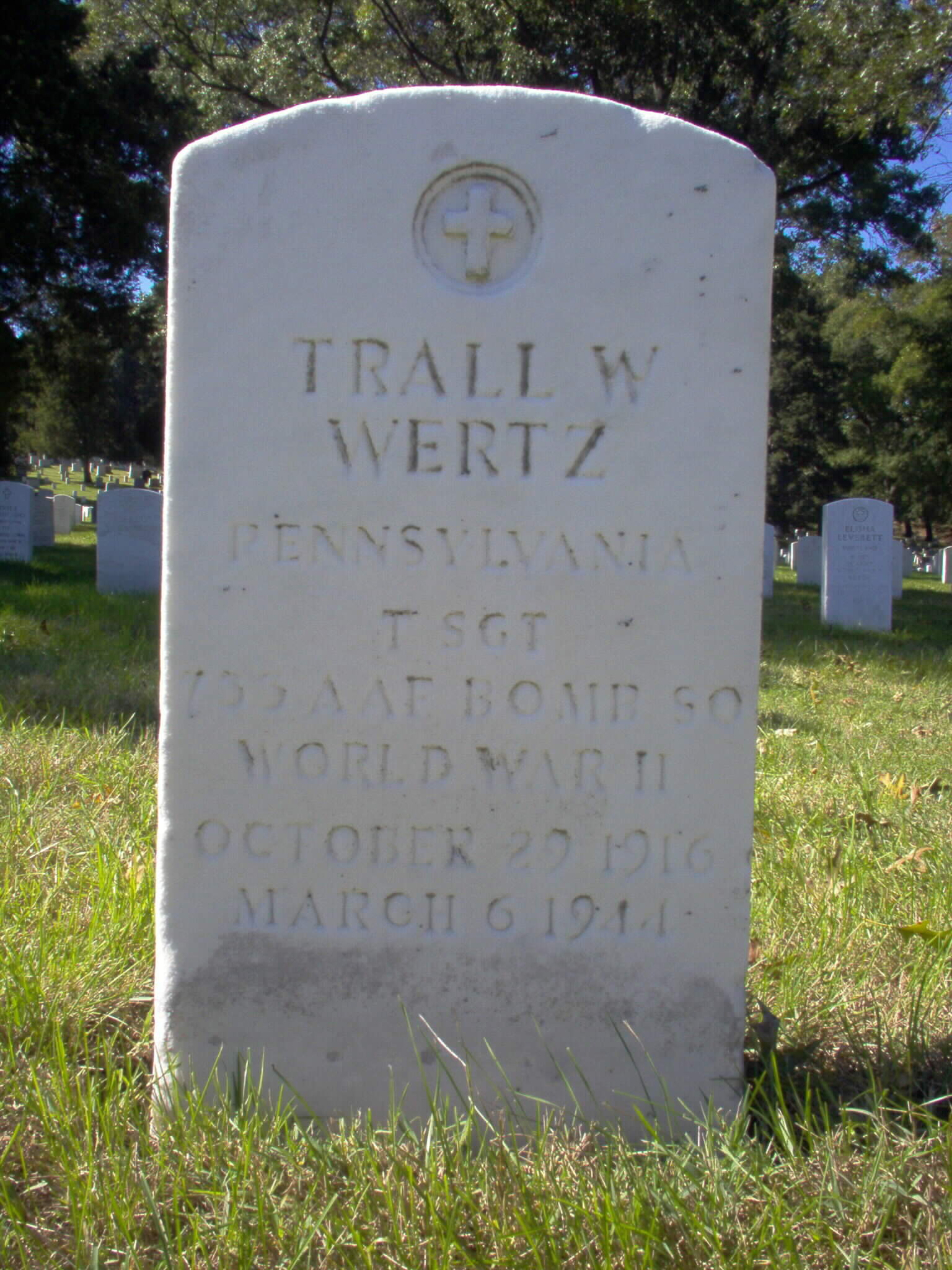
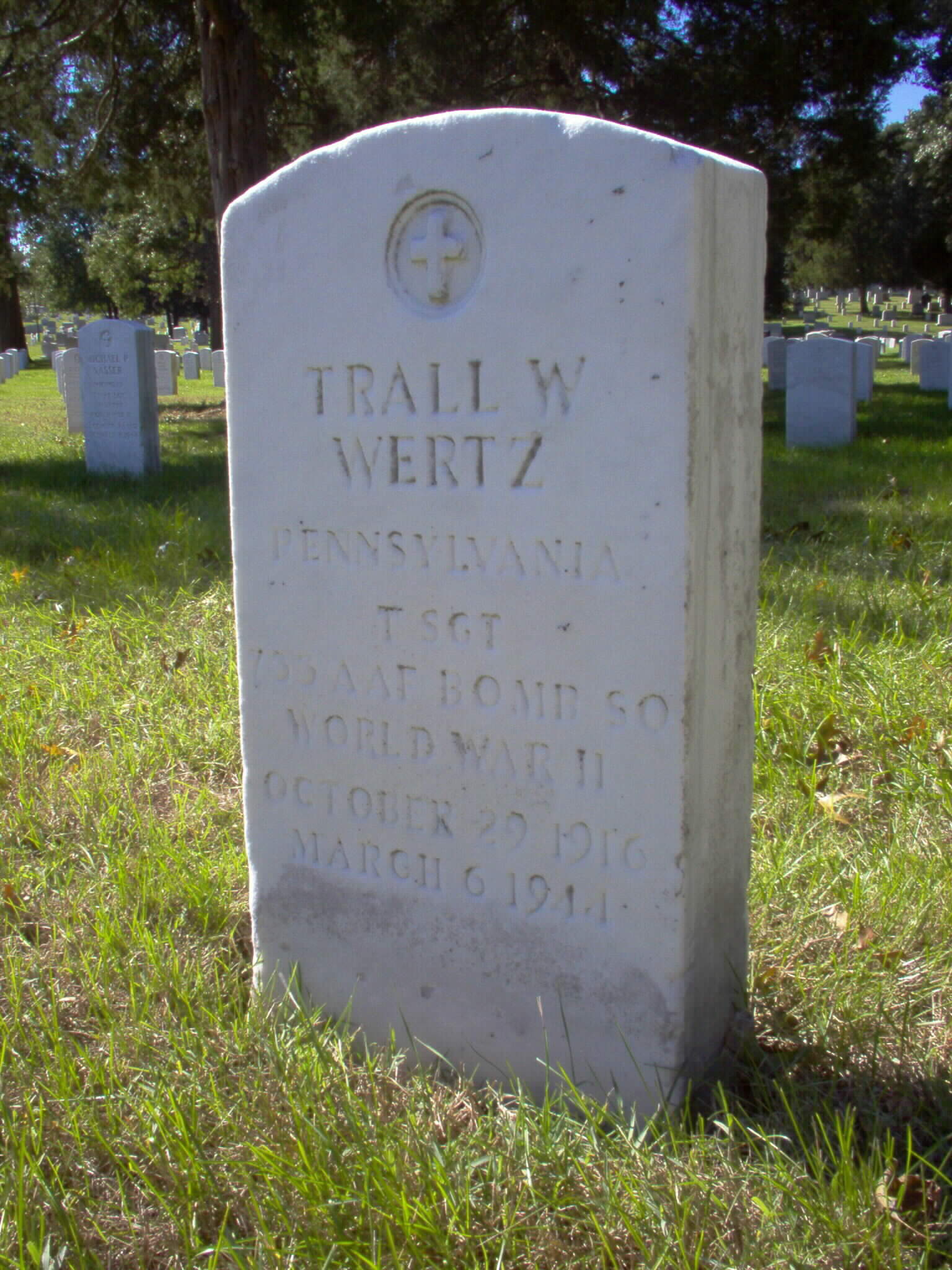
WERTZ, TRALL W
- T/SGT AAF USA WWII
- DATE OF BIRTH: 10/29/1916
- DATE OF DEATH: 03/06/1944
- BURIED AT: SECTION 12 SITE 1540

Michael Robert Patterson was born in Arlington and is the son of a former officer of the US Army. So it was no wonder that sooner or later his interests drew him to American history and especially to American military history. Many of his articles can be found on renowned portals like the New York Times, Washingtonpost or Wikipedia.
Reviewed by: Michael Howard