
Courtesy of the U.S. Army Quartermaster Museum:
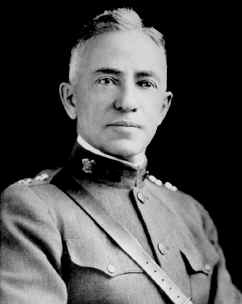
Major General William H. Hart
26th Quartermaster General
August 1922 – January 1926
William Horce Hart was born at Winona, Minnesota., on March 20, 1864. There he obtained his early schooling, graduating from the Normal School of Winona. His family then moved westward, settling at Bath in Dakota Territory. Hart attended the United States Military Academy, becoming the first cadet appointed from the Dakota Territory, graduating in 1888.
Assigned to the 20th Infantry on June 11, 1888, he served on frontier duty at Fort Assinniboine, Montana, for less than a year before transferring to the 4th Cavalry. For almost a decade he followed the guidons of the cavalry at frontier posts in Arizona, Idaho, Montana, Colorado, Nebraska, and Washington. He was promoted to First Lieutenant on May 23, 1896, and transferred to the 7th Cavalry, serving as its Regimental Quartermaster until June 1898.
At the outbreak of the Spanish-American War, General Hart served for several months as aide-de-camp to Brig. Gen. B. V. Sumner, commander of the 7th Cavalry, and then was temporarily assigned to the Department of Colorado as chief commissary. He saw no service in Cuba during the war, but his regiment was with the Army of Cuban Occupation from January 1899 to November 1900.
In the fall of 1898 he applied for transfer to the Quartermaster's Department. Two years later when a place was available in the Subsistence Department, General Hart was transferred to that Department and was appointed Captain and commissary. In the next three years his assignments took him to New York as assistant to the purchasing commissary at the depot; to Chicago, first as acting chief commissary at Headquarters, Department of the Lakes, and them as assistant to the purchasing commissary at the depot; and to Manila, to serve at the depot and later as assistant to the chief commissary of the Philippine Division. There he pioneered the use of cold storage for
perishable foodstuff both on inter-island transports and rail cars making it possible to bring fresh meat, milk, fruits and vegetables to troops in the field.
On July 27, 1903, he was promoted to Major, and assigned to the Washington office as assistant to the Commissary General of the Army. During the period when he was serving in Washington, General Hart developed the first practical Army field range and bake oven for use in the field. He patented this range, which was the cause of disagreement with his superiors who though that the invention belonged to the government. For that reason the Army failed to adopt the field range. In 1911 the Army produced a field range identical to his design causing General Hart to ask for an inquiry which was denied.
General Hart was temporarily detached to attend a course of study at the British Army Service Corps School at Aldershot, England 1908-09. After returning to the United States he was assigned depot commissary at Honolulu, a post he held for about fifteen months. On February 23, 1911, Major Hart was assigned to San Francisco as purchasing commissary and subsistence
superintendent, Army Transport Service. The next year, after the consolidation of the Subsistence, Pay, and Quartermaster's Departments, he was designated assistant to the depot Quartermaster at San Francisco and on March 6, 1913, was promoted to Lieutenant Colonel in the Quartermaster
Corps. He temporarily assumed the duties of depot Quartermaster and general superintendent, Army Transport Service, at San Francisco between April 1, 1914, and June 15, 1916. He was transferred to Seattle, Wash., in the fall of 1916 as depot Quartermaster and served there until July 4, 1917, being promoted to Colonel on May 2.
During World War I his assignments took him to Fort Sam Houston, Texas, as depot Quartermaster and department Quartermaster of the Southern Department from July 10, 1917, to January 1, 1918; then to Jeffersonville, Indiana, as depot Quartermaster for about the first six weeks in 1918; and
finally overseas for duty with the American Expeditionary Forces.
From March 1918, to April 1919, he served at St. Nazaire, France, as Base Quartermaster, Base Section No 1. There he was in charge of the great depots at St Nazaire, Nantes, and Montoir, the largest and most important supply bases in France. For his successful and efficient administration of
those depots, he was awarded the Distinguished Service Medal and was also decorated with the Legion of Honor by the French government in recognition of his services the Allied cause.
When General Hart returned to the United Sates after the war, he established a reputation for conscientious performance in downsizing Army depots. He was instructed to effect drastic reductions without interfering with the efficient supply of the Army. So effective were his measures that over $6,000,000 was saved, and the Secretary of War commended him for his zeal and administrative ability.
While serving at the New York Depot, He was appointed Quartermaster General with the rank of Major General on August 28, 1922. As Quartermaster General he continued to oversee the downsizing and restructuring of the Quartermaster Corps as the Army transitioned to a smaller peacetime organization. General Hart was responsible for a educational program for Reserve Officers that he called “Winter Plattsburgs.” Organized in the more important business and industrial centers where efficient instruction and supervision were attainable, that project provided a course of logistics training during the winter months designed to familiarize reserve Quartermaster officers and interested civilians, with their duties in time of war and with the problems of industrial mobilization. He also fostered close ties between the Corps and civilian industry.
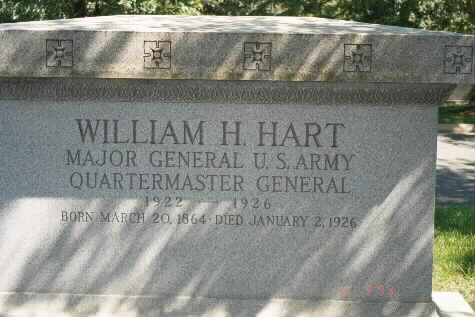
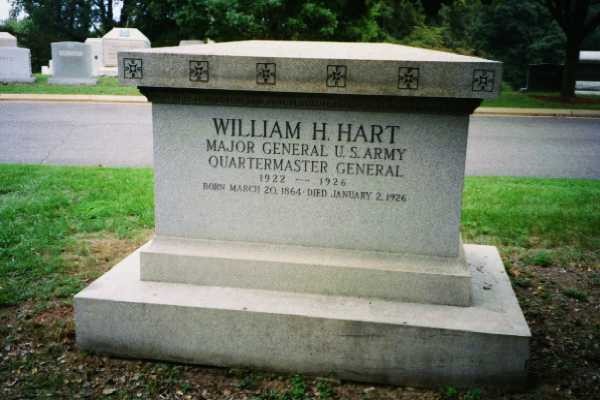
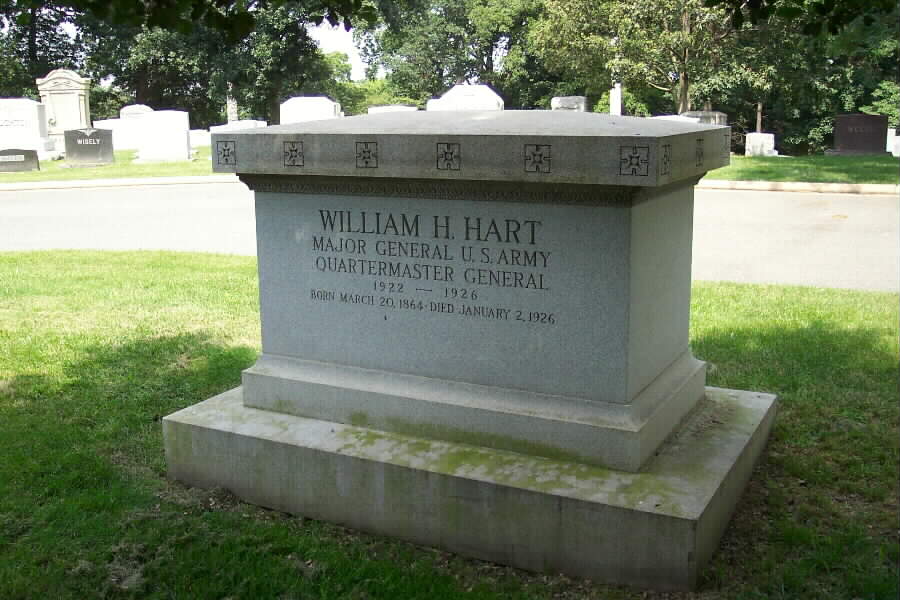
General Hart died at Walter Reed General Hospital January 2, 1926. He was the first Quartermaster General to die in office since General Thomas S. Jesup in 1860. He was buried with full military honors at Arlington Cemetery.

Michael Robert Patterson was born in Arlington and is the son of a former officer of the US Army. So it was no wonder that sooner or later his interests drew him to American history and especially to American military history. Many of his articles can be found on renowned portals like the New York Times, Washingtonpost or Wikipedia.
Reviewed by: Michael Howard