
Representative and Senator From Michigan
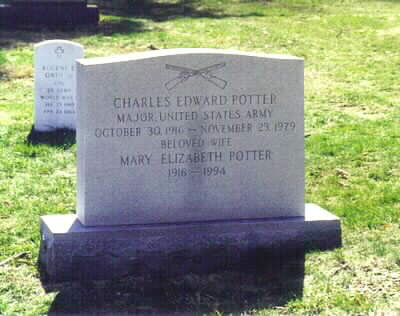
Born at Lapeer, Michigan, October 30, 1916, he received an AB degree from Eastern Michigan University, 1938, and a LD degree from Hillsdale College, Michigan, 1935. He married Mary Elizabeth Bryant Wismer.
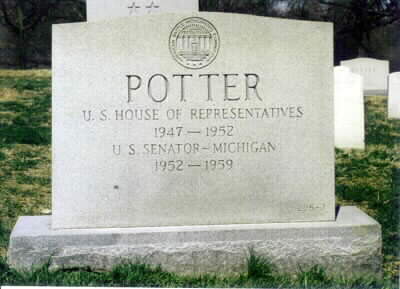
He served as an Administrator, Bureau of Social Aid, Cheboygan County, Michigan, 1938-42; Vocational Rehabilitation Adviser, Retraininga and Reemployment Administration, Washington, D.C., 1946-47. He was elected to the 80th Congress, 11th District of Michigan, to fill the unexpired term, 1947. He was reelected to the 81st and 82nd Congresses. He was appointed United States Senator for the unexpired term of Senator Vandenberg, 1952-53, and was elected to a full term in the Senate, 1953-59. He was chairman of the 1972 Campaign Liquidation Trust; Chairman of the Board of Potter International, Inc. Vice Chairman of the American Battle Monuments Commission.
He served as an Army combat officer in World War II with the 28th Infantry Division and was wounded at Colmart, France, in 1945. He was discharged from the Army as a Major in 1946. He was awarded the Silver Star (2); French Croix de Guerre with Silver Star; the U.S. Purple Heart with 2 oak leaf clusters. He was a Republican, a Methodist, an Eagle, an Elk and a Kiwanian. He was the author of “Days of Shame,” 1965.
He resided at Queenstown, Maryland, until his death at Walter Reed Army Hospital in Washington, on November 23, 1979. He was buried in Section 30 of Arlington National Cemetery.
Courtesy of the U.S. Congress:
Representative and a Senator from Michigan; born in Lapeer, Mich., October 30, 1916; attended the public schools; graduated from Eastern Michigan University, Ypsilanti, Mich., in 1938; administrator of Bureau of Social Aid, Cheboygan County, Mich., 1938-1942; in 1942 enlisted as a private in the United States Army with combat service in the European Theater of Operations; seriously wounded in France in 1945, resulting in the loss of both legs; discharged from the service as a major in 1946; engaged as vocational rehabilitation representative for the Retraining and Reemployment Administration with the United States Labor Department until his resignation in 1947; elected as a Republican to the Eightieth Congress in 1947 to fill the vacancy caused by the death of Frederick V. Bradley; reelected to the two succeeding Congresses and served from August 26, 1947, until his resignation November 4, 1952; elected to the United States Senate in 1952 to fill the vacancy caused by the death of Arthur H. Vandenberg and served from November 5, 1952, to January 3, 1953; also elected in 1952 for the term commencing January 3, 1953, and served until January 3, 1959; unsuccessful candidate for reelection in 1958; engaged as an industrial consultant and international securities executive; member of the American Battle Monuments Commission; resided in Queenstown, Md., until his death at Walter Reed Army Hospital, Washington, D.C., November 23, 1979; interment in Arlington National Cemetery, Ft. Myer, Va.

Michael Robert Patterson was born in Arlington and is the son of a former officer of the US Army. So it was no wonder that sooner or later his interests drew him to American history and especially to American military history. Many of his articles can be found on renowned portals like the New York Times, Washingtonpost or Wikipedia.
Reviewed by: Michael Howard