
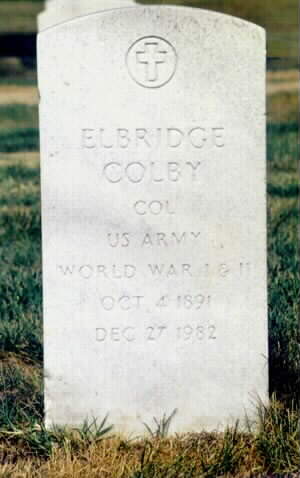
Elbridge Colby was incensed by the murder in 1925 of a black soldier from Fort Benning, Georgia–shot dead when he refused to step off a sidewalk to let a white man pass. In the Nation magazine, he denounced the murderer's acquittal by an all-white jury and badly damaged his army career.
In 1925, Captain Elbridge Colby, United States Army, helped formulate the U.S. attitude towards air power as an instrument of total war. He wrote that a “belligerent will not wish to risk his planes and pilots, expend his gasoline, or waste his munitions, on any objectives except those of military importance.” This was already problematic, given the U.S. tradition of defining “military targets” rather broadly.
Colby went on to say that everyone knows that bombing is highly inaccurate. “Innocent people are bound to be struck,” he says, even if the bomber’s intention is to strike a genuinely military target [my italics]. He surveyed standing legal doctrine and concluded, rather predictably, that since adherence to the rules would virtually outlaw bombing, it was the rules, not the bombing, which must yield. No one, he said, could possibly be expected to forego wielding such a convenient and useful weapon. Interestingly, he cites British bombing of Afghanistan in May 1919 as telling precedent.
Born on January 4, 1920, in St. Paul, Minnesota, William Colby, a future Director of the Central Intelligence Agency, grew to his teens as an Army brat.
His father, Elbridge Colby, became a lieutenant shortly after his son’s birth, returning to the U.S. Army after seeing service in World War I.
Like so many military families, Lieutenant Colby and his wartime bride, Margaret Mary Eagan Colby, along with their son, moved frequently.
Before his sixteenth birthday, young William had experienced substantial foreign travel and could count residences from the Canal Zone to Tientsin, China, and United States addresses from Minnesota to Georgia and to Vermont.
He wrote many books on military history, and he was the head of the George Washington University Journalism Department, 1948-1958.

Michael Robert Patterson was born in Arlington and is the son of a former officer of the US Army. So it was no wonder that sooner or later his interests drew him to American history and especially to American military history. Many of his articles can be found on renowned portals like the New York Times, Washingtonpost or Wikipedia.
Reviewed by: Michael Howard