
James A. Greer (28 February 1833-17 January 1904) was an Admiral in the United States Navy who served during the Civil War.
Born in Cincinnati, Ohio, Greer enlisted in the Navy in 1848. He entered the United States Naval Academy in 1853 and graduated as a Passed Midshipman the following year. After participating in the Paraguay Expedition, he cruised the west African coast until the outbreak of the Civil War.
Greer was serving on board the USS San Jacinto on November 7, 1861, when she stopped the British steamer Trent and removed the Confederate diplomatic commissioners on their way to Britain, thereby nearly drawing Great Britain into the war on the Confederate side. This incident became celebrated as the Trent Affair.
Greer served on the USS St. Louis from 1862 to 1863, and then was attached to Rear Admiral David Dixon Porter's Mississippi Squadron.
While in command of the ironclads Carondelet and USS Benton, he participated in the Vicksburg campaign and the shelling of Grand Gulf as well as the abortive Union Red River expedition.
After commanding the Naval Station at Mound City, Illinois, he assumed command of the hip USS Blackhawk, and then was in charge of conveying Army transports up the Tennessee River.
A tour of duty as Assistant to the Commandant at Annapolis after the war was followed by command of USS Mohongo on the Pacific Station, where Greer was commended for “defending American interests” in Mexico. After a tour of duty at the Naval Academy between 1869 and 1873, Greer returned to the Pacific Station.
In 1873 he commanded the USS Tigress when that ship was sent to find and aid the ship Polaris. The Polaris was wrecked on an Arctic expedition which had been led by Charles Francis Hall.
After special service in Constitution during the Paris Exposition, Greer held a variety of shore posts and then served as commander of the European Squadron from 1887 to 1889.
Promoted to Rear Admiral in 1892, he retired on February 28, 1895. Admiral Greer died in Washington, D.C.
The destroyer USS Greer (DD-145) was named for him.
Born at Cincinnati, Ohio, 28 February 1833, the son of James and Caroline (King) Greer. Married Mary Randolph Webb and had one daughter and two sons. He received an appointment to the United States Navy from Ohio, 10 January 1848, attending the US Navy School, Annapolis, Maryland, January-March 1848.
Born: Cincinnati, Ohio, February 28, 1833. Educated in private schools, Dayton, Ohio. Married: Mary Randolph, daughter of Captain T.T. Webb, United States Navy, November 26, 1857. Entered the United States Navy as a midshipman, January 10, 1848. Became Lieutenant, September 16, 1855, Lieutenant Commander, July 16, 1862. Assisted in the removal of Mason and Slidell from British steamer “Trent.” Commanded the iron-clad “Benton” and a Division of Admiral Porter's squadron at the passage of the Vicksburg batteries, April 16, 1863 and succeeding engagements. Fought at the battles of Grand Gulf for 5 hours, April 29, 1863. Was with Red River expeditions, etc.
After the Civil War he was promoted through various grades to Rear Admiral. Commanded the USS Tigress in the Polaris search expedition, 1873, finding the wreck at Littleton Island, North Greenland. Commander, US European Naval Station, 1887-89. Chairman, Lighthouse Board, 1891-94. President, USN Examining and Retiring Board, December 1, 1894. Placed on the retired list, 28 February 1895.
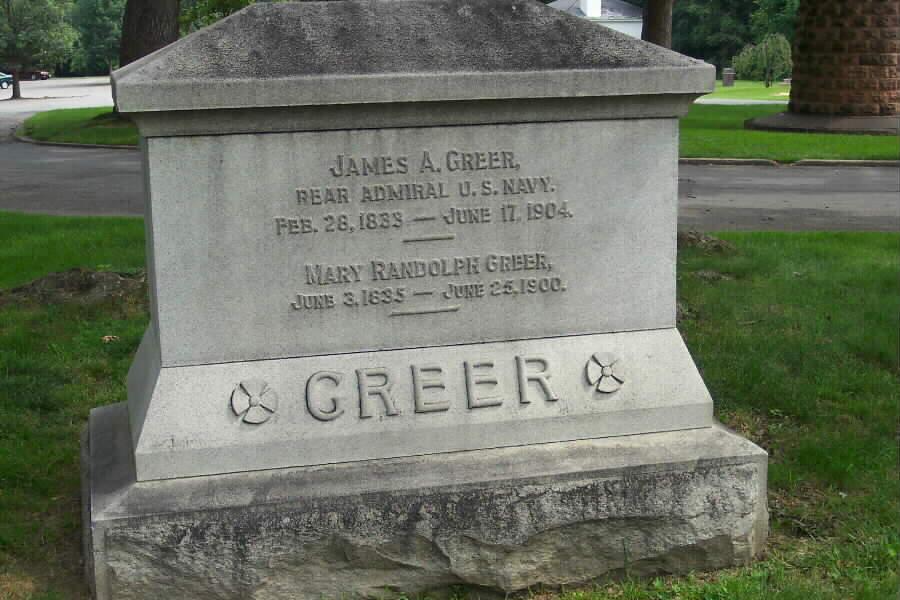
Admiral Greer died June 17, 1904 in Washington, D.C. and was buried in Section 1 of Arlington National Cemetery.
Mary Randolph Webb Greer was born on June 3, 18354 and died on June 25, 1900. She is buried with her husband in Section 1.
James Augustin Greer, Naval Officer, born in Cincinnati, Ohio, 28 February, 1833. He entered the navy as Midshipman, 10 January 1848, became Lieutenant, 16 September, 1855, and Lieutenant Commander, 16 July, 1862.
He commanded the iron-clad “Benton” and a division of Admiral Porter's squadron at the passage of the Vicksburg batteries on 16 April, 1863, and in the succeeding engagements on the Mississippi until the fall of that City. He also accompanied the Red River expedition. He was made commander, 25 July, 1866, and in 1873 commanded the ” Tigress” in the “Polaris” search expedition. He was promoted to the grade of Captain on 26 April, 1876, in 1886 served as President of the Examining Board, and in the same year was made Commodore.

Michael Robert Patterson was born in Arlington and is the son of a former officer of the US Army. So it was no wonder that sooner or later his interests drew him to American history and especially to American military history. Many of his articles can be found on renowned portals like the New York Times, Washingtonpost or Wikipedia.
Reviewed by: Michael Howard