
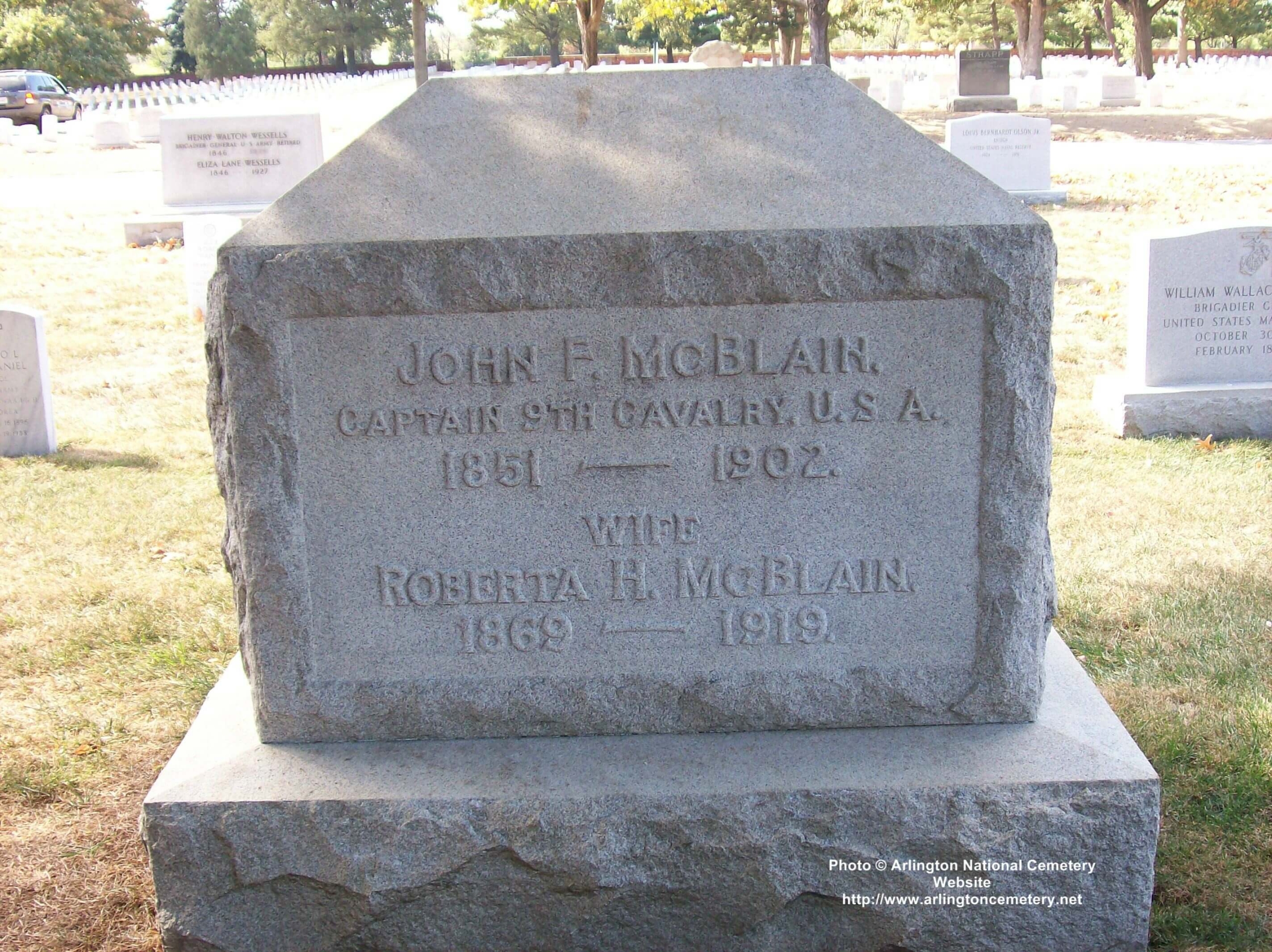
McBlain, John Ferral of Pennsylvania
Served in the Army as Private, Corporal and Sergeant, Troop L, 2nd U. S. Cavalry, 7 October 1872 to 29 June 1877 and from 22 October 1878 to 16 July 1880
Second Lieutenant, 8th U. S. Cavalry, 24 June 1880
First Lieuetnant, 11 February 1887
Captain, 29 June 1897
Died 22 November 1902
Was a participant, in the 1876 Sioux Indian Campaign as well as various campaigns of the Spanish-American War.
Note: His son, John Ferral McBlain, Jr., Major General, United States Air Force, is also buried in Arlington National Cemetery.
From: “In Defense of a Career: John Ferral McBlain, Captain, 9th Cavalry, U.S. Army” By: Mary H. Yuhasz
The military career of John Ferral McBlain took many twists and turns in the decades after the Civil War. At the age of 21 he joined the army in Philadelphia and served two enlistments with the Second Cavalry in the Montana Territory.
His cavalry battalion arrived at the Little Bighorn battlefield the day after Custer's fatal encounter with the Indians. In 1880 he was one of the few enlisted men who rose through the ranks to become an officer with the Buffalo Soldiers of the Ninth Cavalry. His army career nearly came to an end in 1886, following a series of unforeseen and improbable events.
When the Spanish-American War broke out, Captain McBlain and his Buffalo Soldiers were sent to Cuba, where they distinguished themselves at San Juan Hill fighting alongside Teddy Roosevelt. Captain McBlain narrowly escaped death several times during his thirty years in the field. However, while on duty in the Philippines, his health gradually began to fail. He returned to a recruiting assignment in Texas where he died in 1902.
Roberta Hardesty, married Captain McBlain, U. S. A., who died in Houston, Texas, and was interred in the National Cemetery at Arlington. They resided at Fort Riley, Kansas, and after his death she was appointed postmistress at that place by President Roosevelt and has served two terms. They had one son, John F. McBlain, who is now a lad of eleven years.
MCBLAIN, JOHN F
- CAPT 9TH US CAV
- DATE OF DEATH: 11/22/1902
- BURIED AT: SITE 1361
- ARLINGTON NATIONAL CEMETERY
MCBLAIN, ROBERTA HARDESTY W/O JOHN F
- DATE OF DEATH: 08/17/1919
- BURIED AT: SECTION S N SITE 1361
- ARLINGTON NATIONAL CEMETERY
- WIFE OF JF MCBLAIN, CAPT 9TH U S CAV
With Gibbon On The Sioux Campaign Of 1876
BY FIRST LIEUTENANT JOHN F. McBLAIN, NINTH CAVALRY. U. S. ARMY.
THE spring of 1876 witnessed unusual activity in military matters in the Northwest.The war department had determined upon putting an end to the annual outbreaks of the Sioux and kindred tribes of Indians, if possible, and to this end had ordered preparations to be made for extended operations in the Departments of the Platte, under General CROOK, and Dakota, under General TERRY.
General JOHN GIBBON, with a column made up of six companies of his own regiment, the Seventh Infantry, and four troops of the Second Cavalry, under Major J. S. BRISBIN, left Fort Ellis, Montana, early in April, 1876, under orders to patrol the north bank of the Yellowstone River, to intercept and capture any hostile Indians that might be driven that way by General CROOK, who was to operate from the south.
Whether the Montana column took the field earlier than was intended, or the Department of the Platte column was later than it should have been, I have never been able to ascertain, but the former was quite a long while in the field before anything was heard of the movement of the other troops. General GIBBON'S command had used up all the rations it had taken with it, had drained all the Montana posts, and had contracted for meats and hard bread long before, there was any apparent movement in the south.
At Fort Pease, a stockade built on the north bank of the Yellowstone a little below the mouth of the Big Horn by a party of Montana trappers and prospectors, and named for Major PEASE, their leader, was the first place that GIBBON'S column camped for any length of time, and here the command was nightly visited by hostiles; not that any attack was made, but nearly every morning there were unmistakable evidences that prowlers had been in our camp the night before. One night several head of ponies were stolen; this, too, in spite of the fact that we had a number of Crow scouts with the command, and that the camp was well guarded, and with outlying pickets.
In 1877 one of the officers of the Second Cavalry was recognized by a surrendered Cheyenne as one of a party of officers that had been engaged in a game of cards in a room in the stockade on the night the horses were stolen. This Cheyenne was one of the hostiles participating in that visit, and made his way to the stockade around which the troops were camped, had looked through the window at the officers playing. The officer—Captain S. T. HAMILTON, retired —recollected that on that night he had been one of a card party in the stockade. The next camp was made nearly opposite the mouth of the Rosebud, and it was in this camp that the rations began to get low, and it was also here that the command lost the only men it did on the campaign. Three men, two soldiers and a civilian teamster, in violation of positive orders against leaving the camp for hunting or any other purpose, went out, presumably to hunt, and were killed within sight of the camp. The camp was alarmed by considerable firing along a line of hills a couple of miles distant, and along which men could be seen running. Infantry companies were hurried to the fords above and below the camp in the hope of intercepting any Indians that might try to escape that way, while the cavalry herds were brought in quickly, and a troop dispatched in the direction in which the men were seen running. It was soon learned that these three men had been killed, and it is doubtful if they ever saw the Indians who killed them. They were ambushed, killed and mutilated. The writer was one of a party sent out with litters to bring in the bodies, and the sight of them was one not soon to be forgotten, for they had been mutilated in all the various forms that Indian deviltry and fiendishness could devise. One of the men had his own hunting-knife sticking in his head close behind the ear. The bodies were given a soldier's burial under a large cottonwood tree, and their names and date of death carved upon it.
This camp was arranged nicely for defensive purposes, and as we were in the heart of the Sioux country the fine soldierly instincts of the commander appreciated the necessity for constant vigilance and preparation for any attack that might be made. The wagon train was in an almost circular corral, around which were camped the six companies of infantry; at the open or entrance side of the corral was camped the four troops of cavalry, two on each side, the flanks furthest from the corral being thrown back so as to form a funnel-shaped driveway to the corral, through which would be driven all the animals in case of a threatened attack on the herds. The defensive strength of a camp like this can readily be seen. This camp was also visited nightly by hostile prowlers until General GIBBON, in order to be better prepared to repel a daylight attack, directed that the troops be quietly aroused at 2 o'clock every morning, and a line formed completely around and about 300 yards outside of the camp. We were not attacked, but that immunity was doubtless owing to the commander's precautions against surprise. One of our camps, before reaching the Rosebud, was known as the “alarm camp.”
The Indians could be seen on the opposite bluffs chasing buffalo, and our proximity did not appear to concern them in the least. The camp got its name from the fact that the picket on the river bank, on two different occasions at night, fired at what was thought to be an Indian crossing the river, but which proved to be, in each case, a log. General GIBBON tried very hard to cross the command at this place to attack the Indians who seemed to be so audacious and inviting, but owing to the river being in the fullness of its “June rise” it was physically impossible with the facilities at hand to get the command over, and after trying all manner of schemes and methods the attempt was abandoned. Right at this place was seen a beautiful illustration of the wonderful strength of the buffalo. Some few of our horses swum the river, but landed several hundred yards below the point at which they started, so strong was the current, whereas some buffalo that crossed the river did so in an almost straight line.
It is, I think, a cause for self-felicitation by the members of the command that we did not get across, for we subsequently ascertained that the Indians were entirely too strong for us, and that was why they seemed so indifferent to our being there. A few days after this we had reached a point a little above the mouth of Tongue River, when the steamer Far West was seen coming up the Yellowstone. Camp was made, and in a short time it was learned that General TERRY was aboard and that the Seventh Cavalry, under command of General CUSTER, was on the opposite side of the river; that Major RENO, with six troops of that regiment, had just made a reconnaissance to the Rosebud, locating the camp that GIBSON wanted to attack, and we were informed, in Montana parlance that those “were not our Indians. ”
We were then started back to the mouth of the Big Horn, as General TERRY, acting on the suggestion of the Crow scouts that we would find the hostiles on the Little Big Horn, probably at the “big bend,” planned to send CUSTER up the Rosebud, while GIBBON would go by way of the Big Horn, with the hope of catching the Indians between the two commands, thus “bagging” the whole crowd. The plan would have worked admirably had both its parts been conducted as the commander had a right to expect they would be.
A short halt was made at the Rosebud pending a consultation aboard the steamer between Generals TERRY, GIBBON and CUSTER and Major BRISBIN as to the advisability of CUSTER taking the four troops of the Second Cavalry with him, thus making sixteen troops. CUSTER was opposed to this; he thought his regiment strong enough to cope with any body of hostiles that might be out. We had no information from any of the Sioux agencies, neither had we heard of the rough handling that General CROOK had been subjected to at the head of the Rosebud just five days before this consultation, and CUSTER might be excused for his pardonable pride and confidence in his regiment. At any rate, the original plan was adhered to. CUSTER started up the Rosebud and GIBBON continued his march up the Yellowstone to the place where we were to cross.
June 24th GIBBON'S command was ferried across the Yellowstone by the steamer Far West and bivouacked on Tullock's Fork. The next morning it was on the march by daylight, and those who participated in that march will not soon forget it; after twenty years the writer's recollections of it is as of yesterday. Over the divide to the Big Horn, which was struck about 6 o'clock, and was our first water since leaving Tullock's Fork, which was but a series of alkaline pools, was a march that General TERRY characterized as one of the severest tests in the way of marching to which American soldiers had ever been put. It was a tramp that tried the mettle of the Seventh Infantry, but right nobly did that regiment respond to the call made upon it; we had a duty to perform, for CUSTER was coming in from the east, and we were not going to let it be said that while our commander had vouched for our being at the “big bend” of the Little Big Horn on the 27th that we would let a hard march prevent our being there. Some might fail, others might cause the campaign to be a failure, but they were not in the ranks of the Seventh Infantry; the regiment had not tramped from its post down the Yellowstone for nothing, and there was not a straggler on that day. The infantry went into bivouac immediately upon striking the river, while the cavalry continued its march.
Our guide, “MUGGINS” TAYLOR, an old frontiersman, who assumed the duties of guide after “MICH” BOWYER, our regular guide had been sent with CUSTER, had but an imperfect knowledge of the country over which we must go, and while he guaranteed taking the command through all right while he had daylight for it, he would not be so certain after dark. About sunset rain began falling and the night was as dark as Egypt, and it needed a good guide indeed to take us through that darkness ; the eye was of no use in this case for it could not see; instinct was what had to be depended upon; riding in column one could hardly see the man in his immediate front, although only three feet separated them, and TAYLOR was forced to acknowledge himself helpless. LITTLE FACE, a Crow scout, was then entrusted with getting us into the valley of the Little Big Horn. Shortly after his assignment to that task we were obliged to abandon the three Gatling guns that we had with us in a ravine, from which it seemed impossible to extricate the command. A mile or two further on we were floundering about in another ravine when General TERRY, concluding that we were not profiting any by marching in this way, ordered a bivouac, and right glad were we to have a chance to throw ourselves on the ground, which we did so soon as our horses were cared for and secured for the night.
Very early on the morning of June 26th Lieutenant BRADLEY, Seventh Infantry, who had command of the scouts, of which some were Crow Indians, left the bivouac, General TERRY intending to delay marching and to march slowly so as to permit the infantry to overtake us, and also to enable the artillery detachment to bring up the guns that had been left back the night before. The command had hardly got started when horsemen could be seen rapidly approaching us from our front; they proved to be Lieutenant BRADLEY and his scouts. It appeared that upon coming up out of the ravine in the morning, he espied several mounted Indians going like the wind, as though they were trying to escape from him. He followed them as fast as possible; the chase led down into the valley of the Little Big Horn, and from the timber and undergrowth on the banks of that stream the runaway Indians had a chance to see who it was that they were running away from, and when they saw that it was some of their own people with soldiers, they came from cover and showed that they were Crows. Then for the first time did white man learn of the fate of CUSTER and his command; these Crows were of the ones sent with CUSTER from GIBBON’S command. They told of CUSTER striking the Indians and of the result, telling us that the “soldiers were shot down like buffalo. ”
BRADLEY returned to the command, he and the infantry arriving at about the same time, and reported what the Indians had told him. So improbable did it seem that a whole regiment could have been annihilated; so averse were TERRY and GIBBON to believing that enough hostiles were out to do this, that they looked upon the reports as the imaginings of panic-stricken and cowardly Indians. And the actions of these Crows, who having been with GIBBON and knowing that he was expected from the direction in which we were approaching, had come upon us in the early dawn and were so frightened that they did not wait to satisfy themselves who we were, somewhat justified the belief that their reports were highly colored by terror. None of us as yet knew anything about the probable strength of the Indians off their reservations, or of CROOK'S unsatisfactory fight with a part of them at the head of the Rosebud on the 18th.
On the night of the 25th, when we were slowly and laboriously picking our way over the worrying windings of a night march during an Egyptian darkness, we observed a reflection off to our left and front. It was so faint that it was looked upon as atmospheric phenomena of some kind. In the morning the place of the light was taken by a column of smoke. Neither the light nor the smoke would have been thought much of, had it not been for the information brought us by these Crows, but the extent to which TERRY and GIBBON would credit their statements was that CUSTER had struck the hostiles and was burning their camp, thus accounting for the light and smoke, and the entreaties of the Crows for us not to go up there because the hostiles were so many, was not heeded further than to bring down upon their heads condemnation and threats of court-martial.
Although the commander was not willing to take the reports as given, he lost no time in pushing the command, so that we dropped down into the valley of the Little Big Horn about noon, when a halt was ordered, so that coffee could be made. While this was being done scouts were sent out to open communication with CUSTER, one being sent by way of the river and the other by the foothills which flanked the valley.
About half an hour after the march was resumed one of the scouts returned with the information that he could not get through for hostiles, and it was but a short time after when the other returned with a similar report; still it would, not be believed that CUSTER had met with serious reverse. However, we advanced very cautiously up the valley; advance and flank patrols were sent out, and about midway in the afternoon a small bunch of Indian ponies came out of the timber on the river and came to the column, but did not seem to be satisfied to remain with us, and galloped ahead toward the advance party; they had gone about halfway when several Indians darted out of the timber and drove the ponies up into the hills; their audacity was something wonderful, but no firing could be permitted for fear of hitting some one in the advance party or in the main column.
Late in the afternoon figures could be seen on the bluffs to the right front of the column, and along which Lieutenant C. F. ROE with his troop, “F,” Second Cavalry, was marching as flankers. Later it could be seen that these figures had the appearance of cavalry marching in column, with guidons flying. About 6 o'clock the command was halted until it could be definitely determined what it really was that was in front of us; they were in cavalry formation and yet there was an indefinable something in their movements that did not appear altogether natural.
We were still far enough away from them to require stronger glasses than anyone in the command had, to make them out. ROE was abreast of the column, and three horsemen were seen to approach his front and appeared to be making a report of some kind, and one of our officers looking at them with glasses, exclaimed, “Of course that's CUSTER'S command; his scouts are reporting to ROE.” A man was seen to leave ROE and come toward us on the gallop; it was his trumpeter, with the report that the men in our front were hostiles, and with a request for orders to attack them.
The valley was narrowing up here, and as it was getting well toward nightfall, ROE was ordered to rejoin the column, and the column was ordered info bivouac in such a manner that it would have been able to repulse any attack the Indians might make, but the strength of the bivouac was as apparent to the Indians as it was to us, and as they were not hunting for any such fight as we could have given them they drew off, and did not fire a shot. The very ground covered by the command in its bivouac is now occupied by some of the buildings of the Crow Indian Agency.
Early on the morning of June 27th the march was resumed, Lieutenant BRADLEY with his scouts crossing to the right bank of the Little Big Horn, while the main column remained on the left bank. It was very soon seen what character of place it was that the hostiles wanted to draw our command into. The river here bends and washes the bluff, and just where it does so is a narrow ravine with broken bluffs. It was here that the hostiles hoped to entrap us, but Generals TERRY and GIBBON were too wary for them. Crossing this place and dropping down again into the valley, we struck the lower end of what had been the camp of the hostiles, and discovered the first evidences of the fight. Here were found the buckskin coats of Lieutenants STURGIS and PORTER, of CUSTER'S regiment, blood-stained and with numerous bullet holes in each. Three “tepees,” filled with dead Indians, scaffolds here and there holding others, and evidences of hurried departure, carried with them proofs that the killing was not altogether one-sided.
Just after we had reached the bottom, and were examining the camp, a courier from Lieutenant BRADLEY arrived with the intelligence of the finding of a group of dead soldiers, followed shortly after by a second courier with word that the bodies of about fifty dead soldiers had been found. This courier had hardly started on his return to BRADLEY when the third had arrived, bringing the report that upwards of 200 had been found, and others could be seen some distance off.
Now was the truth of the report brought us by the Crows made apparent. With faces blanched by suppressed emotion and apprehension for CUSTER'S safety, the officers exchanged glances and counseled together; with firmly set lips commands were passed from one to another, the men instinctively seating themselves firmly in their saddles, shortening their reins, and dropping their right hands to their carbines. The general bearing of the command boded ill for the hostiles should they make their appearance.
Captain BALL, with his troop, “H,” Second Cavalry, was in advance as we moved up the valley, feeling our way cautiously, not knowing at what moment we might be called upon to repel an attack, and that this might be better done part of the cavalry was dismounted to fight on foot. Suddenly BALL'S troop was seen to take the gallop, and in a little while disappear from our view. We could see moving objects on some bluffs that were to our left front, but too far off to be made out. What had become of “H” Troop was food for wild conjecture, when two horsemen were seen coming toward us as fast as their horses could carry them from the direction in which “H” Troop had disappeared. “H' Troop has been ambushed,” was of course on every lip, but we were soon relieved of that painful apprehension when the riders got close enough to be recognized as Lieutenant JACOBS, Seventh Infantry-now major and quartermaster-and a civilian named MAT. CARROLL, who brought us word that CUSTER and the Seventh Cavalry had been wiped out, and that the troops we could see was the remnant of RENO'S battalion with thirty wounded and no doctor. All haste was made to reach and succor RENO'S command, and we got there about noon, and went into bivouac across the river from where RENO made his stand, and on the ground where he had struck the hostiles, had his fight, and was driven across the river. In order to get room to bivouac we had to bury his dead and drag away the slain horses.
The fiendish and devilish ingenuity displayed by the hostiles in devising modes of mutilation and torture for the unfortunates who fell into their hands is almost beyond the conception of man; their atrocity extended to the infliction of cuts and stabs upon the dead horses. Lieutenant DERUDIO and Scout GIRARD became separated from the command in the stampede for the hills, and concealed themselves in the brush on a small island, from which position they were unwilling witnesses of the work of the Indians in torturing and mutilating the wounded, and declare that it was done by the squaws. Still we are expected when fighting those people to defer firing until the sex of those firing at us can be determined, for fear that we might kill a squaw, and yet the ounce of lead that comes hurtling toward us, searching out a victim, comes as unerringly when the trigger is pulled by a squaw as if sent on its errand by a man.
Everything possible was done for RENO'S wounded. Dr. PAULDING, our surgeon, was here, there and everywhere, and did all in his power to alleviate the sufferings of those whose wounds were necessarily fatal, and who had lain out in the hot June sun for two days and a half, and to cure up those whose wounds were less serious or painful. General TERRY and staff surrendered their tents for the use of the wounded, and there is no doubt that the shade they afforded was a godsend to the poor fellows in their sufferings.
Lieutenant DOANE, Second Cavalry, was charged with the preparation of hand and mule litters and travels for the transportation of the wounded to the steamboat at the mouth of the Little Big Horn ; there was not a shirk in GIBBON'S command, and it responded cheerfully to the demands made upon it to make these wounded as comfortable as possible. One poor fellow was shot through the body, and the agony he endured was terrible; he was carried on a hand litter, so that he should be jolted as little as possible, and it required four strong men to carry him. Even now I see the care displayed by Lieutenants JACOBS, HAMILTON and ROE and MAT. CARROLL, four large men, as they gingerly picked their steps and carefully handed the litter over to four stout enlisted men.
On the 28th the remnant of the Seventh Cavalry performed the last sad offices for their dead comrades, and then bivouacked with us in the bottom, and as the sun was setting we started on our return to the Yellowstone to await reinforcements. The marching to the mouth of the river was done at night, so as to protect the wounded as much as possible from the sun.
The “CUSTER Massacre,” as it is called, has been so thoroughly threshed over that I do not wish to make this article an argument for either side of the controversy, but I cannot divest myself of the belief that RENO is not altogether deserving of the censure and adverse criticism that has been heaped upon him. It seems to me that CUSTER was too impetuous; that he acted in ignorance of the strength of the Indians, and underestimating the force before him, thought RENO strong enough to hold them while he got around behind them. He cannot be blamed for mistaking their strength, for there is no place in the surrounding country from which the extent of the camp could be observed. With GIBBON'S command was an odometer cart, and the instrument registered the camp as four and three-quarters miles long ; now let any one familiar with Indian ways of camping picture to himself the fighting strength of that camp. I never did and do not now believe that there was a soul less than 6,000 fighting men.
RENO crossed the river to the attack under orders that justified the impression that his three troops were to compose the first, or fighting line, and that CUSTER would support him in the attack, and I firmly believe that CUSTER so intended when he sent RENO in, and that doing as he did was an afterthought. At RENO'S approach the Indians fell back. They soon saw, however, that CUSTER had drawn back and was not coming at them. Knowing the country, they were aware that there was but one other place where he could get to the river after leaving RENO'S crossing, and also knowing that they could annihilate RENO'S small force before CUSTER got to that other crossing, they turned on and overwhelmed RENO. He might or might not have been a tactician, a strategist or a fighter; it is possible that his retreat to the hill might have been conducted in a better manner, but I do not believe it was physically possible for him to have held his position in the bottom for any length of time, at any rate not long enough to have kept back any considerable number of Indians from CUSTER. There is no reason for believing that had he attempted to stay in the bottom it would have had any other result than that we would have had his command to bury as well as CUSTER's.

Michael Robert Patterson was born in Arlington and is the son of a former officer of the US Army. So it was no wonder that sooner or later his interests drew him to American history and especially to American military history. Many of his articles can be found on renowned portals like the New York Times, Washingtonpost or Wikipedia.
Reviewed by: Michael Howard