
A small, 3MW experimental BWR called SL-1 (Stationary Low-Power Plant No. 1) in Idaho was destroyed on January 3, 1961, when a control rod was removed manually.
At 9:01pm, alarms sounded at the fire stations and security headquarters of the U.S. National Reactor Testing Station where the reactor was located. Investigation found two operators dead (third died later), and detected high radiation levels in the building.
A careful examination of the remains of the core and the vessel concluded that the control rod was manually withdrawn by about 50 centimeters (40 centimeters would have been enough to make the reactor critical), largely increasing the reactivity. The resulting power surge caused the reactor power to reach 20,000MW in about .01 seconds, causing the plate-type fuel to melt. The molten fuel interacted with the water in the vessel, producing an explosive formation of steam that caused the water above the core to rise with such force that when it hit the lid of the pressure vessel, the vessel itself rose 3 meters in the air before dropping back down.
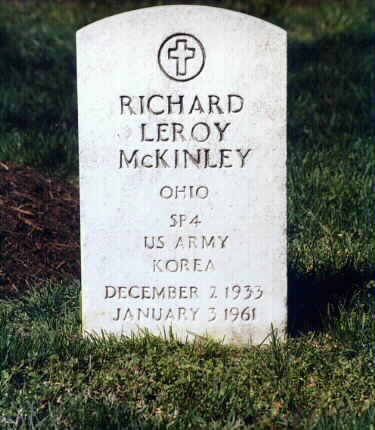
The SL-1 accident was the first fatal nuclear accident in the United States. The men killed in the incident were two Army Specialists, John Byrnes, age 25 and Richard McKinley, age 27, and Richard Legg, a 25 year old Navy Electricians Mate. Richard McKinley was interred in Arlington National Cemetery. John Byrnes and Richard Legg were buried in their hometowns in New York and Michigan.
Richard LeRoy McKinley was killed in the only fatal U.S. nuclear plant accident in 1961 (Idaho), he is buried in a lead-lined casket which was then sealed in concrete and placed in a metal vault.
Per the records at Arlington National Cemetery, the body, which was contaminated with long-life radioactive isotopes, cannot be moved from its location in Section 31 without the approval of the Atomic Energy Commission (United States Energy Department). It is believed that the “accident” at the Idaho plant was a suicide by one of the operators working at the site on the night of the explosion.
HEADQUARTERS
MILITARY DISTRICT OF WASHINGTON
WASHINGTON 28, D.C.
In Reply Refer To
AMHRC 31 January 1961
SUBJECT: Internment of Radioactive Remains
TO: Superintendent
Arlington National Cemetery
Arlington 11, Virginia
1. Radioactive remains of SP4 Richard L. McKinley were interred at Arlington National Cemetery on 25 January 1961.
2. It is desired that the following remark be placed onthe permanent record, DA Form 2122, Record of Internment:
“Victim of nuclear accident. Body is contaminated with long-life radio-active isotopes. Under no circumstances will the body be moved from this location without prior approval of the Atomic Energy Commission in consultation with this headquarters.”
FOR THE COMMANDER:
Leon S. Monroe, II
2d Lt. AGC
Assistant Adjutant General
NUCLEAR POWER: BURNING CALIFORNIA ISSUE
15 Years After Fatal Accident,
It Is A Factor In Tuesday's Primary
By Thomas O'Toole, Washington Post Staff Writer
John Byrnes is buried in his hometown of Utica, New York; Richard Legg in his hometown of Kingston, Michigan, and Richard McKinley in Arlington National Cemetery.
As far apart as they are, their graves are strikingly similar. The caskets are lined with lead and sunk in concrete. The coffins rest inside metal vaults driven as far as 10 feet into the ground. Concrete has been poured on top of the vaults so that relatives of the dead men can freely visit and care for their grave sites.
Byrnes, Legg and McKinley were given such elaborate burials because they died together in what is still history's only fatal atomic power accident. Now more than 15 years old, it was an accident that killed two of them at once and the third two hours later — a tragedy that left their bones and bodies radioactive.
Their deaths are a part of a burning debate about whether the nation should turn to nuclear energy for its electricity for the next 50 years.
The nuclear debate has inflamed parts of 30 states, dividing communities and even households. Some divorces have been set in motion in California and New York by family nuclear differences. Sit-ins, walk-ins, pray-ins and shout-ins have been held for and against nuclear energy. There are at least 50 different bumper stickers damning or praising atomic power.
1961 ‘ACCIDENT' AT REACTOR IS TERMED MURDER-SUICIDE
The Washington Star – Tuesday, March 6, 1979
Brattleboro, Vermont (UPI) — A 1961 Idaho nuclear reactor “accident” that killed three people resulted from sabotage by an employee bent on a murder-suicide, says an internal government memo published yesterday in The Brattleboro Reformer.
The memo was written in September 1971 by Atomic Energy Commission staff member Dr. Stephen Hanauer. In it he expressed concern that similar acts of sabotage could take place in commercial nuclear reactors.
But Hanauer, now a senior staff member at the Nuclear Regulatory Commission, told the Reformer this week that although he is “paid to worry,” he believed such sabotage would be much more difficult today.
The Reformer obtained the memo from Robert Pollard, a nuclear engineer and former Nuclear Regulatory Commission staff member, who is now an opponent of atomic power. The incident was at the National Reactor Testing Station, near Idaho Falls, Idaho.
3 January 1961: A reactor explosion (attributed by a Nuclear Regulatory Commission source to sabotage) at the National Reactor Testing Station in Idaho Falls, Idaho, killed one navy technician and two army technicians, and released radioactivity “largely confined” (words of John A. McCone, Director of the Atomic Energy Commission) to the reactor building. The three men were killed as they moved fuel rods in a “routine” preparation for the reactor start-up. One technician was blown to the ceiling of the containment dome and impaled on a control rod. His body remained there until it was taken down six days later. The men were so heavily exposed to radiation that their hands had to be buried separately with other radioactive wastem, and their bodies were interred in lead coffins.
MCKINLEY, RICHARD LEROY
SP 4 U S A
- VETERAN SERVICE DATES: Unknown
- DATE OF BIRTH: 12/02/1933
- DATE OF DEATH: 01/03/1961
- DATE OF INTERMENT: 01/23/1961
- BURIED AT: SECTION 31 SITE 472
ARLINGTON NATIONAL CEMETERY

Michael Robert Patterson was born in Arlington and is the son of a former officer of the US Army. So it was no wonder that sooner or later his interests drew him to American history and especially to American military history. Many of his articles can be found on renowned portals like the New York Times, Washingtonpost or Wikipedia.
Reviewed by: Michael Howard