
SYNOPSIS: The Phantom, used by Air Force, Marine and Navy air wings, served a multitude of functions including fighter-bomber and interceptor, photo and electronic surveillance. The two man aircraft was extremely fast (Mach 2), and had a long range (900 – 2300 miles, depending on stores and mission type). The F4 was also extremely maneuverable and handled well at low and high altitudes. Most pilots considered it one of the “hot test” planesaround.
Lieutenant Colonel Bobby G. Vinson was the pilot and First Lieutenant Woodrow W. Parker II the bombardier/navigator, of an F4D Phantom sent on a scramble mission with another aircraft from Da Nang Airbase, South Vietnam on April 24, 1968.
Vinson was orbiting the area looking for targets over Quang Binh Province, a few miles southwest of the city of Quang Khe and radioed he was decreasing altitude for a better sighting of ground targets. Shortly thereafter, a fireball was seen on the ground by the crew of the other aircraft. Radio contact with Parker and Vinson was unsuccessful. However, the possibility existed that the two were able to safely eject from the aircraft, and they were not listed as killed in action but missing in action.
Alarmingly, evidence continues to mount that Americans were left as prisoners in Southeast Asia and continue to be held today. Unlike “MIAs” from other wars, most of the nearly 2500 men and women who remain missing in Southeast Asia can be accounted for. If even one was left alive (and many authorities estimate the numbers to be in the hundreds), we have failed as a nation until and unless we do everything possible to secure his freedom and bring him home.
Bobby G. Vinson was promoted to the rank of Colonel and Woodrow W. Parker to the rank of Major during the period they were maintained missing.
Car kept as tribute to lost pilot
The Associated Press
Martinez Georgia — Twice a month the 1967 Buick Wiildcat in retired Colonel Woodrow W. Parker's garage gets a fastidous cleaning.
Not because it's driven to filth so often, nor because Parker is fanatical about car hygiene.
The gleaming blue Buick belonged to the colonel's son, Air Force Major Woodrow “Woodie” Parker II, who left 30 years ago to fly an F-4 Pantom in Vietnam and never returned. The father keeps it clean in the faint hope that his son is still alive.
The younger Parker, a year out of The Citadel in Charleston, had turned 25
six days before he was lost in action on his 10th mission in Southeast Asia. Parker was classified as missing for 10 years.
Today, he is listed as killed in action.
The military says DNA tests performed on recovered bones a few years ago prove that Woodie Parker died in Vietnam, but his parents persisted and the governemnt agreed to conduct a second round of forensic tests. The Parkers hold a faint hope that the new tests will show that their son could be alive.
Subject: DoD Memoranda For Correspondents
No. 165-98
MEMORANDUM FOR CORRESPONDENTS October 1, 1998
The remains of two American airmen previously unaccounted-for from the war in Southeast Asia have been identified and returned to the United States for burial.
The first set of remains is identified as those of Major Woodrow W. Parker II, U.S. Air Force, of St. Petersburg, Florida. The other set of remains is those of Parker's aircraft commander. At the wishes of the commander's family, the identity of these remains will not be released. Since the end of American participation in the war in 1973, the remains of 504 Americans have been recovered and identified; 2,079 remain unaccounted-for.
On April 24, 1968, Parker and his aircraft commander were on a combat mission over Quang Binh province, North Vietnam, when their F-4D Phantom crashed amid a large fireball. The flight leader was unable to establish radio contact. No parachutes were observed, nor was there an emergency signal detected.
Hostile threats in the area precluded airborne or ground search and rescue operations.
In April 1992, a joint U.S.-Vietnam team, led by the Joint Task Force-Full Accounting, interviewed several local informants in a village near the location of the loss. Three informants turned over human remains and survival-related items that had been collected at the crash site years earlier. In July of 1992, a second joint U.S.-Vietnam team returned to the site and recovered aircraft wreckage and crew-related equipment. A third joint team excavated the crash site during Aug.-Sept. 1993 and recovered aircraft wreckage, life support equipment and several skeletal fragments.
Anthropological analysis of the remains and other evidence by the U.S. Army Central Identification Laboratory Hawaii confirmed the identification of Parker and his aircraft commander. The U.S. government welcomes and appreciates the cooperation of the government of the Socialist Republic of Vietnam that resulted in the accounting of these servicemen. We hope that such cooperation will bring increased results in the future. Achieving the fullest possible accounting for these Americans is of the highest national priority.
PARKER, WOODROW WILSON
COL US ARMY
WORLD WAR II
- DATE OF BIRTH: 10/25/1917
- DATE OF DEATH: 05/17/2005
- BURIED AT: SECTION 66 SITE 1315
- ARLINGTON NATIONAL CEMETERY
Courtesy of the United States Air Force
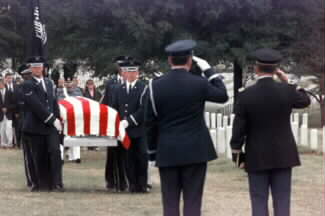
An Air Force Honor Guard team marches with the flag-draped casket of Major Woodrow Parker II, September 26, 1998, in Arlington National Cemetery. On April 24, 1968, Parker, a backseater, was on a combat mission over Quang Binh province, North Vietnam, when his F-4D Phantom crashed. Since the end of American participation in the war in 1973, the remains of 504 Americans have been recovered and identified; 2,079 remain unaccounted-for.
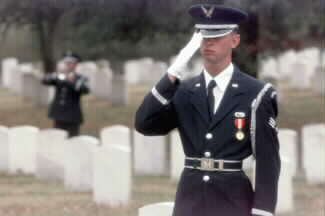
Senior Airman Michael Johnson, U.S. Air Force Honor Guard, salutes as a bugler sounds “Taps” during a September 26,1998 repatriation ceremony at Arlington National Cemetary. The Air Force, family members and others welcomed Maj. Woodrow Parker, an Air Force pilot missing in action in North Vietnam since 1968, back home and laid him to rest. He was reported missing when his F-4D went down in North Vietnam. Parker's parents were presented the folded American flag that draped their son's casket.

Michael Robert Patterson was born in Arlington and is the son of a former officer of the US Army. So it was no wonder that sooner or later his interests drew him to American history and especially to American military history. Many of his articles can be found on renowned portals like the New York Times, Washingtonpost or Wikipedia.
Reviewed by: Michael Howard